528 Hz: Listen, Compare and Check the DNA Claim
528 Hz is one tone, a slightly sharp C, from the “solfeggio” list first printed in 1999. It is sold as the “love frequency” that repairs DNA. No study shows that; small ones found it calming, like other quiet music.
528 Hz C5, 15.6 cents above the 440 tuning
528 Hz pure tone, with 440 Hz and C5 to compare
Your browser makes a clean sine tone itself, with no music, recording or download. It starts quietly and fades in and out over about a second. With JavaScript on, a 528 ↔ 440 switch, a timer and two short comparisons appear here.
Compare in a row
Each ear gets a slightly different tone, and the slow “beat” you hear is made by your brain, so it only works in headphones. Not while driving or doing anything that needs your full attention. If you have epilepsy, ask your doctor before listening to beating tones.
Keep it quiet: start low and raise the volume only until you hear the tone clearly. The WHO advises keeping personal devices below 60% of maximum. Stop if your ears ring or ache.
What is 528 Hz?
It means a sound wave that vibrates 528 times a second. On a piano tuned the standard way, it falls between keys, 15.6 cents above C5 (523.25 Hz), so the tone sounds like a very slightly sharp C. In air its wavelength is about 65 cm.
The number became famous through the “solfeggio frequencies”, a list of tones published in 1999 by Leonard Horowitz and Joseph Puleo, where 528 is assigned to the syllable MI. Our solfeggio frequencies page explains where that list comes from. On streaming sites, “528 Hz” can mean two things: a pure tone like the one in the player, or music retuned so that 528 becomes one of its notes.
528 Hz meditation music is almost always the second kind: ambient tracks with a 528 Hz drone or tuned to A = 444, often hours long. Nothing about them has been tested apart from the tone studies below, so judge them as music. If one helps you sit still, that is reason enough; if it grates, the player above lets you hear the bare tone and decide.
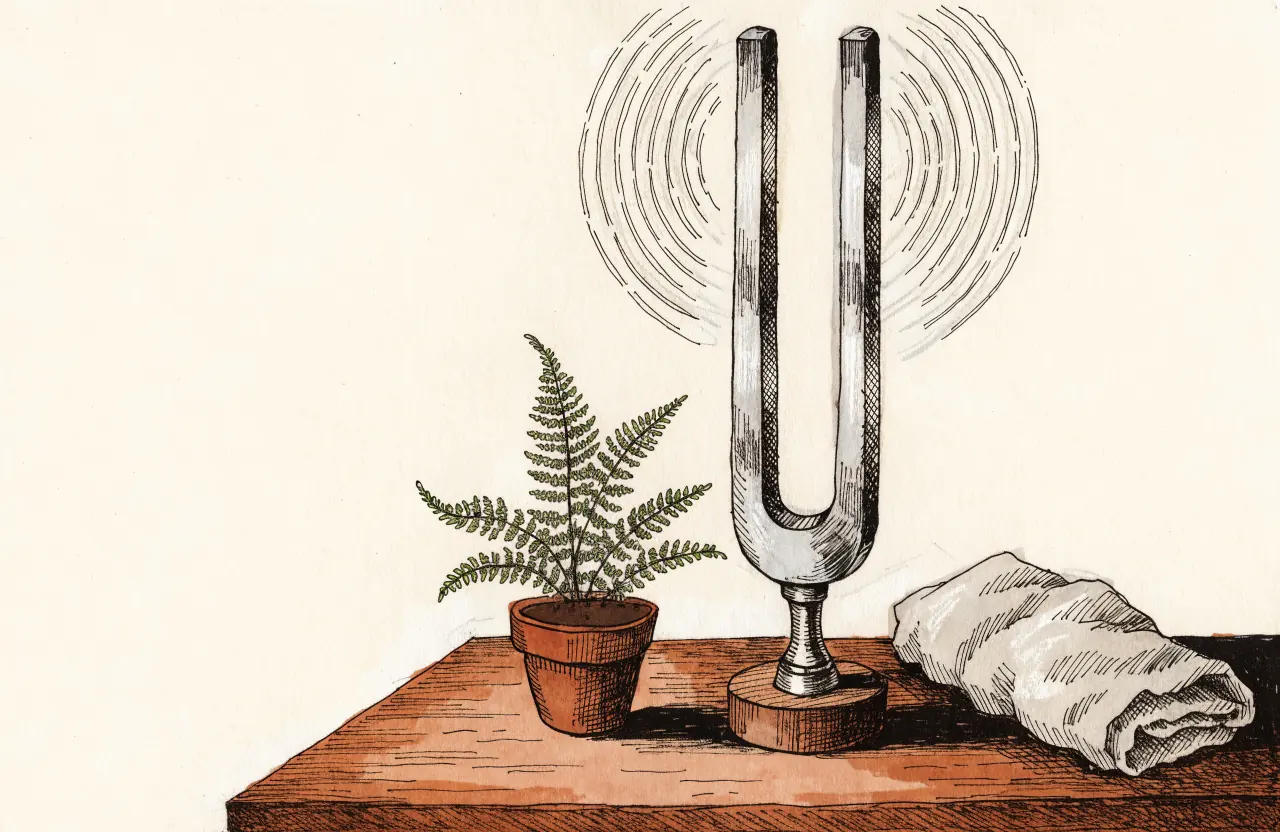
528 Hz tuning forks are sold for “sound healing”: you strike the fork and hold it near the ear or rest its stem on the body. A fork gives a cleaner tone than most speakers, and that is all it adds. Doctors use tuning forks too, but for testing hearing, at 512 Hz, not as treatment. No study we found has tested a 528 Hz fork for any health effect.
528 Hz frequency benefits: what the studies measured
Most pages list five or seven benefits. We read every study we could find on this tone (PubMed and the journals, October 20, 2026).
| Study | Who | What they did | What changed |
|---|---|---|---|
| Akimoto and colleagues, 2018 | 9 healthy adults in Japan | calm piano music tuned so 528 is a note, or the same music at 440, 5 minutes each on different days | saliva cortisol 0.43 → 0.25 after 30 minutes and oxytocin up after 528; changes after 440 not significant |
| Bozok and colleagues, 2026 | 162 students before exams | silence, 528 music or 432 music, 20 minutes | two saliva markers (BDNF, CREB) higher with 528 than silence; no change in a concentration test |
| Bhoot and colleagues, 2025 | 60 adults with high blood pressure | a recorded OM chant “at 528” daily for a month, vs usual care | pulse and blood pressure lower |
| Ravikumar and Sathyanarayanan, 2026 | 100 adults in India | 4 weeks of daily in-person sessions: a 528 recording with bowls and gongs, vs online music sessions | less anxiety, lower cortisol |
| Rybicki and colleagues, 2026 | 140 patients, not randomized | the tone twice a day for 3 months, plus usual care | better scores at 10 days; no difference at 90 days |
| Babayi and Riazi, 2017 | human brain cells in a dish | alcohol plus the tone at 80, 100 or 120 dB for an hour | about 20% more cells survived |
| Babayi Daylari and colleagues, 2019 | 20 rats, 5 per group | the tone at 80, 100 or 120 dB, 2 hours a day for 21 days | more testosterone in the brain and less anxious behavior at 100 dB |
In the three human trials with the biggest effects, the 528 group also got something else the control group didn’t: chanting, a group session, live instruments. The cell and rat studies used volumes of 80 to 120 dB, from heavy traffic to a siren close by, and had no other frequency for comparison. The only study that put 528 next to the same music at 440 is the one with nine people.
What the evidence supports is modest: a few minutes of calm music, 528 included, can lower stress for a while. Whether the number 528 adds anything is not settled.
Does 528 Hz repair DNA? Where the claim comes from
No study has shown that this sound repairs DNA in people. The claim spread through Horowitz’s books on the solfeggio numbers (1999) and his later The Book of 528, where 528 is called a key to “love” and to DNA repair. Pages that repeat it usually give one of three sources:
- “Genetic biochemists use 528 to repair DNA.” We found no such method in any genetics paper. DNA in labs is repaired with enzymes, not sound. None of the pages we found that use this line gives a source.
- “DNA absorbs more light under music.” This goes back to Glen Rein, whose reports were not published in mainstream journals. His one paper in PubMed (1995) measured DNA in a test tube while two people focused their “intention” on it. No sound was played at all.
- The 2017 brain-cell study. Its introduction mentions that the tone “has been reported” to help DNA repair, but the study itself measured cell survival after alcohol, not DNA repair, at volumes between 80 and 120 dB.
For scale: the sound wave is about 65 cm long, and a DNA molecule is about two millionths of a millimetre wide. The size gap alone proves nothing, but it is a fair reason to ask for evidence before believing that one note “tunes” DNA.
528 Hz for sleep and anxiety
If you want to try 528 at bedtime, play it quietly for 10 or 20 minutes with the timer and judge by how you feel the next morning. We found no sleep study of this tone by itself, and the anxiety trials in the table are short and mix 528 with other things. Music in general has better support: a 2022 Cochrane review of 13 trials found that relaxing music improved how well adults with insomnia said they slept.
Long “deep sleep” tracks and black-screen videos run for hours. Sleep trouble that goes on for weeks has causes a tone can’t reach; a doctor can look for them. If you want something to do at bedtime instead, there are breathing exercises for sleep, with a timer.
Is 528 Hz dangerous? How to listen safely
- The tone is not dangerous; the volume can be. The WHO counts 80 dB as safe for up to 40 hours a week, 90 dB for 4 hours and 100 dB for 20 minutes. The rat study that started the testosterone claim used 100 dB for two hours a day.
- All-night tracks. Eight hours a night is 56 hours a week, more than the 40 the WHO allows at 80 dB; overnight, keep it at the level of quiet speech or below.
- Ringing ears. A steady tone can make tinnitus more noticeable. A tone from a playlist is not a tinnitus treatment; the NIH lists sound therapy fitted by an audiologist as one real option.
- Binaural mode. Headphones only, not while driving, and ask your doctor first if you have epilepsy.
Why 528 is called the “love frequency” and the “miracle tone”
“Miracle” comes from the medieval hymn behind the solfeggio syllables. Its third line begins Mira gestorum, “the wonders of your deeds”, and MI is the syllable the 1999 list attached to 528. Horowitz read “mira” as “miracle” and called 528 the miracle tone. In the hymn the word is about the deeds of John the Baptist, and the medieval syllable had no fixed pitch.
“Love frequency” comes from The Book of 528: Prosperity Key of LOVE, also by Horowitz. Horowitz is the only source for the name, and nothing was measured. Searches for its spiritual meaning and its chakra lead back to the same source: modern charts assign 528 to the solar plexus or the heart. Our page on the solar plexus chakra shows what the older texts describe.
What note is 528 Hz?
It depends on how the instrument is tuned. This is our own calculation, the same one the player uses:
| If A is tuned to | C5 is | 528 Hz is |
|---|---|---|
| 440 Hz (standard) | 523.25 Hz | C5, 15.6 cents sharp |
| 432 Hz | 513.74 Hz | 47.4 cents above C5, nearly halfway to C♯ |
| 444 Hz | 528 Hz | exactly C5 |
That is why most “528 Hz music” is really music tuned to A = 444. The Japanese study in the table says so directly: “there is no 528 Hz note” in standard tuning, “however, setting the reference tone to 444 Hz means that 528 Hz is included in the musical scale.” It also means that 432 and 528 can’t both be the “natural” tuning: at 432, the 528 note doesn’t exist either.
528 Hz vs 432 Hz and 440 Hz
528 vs 440. These are two different notes, not two tunings of one note: 528 is a minor third above 440 (a ratio of exactly 6 : 5, 316 cents). Played one after the other they sound like two notes of a melody. The “Play 440 then 528” button lets you hear it.
528 vs C5. A more useful comparison is 528 against ordinary C5. They differ by only 4.75 Hz. Below 500 Hz people need about 3 Hz to hear a difference between two pure tones, so many listeners hear these two as the same note or as “very slightly higher”. Try “Play C5 then 528” before deciding that 528 sounds special.
528 vs 432. 432 is a tuning of A; 528 is a single tone in a modern list. The only study that tested both found different saliva markers in each group and no difference in performance. Our 432 Hz page covers that tuning and its history.
528 Hz healing water and cymatics
“528 water” draws on Masaru Emoto’s photographs of ice crystals that he said changed with music and words. His experiments were criticized for weak controls, and independent labs have not reproduced his results. Horowitz writes that he met Emoto in 1998 through Lee Lorenzen, who sold “clustered water”; Lorenzen’s patent on it does not mention 528. Cymatics, the patterns sound makes in sand or water, is real physics: every frequency makes a pattern, and 528 makes one too. A pattern doesn’t make water healthier to drink.
What a 528 Hz tone can’t do. Repair your DNA, raise testosterone, open a chakra, bring love or money: none of it has been shown in people, and most of it was never tested. A slightly sharp C at a quiet volume is a pleasant sound for some people and an irritating one for others, and either reaction is fine.
How the player works
The player is the one from our 432 Hz page: your browser generates a sine wave with the Web Audio API, starting quietly and fading in and out so there is no click. 528 is the first tone; the 528 ↔ 440 button switches between them with a short crossfade. The two comparison buttons play four tones of 1.2 seconds each. C5 is calculated as 440 × 2^(3/12) = 523.25 Hz. Nothing is downloaded, recorded or sent.
Frequently asked questions
What does 528 Hz do to the human body?
As a sound at a normal volume, it does what other calm sounds do: it can help some people relax for a while. A 9-person study found lower saliva cortisol after people listened to 528 music for 5 minutes. Claims that it repairs DNA, raises testosterone or heals cells come from cell and rat studies at very loud volumes, or from no studies at all.
Is 528 Hz good for sleep?
We found no sleep study of it on its own. Music in general does help: a 2022 Cochrane review of 13 trials found better self-rated sleep with relaxing music. If the tone helps you settle, use it quietly with a timer rather than all night.
Is it safe to listen to 528 Hz?
Yes, at a gentle volume. The frequency itself is an ordinary tone near the C above middle C, no riskier than a flute note. What can hurt is a loud setting kept up for hours. Stop if your ears ring.
How long should you listen to 528 Hz?
Sessions in the human studies lasted 5 to 20 minutes, and none compared lengths. A few minutes is enough to notice whether you like it; set the player’s timer to 5 or 10 and see how you feel when it stops.
Does 528 Hz increase testosterone?
The claim comes from a 2019 study on 20 rats, which found more testosterone in the brain after the tone was played at 100 dB, two hours a day for three weeks. The WHO counts that level as safe for about 20 minutes a week. There are no human studies, and nothing shows a quiet tone does the same.
What is the healthiest Hz to listen to?
There isn’t one. No frequency has been shown to be healthier than another at the same volume; for your ears, how loud and how long matter more than the number.
What songs use 528 Hz?
Most “528 Hz” songs on YouTube and Spotify are ordinary tracks retuned to A = 444, where 528 becomes the note C, or tracks with the tone mixed in under the music. Commercial pop is tuned to A = 440, where 528 is not a note, and we found no source for lists of hit songs “written in 528”.
Which is better, 528 Hz or 432 Hz?
One 2026 study with 162 students put them side by side: two brain-related saliva markers were higher with 528 music than with silence, and nobody’s concentration score changed. That is too little to rank them. They are also different things: 432 is a way to tune a whole song, 528 is one tone.
Sources (18)
- K. Akimoto, A. Hu, T. Yamaguchi, H. Kobayashi. Effect of 528 Hz music on the endocrine system and autonomic nervous system. Health 10(9): 1159–1170
- Ü. G. Bozok et al. Acute music-frequency exposure modulates salivary stress and neurotrophic markers in young adults: a randomized controlled trial. Brain and Behavior
- T. Babayi, G. H. Riazi. The effects of 528 Hz sound wave to reduce cell death in human astrocyte primary cell culture treated with ethanol. Journal of Addiction Research & Therapy 8: 335
- T. Babayi Daylari et al. Influence of various intensities of 528 Hz sound-wave in production of testosterone in rat’s brain and analysis of behavioral changes. Genes & Genomics 41: 201–211
- A. Bhoot et al. Effect of OM chanting of 528 Hz frequency on heart rate variability, psychological wellbeing, and quality of sleep in patients of hypertension: a randomised controlled trial. Annals of Neurosciences
- H. Ravikumar, S. Sathyanarayanan. Effects of a sound-based meditative intervention on anxiety, depression, salivary cortisol levels, and blood pressure: a randomized controlled trial. Cureus
- W. Rybicki et al. Can phonotherapy serve as an adjunct treatment for acute and chronic stroke? A preliminary report. Healthcare (Basel)
- Frequency-dependent developmental toxicity of anthropogenic noise: effects of 40 Hz, 174 Hz and 528 Hz on zebrafish embryos. Marine Environmental Research
- G. Rein. The in vitro effect of bioenergy on the conformational states of human DNA in aqueous solutions. Acupuncture & Electro-Therapeutics Research 20(3–4): 173–180
- L. G. Horowitz, J. S. Puleo. Healing Codes for the Biological Apocalypse (catalogue record)
- L. Lorenzen. Microclustered water. US Patent 6,033,678
- Masaru Emoto (water crystal claims and their criticism)
- Ut queant laxis (“Mira gestorum”, the line that gives the syllable MI)
- Deafness and hearing loss: Safe listening (questions and answers)
- Just-noticeable difference (pitch: about 3 Hz below 500 Hz for sine tones)
- Tinnitus
- Rinne Test (tuning fork of 512 Hz for hearing tests)
- K. V. Jespersen et al. Listening to music for insomnia in adults. Cochrane Database of Systematic Reviews CD010459