Mudras: Meaning, 12 Hand Mudras and How to Practice Them
A mudra is a symbolic gesture, usually of the hands, used in yoga, meditation and Hindu and Buddhist art. The Sanskrit word means “seal”. This guide pictures 12 mudras people ask about, notes where each one is described and what was added in the 20th century, and lets you try two or three for a few minutes.
Mudra finder: what do you want the next few minutes for?
Pick a goal for two or three mudras with drawings and a short timed practice. Nothing is saved.
Focus before work: Gyan, Shuni · Wind down before sleep: Adi, Dhyana · Seated meditation: Anjali, Dhyana, Gyan
Focus before work
A light touch of two fingertips is easy to feel, so it gives a wandering mind one small, physical thing to come back to.
-
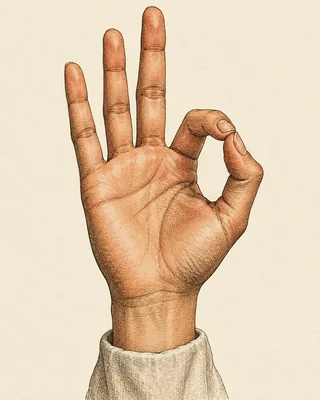 Gyan mudra (and chin mudra)
Let the tip of the index finger touch the tip of the thumb, lightly, as if holding a sheet of paper.
-
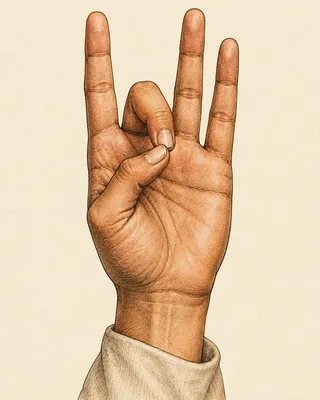 Shuni mudra
Touch the tip of the middle finger to the tip of the thumb.
- Minute 1. Settle. Sit upright. Make gyan mudra with both hands and rest them on your thighs. Notice where the fingertips touch.
- Minute 2. Count. Breathe normally and count each out-breath up to ten. When you lose count, feel the fingertips and start again at one.
- Minute 3. Switch. Change to shuni mudra, middle finger to thumb. Is the contact easier or harder to feel? Then open your eyes and start your task.
Wind down before sleep
In bed, hands that have something to do stop fiddling with the phone. The point is a slower out-breath and a still body, not the shape of the fingers.
-
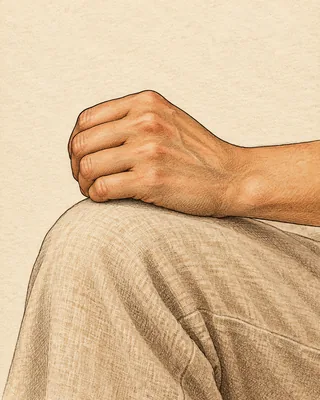 Adi mudra
Tuck the thumb into the palm so its tip rests near the base of the little finger.
-
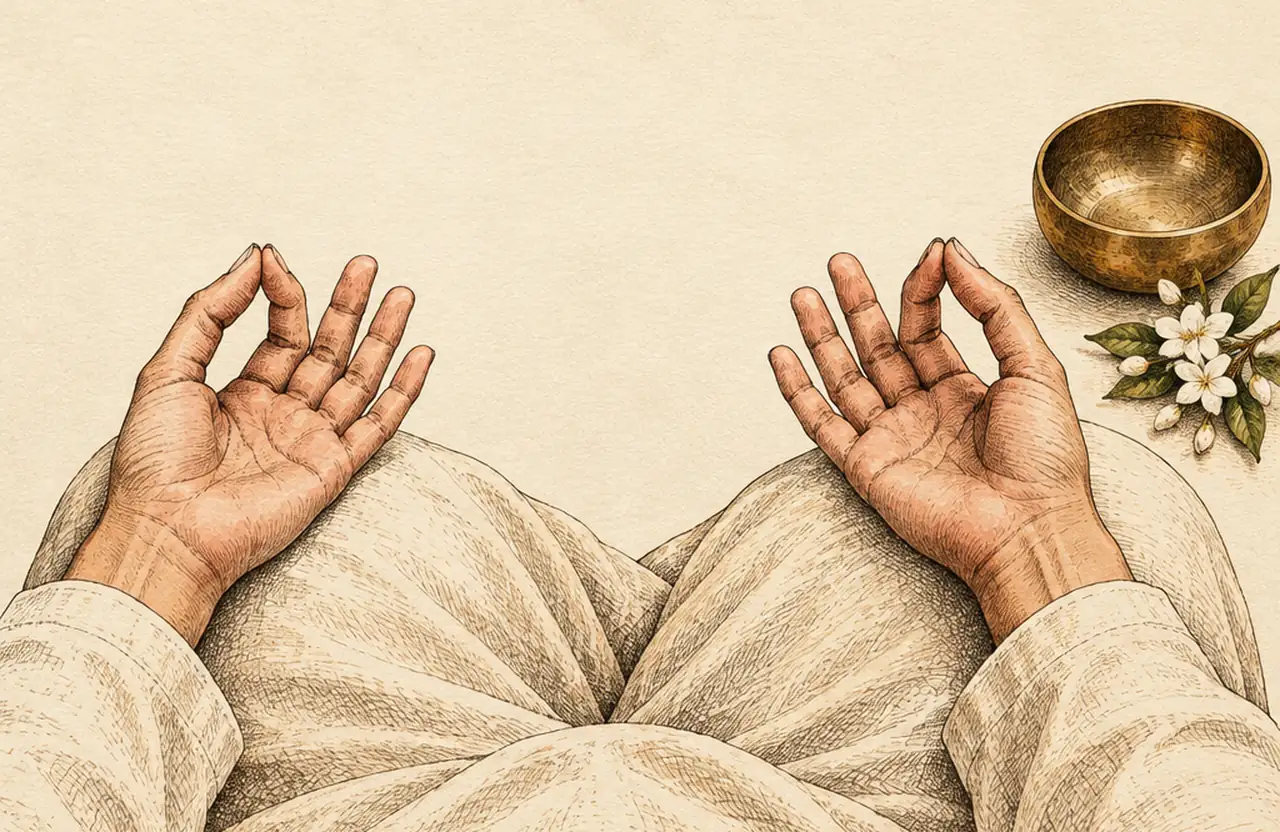
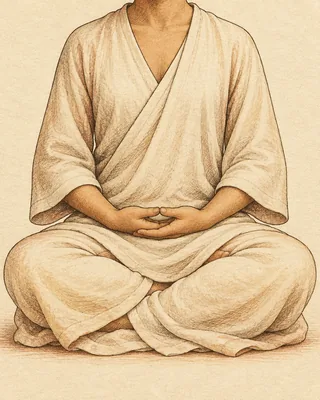 Dhyana mudra
Lay the right hand on the left in your lap, both palms up.
- Minute 1. Lie down. Lie on your back. Curl both hands into adi mudra, a soft fist around the thumb, and rest them on the bed.
- Minute 2. Longer out-breath. Breathe in through the nose, then breathe out a little longer than you breathed in. Let the fists stay soft.
- Minute 3. Hands on the belly. Open the hands and lay them on the belly in dhyana mudra, right in left, thumbs lightly touching. Feel them rise and fall.
- Minute 4. Notice the thumbs. If the thumbs drift apart, you are getting drowsy. Let them.
- Minute 5. Let go. Let the hands slide to your sides. Nothing more to do.
Seated meditation
In meditation a mudra mainly keeps the hands still and shows you, by small changes in pressure, when attention has drifted.
-
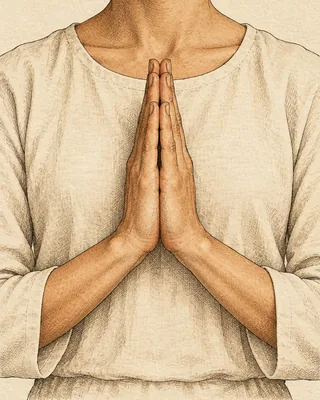 Anjali mudra
Press the palms and fingers together in front of the chest.
- Dhyana mudra
Lay the right hand on the left in your lap, both palms up.
- Gyan mudra (and chin mudra)
Let the tip of the index finger touch the tip of the thumb, lightly, as if holding a sheet of paper.
- Minute 1. Begin. Sit on a chair or cushion. Bring the palms together in anjali mudra for three breaths, then lower them.
- Minute 2. Rest the hands. Place the hands in dhyana mudra in your lap, right in left, thumb tips touching. Feel the breath at the nose or belly.
- Minute 3. Watch the thumbs. When you notice the thumbs pressing or parting, that is a moment of noticing. Return to the breath.
- Minute 4. Change if you like. If the arms tire, move to gyan mudra on the knees and keep watching the breath.
- Minute 5. Close. Bring the palms together once more in anjali, take one slow breath and open your eyes.
What is a mudra? The meaning of the word
A mudra is a held position of the hands, and sometimes of the whole body, the eyes or the tongue, that stands for something or is meant to change your state. The Sanskrit mudrā means “seal” or “stamp”. Yoga Journal’s Richard Rosen explains the image: a mudra stamps the mark of a god on the practitioner the way a signet ring stamps wax.
The word is used in three different worlds that rarely talk to each other:
- Hatha yoga: the classical texts use “mudra” for body practices that work with breath and posture, such as locks of the throat and pelvic floor.
- Images and ritual: in Hindu and Buddhist art, a hand gesture tells you who a figure is and what moment you are seeing: teaching, meditating, protecting, calling the earth to witness.
- Dance: Indian classical dance uses a large vocabulary of hand gestures (hasta) to tell stories, from a lotus bud to a deer.
Most “mudra meaning” pages online blend these into one list and add modern finger positions on top. This page keeps them apart, because the answer to “does this mudra do anything?” depends on which world it comes from.
The 12 hand mudras people ask about
We chose these by what people search for and ask: the mudras named in related searches and in “People also ask”, plus the Buddhist gestures that come up under “mudras buddha”. 5 of them come from images and ritual, the other 7 from modern yoga books. Each card says which.
Gyan mudra (and chin mudra)
jñāna-mudrā, cin-mudrā: “seal of knowledge”; chin from cit, “consciousness”. Also: jnana mudra.
- Let the tip of the index finger touch the tip of the thumb, lightly, as if holding a sheet of paper.
- Keep the other three fingers loose and mostly straight.
- Rest the backs of the hands on the thighs or knees.
- Where it is described
- Hindu images of Shiva as the silent teacher Dakshinamurti show this circle of thumb and index finger; the hymn to Dakshinamurti attributed to Shankara calls it the sign that teaches. Commentators read the thumb as the divine and the index finger as the individual self.
- Added later
- Yoga schools disagree on the names: some call it chin mudra with palms up and gyan with palms down, others the reverse. “Index finger = air, thumb = fire” and claims about memory come from modern teaching, not from the images.
Dhyana mudra
dhyāna-mudrā: “seal of meditation”. Also: meditation mudra.
- Lay the right hand on the left in your lap, both palms up.
- Let the tips of the thumbs meet lightly above the palms, making an oval.
- If the thumbs press together or drift apart, you have noticed your attention change.
- Where it is described
- The gesture of the seated Buddha in meditation, “a characteristic gesture of the Buddha Shakyamuni” as the Tibetan Nuns Project puts it, and one of the main gestures in E. Dale Saunders’s 1960 study of Japanese Buddhist sculpture.
- Added later
- Modern sites add that it “awakens the crown chakra”; the Buddhist images make no such link.
Anjali mudra
añjali-mudrā: añjali, “offering with joined hands”. Also: namaskar, namaste, prayer hands.
- Press the palms and fingers together in front of the chest.
- Let the thumbs rest near the breastbone.
- Hold for a few breaths; it is often used to begin and end a practice.
- Where it is described
- An everyday greeting across South and Southeast Asia. The Natyashastra, the old Sanskrit treatise on theater, includes anjali among its gestures made with both hands. In Buddhist art it is the gesture of devotees rather than of the Buddha.
- Added later
- Claims that it “balances the brain hemispheres” or the pituitary gland are modern and come without sources.
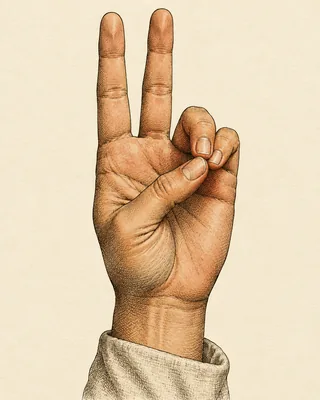
Prana mudra
prāṇa-mudrā: “seal of life breath”.
- Bring the tips of the ring and little fingers to the tip of the thumb.
- Keep the index and middle fingers straight.
- Do it with both hands, backs resting on the thighs.
- Where it is described
- We found no classical text or old image that shows this finger position. It is described in 20th-century books on hand mudras.
- Added later
- Sites list vitality, better eyesight and “healing”; we found no study that tested any of these.
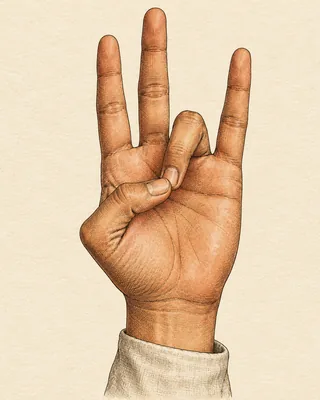
Prithvi mudra
pṛthvī-mudrā: “seal of earth”. Also: earth mudra.
- Touch the tip of the ring finger to the tip of the thumb.
- Keep the other fingers straight but relaxed.
- Feel the weight of the hands on the thighs.
- Where it is described
- Not in the old yoga texts we checked. It belongs to the modern system in which each finger stands for an element and the ring finger is earth.
- Added later
- Often offered as “the root chakra mudra”. The 1577 chakra text, the Ṣaṭ-cakra-nirūpaṇa, describes no hand gesture for any chakra.
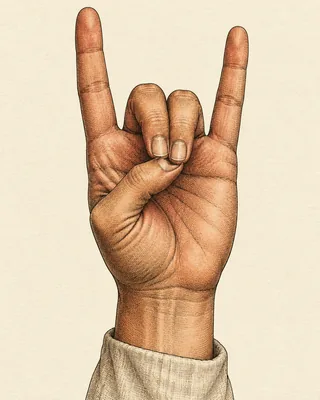
Apana mudra
apāna-mudrā: apāna, the downward-moving breath.
- Bring the tips of the middle and ring fingers to the tip of the thumb.
- Keep the index and little fingers straight.
- Rest the hands on the thighs.
- Where it is described
- Apana is an old idea: one of the five breaths of yoga and Ayurveda, the one that moves down and out. The hand position named after it is described in modern books, not in the old texts we checked.
- Added later
- Sites promise detox and digestion. No study we found has tested that.
Shuni mudra
śūnya / śani-mudrā (spellings vary): linked with Saturn (śani) or with emptiness (śūnya), depending on the school. Also: sometimes called akash mudra.
- Touch the tip of the middle finger to the tip of the thumb.
- Keep the other fingers straight.
- Rest the hands on the thighs, palms up.
- Where it is described
- A modern finger mudra. Even its name is not settled: some teachers say shuni, others akash, and they give it different meanings.
- Added later
- Patience and focus in some books, “more calcium” or ear health on some sites. None of it has been tested.
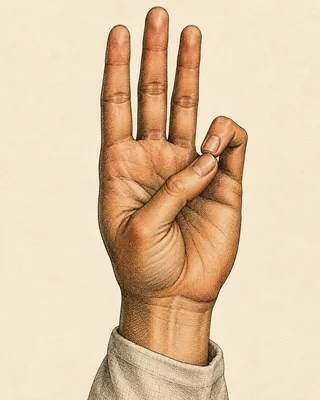
Varuna mudra
varuṇa-mudrā: Varuna, the god of waters. Also: varun mudra, water mudra.
- Touch the tip of the little finger to the tip of the thumb.
- Keep the other three fingers straight.
- Hold lightly; pressing hard changes nothing except your knuckles.
- Where it is described
- A modern finger mudra in the “finger = element” system, the little finger being water.
- Added later
- Sites say it “hydrates the body” or helps the skin. Drinking water hydrates the body; we found no test of the gesture.
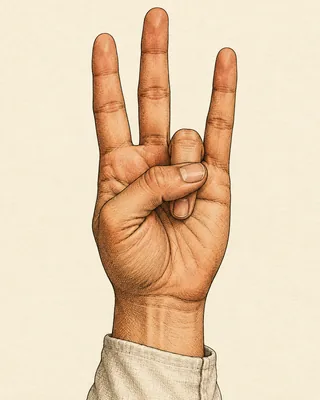
Surya mudra
sūrya-mudrā: “seal of the sun”. Also: agni mudra, sun mudra.
- Fold the ring finger down toward the palm.
- Rest the thumb gently on the folded ring finger.
- Keep the other three fingers straight.
- Where it is described
- A modern finger mudra: the thumb (fire) presses down the ring finger (earth).
- Added later
- Sites promise weight loss and a faster metabolism. No study we know of supports it, and a hand position cannot replace food and movement changes.
Adi mudra
ādi-mudrā: “first” or “original” seal.
- Tuck the thumb into the palm so its tip rests near the base of the little finger.
- Curl the other fingers over it into a soft fist.
- Rest the fists on the thighs, knuckles down.
- Where it is described
- Taught in modern yoga, for example by the Art of Living, which says babies are born in it. We found no older source.
- Added later
- Claims about snoring and lung capacity are the teaching school’s own; we found no study.
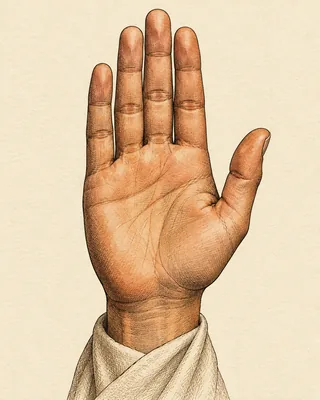
Abhaya mudra
abhaya-mudrā: abhaya, “no fear”. Also: gesture of fearlessness.
- Raise the right hand to shoulder height, elbow bent.
- Turn the palm outward, fingers up and together.
- Let the left hand rest in the lap.
- Where it is described
- One of the oldest gestures in Buddhist and Hindu images: it “symbolizes the dispelling of fear” (Tibetan Nuns Project). A story tells how the Buddha raised his hand like this to calm the maddened elephant sent against him.
- Added later
- It is mainly a gesture of images and blessings; sitting practice rarely uses it.
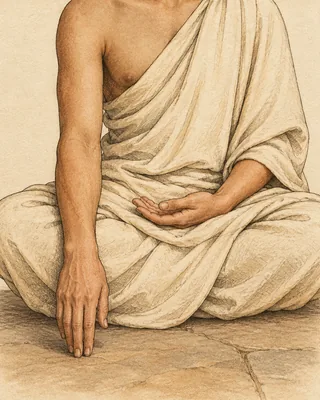
Bhumisparsha mudra
bhūmisparśa-mudrā: “touching the earth”. Also: earth-touching or earth-witness gesture.
- Sit with the left hand in the lap, palm up.
- Let the right hand hang over the right knee, palm in.
- Let the fingertips touch the floor.
- Where it is described
- The gesture of the Buddha at the moment of awakening: challenged by Mara, he touched the ground and called the earth to witness. It is among the most common gestures in Buddhist statues.
- Added later
- Little was added; modern sites sometimes list it under “grounding”.
Mudras in the old yoga texts: seals of the body, not the hands
If you open the classical handbooks of hatha yoga expecting finger positions, you will not find them. The Hatha Yoga Pradipika, compiled in the 15th century, gives its whole third chapter to mudras, and lists ten (3.6–3.7): maha mudra, maha bandha, maha vedha, khechari, the three locks uddiyana, mula and jalandhara bandha, viparita karani, vajroli and shakti chalana. All of them are done with the body and the breath.
The claims are large. The same verse says these ten mudras “annihilate old age and death”, and the text asks for them to be kept secret “as one keeps one’s box of jewelry”. Some are not gentle. Khechari mudra, turning the tongue back into the throat, is prepared by cutting the membrane under the tongue “as much as a hair’s thickness” at a time, for six months. Viparita karani, an inversion, is said to remove wrinkles and gray hair after six months.
The Gheranda Samhita, a later manual (about 1700), counts 25 mudras, again mostly body techniques. Modern readers, including the hatha.es commentary on 3.6, read “annihilating old age and death” as the rhetoric of the genre rather than a literal promise. Either way, these are practices that the texts themselves say are learned from a teacher.
Mudras in Buddhist and Hindu images
The oldest hand gestures are the ones in sculpture and painting. In a Buddhist image, the hands tell you which moment of the Buddha’s life you are looking at: the meditation gesture (dhyana), touching the earth to call it as witness at the moment of awakening (bhumisparsha), the raised palm of fearlessness (abhaya), the circle of thumb and index finger in teaching (vitarka), the turning of the wheel of teaching (dharmachakra). E. Dale Saunders’s 1960 study of Japanese Buddhist sculpture is a whole book on gestures of this kind.
In Hindu images, Shiva as Dakshinamurti, the teacher who instructs in silence, holds the thumb and index finger together. The hymn to him attributed to Shankara bows to the one who “by means of the blessed symbol, manifests to the disciples the True Self”, and commentators read the thumb as the divine, the index finger as the individual self and the three free fingers as what keeps them apart (the three gunas, or three impurities, depending on the commentator). This is where the gesture now sold as gyan mudra comes from.
Dance has its own system. The Natyashastra, the old Sanskrit treatise on theater, counts 24 one-hand and 13 two-hand gestures; the later Abhinaya Darpana counts 28 one-hand gestures and about two dozen for both hands. A dancer’s pataka, the flat hand, can mean a cloud, a forest, a river or the act of taking an oath, depending on the movement.
Finger elements and “healing mudras”: where they come from
The idea most mudra sites start with, that each finger is an element and that pressing it against the thumb balances that element in the body, is a modern system. Its usual form: thumb fire, index finger air, middle finger space, ring finger earth, little finger water. Teachers explain it through Ayurveda’s five elements, which are old; the finger chart and the gestures built on it we found only in 20th-century teaching and in books such as Gertrud Hirschi’s Mudras: Yoga in Your Hands (German 1998, English 2000).
That is the origin of prana, apana, prithvi, varuna, shuni and surya mudra, and of the long lists of health effects attached to them: eyesight, digestion, calcium, weight, hydration. The lists differ from site to site, and two sites will give the same finger position different names.
As a place to rest attention the gestures do their job; as remedies they are untested.
Do mudras work? What the studies found
Very little is known. A 2025 narrative review of mudras and heart and lung function admits that direct studies on mudras are limited and leans on studies of yoga as a whole, where the effect of breathing, posture and relaxation cannot be separated from the hands. It ends by calling for better research before mudras are offered as a complement to treatment.
A 2018 study measured the effect of prana mudra with an “electrophotonic” camera, which records the glow of an electrical discharge around the fingertips. The same kind of glow in older Kirlian photography was shown in 1976 to depend mainly on skin moisture (see what aura photos really show). A change in the glow tells you something about the skin, not about prana.
What is reasonably well studied is the thing mudras usually come with: sitting still and paying attention to the breath. Meditation trials find modest benefits for stress in many people, and the National Center for Complementary and Integrative Health notes it can also bring up anxiety in some. If a mudra helps you sit, that is where any benefit is likely to come from.
How long to hold a mudra, lying down, and who should not
- How long: there is no traditional rule for finger mudras, and modern teachers disagree, from 3 minutes to 45. Three to five minutes is enough to notice whether a gesture helps you settle.
- Which hand: both hands usually do the same mudra in sitting practice. In Buddhist images the right hand often makes the gesture and the left rests in the lap.
- Lying down, walking, at a desk: fine. Nothing in the finger mudras needs a special posture.
- Who should not: we found no evidence of harm from finger mudras. If a gesture strains a joint, let it go. Body mudras from the hatha texts, especially khechari, inversions and the locks, are a different matter; learn them in person, and not at all if you have high blood pressure, glaucoma or a neck problem, unless your doctor agrees.
Mudras and chakras
Searches like “mudras for chakras” and “root chakra mudra” assume a pairing that the chakra texts do not make. The 1577 text behind the seven-chakra system, the Ṣaṭ-cakra-nirūpaṇa (English translation by John Woodroffe in The Serpent Power), describes each center through images, letters and sounds, and gives no hand gesture for any of them. Modern lists usually pair prithvi with the root chakra, varuna with the sacral, surya or agni with the solar plexus, and dhyana with the crown; other lists differ.
If you want to combine them, use the chakra image for attention and a gesture to keep the hands still, the way the 5-minute root chakra practice does. The chakras overview separates what each center is in the old text from what was added in the West.
What this page does not promise
We don’t claim that any hand position heals, detoxes, raises energy, attracts money or changes a chakra. The drawings show positions as they are taught today; where a gesture comes from an image or a text, the card says so, and where it comes from a modern book, the card says that too. The finder offers a few quiet minutes. If you live with pain, anxiety, sleep problems or any illness, a doctor or therapist will help more than any gesture, and a mudra can be used next to that help.
Frequently asked questions
What does mudra mean?
Mudrā is Sanskrit for “seal”, “mark” or “stamp”, as in the impression a signet ring leaves in wax. In yoga and in Hindu and Buddhist art it names a gesture, most often of the hands, that marks a state of mind or a moment in a story.
How many mudras are there?
There is no fixed number. The Hatha Yoga Pradipika lists 10 mudras and the Gheranda Samhita 25, and nearly all of them are body practices, not hand gestures. The theater treatise Natyashastra counts 24 one-hand and 13 two-hand gestures for dance. Modern books add dozens of finger mudras, and the lists keep growing.
What are the five mudras?
The question usually means the five-element finger system: each finger stands for an element (thumb fire, index air, middle space, ring earth, little finger water), and touching it to the thumb is said to strengthen that element. The system is taught in modern yoga and Ayurveda courses; we found it in no old yoga text.
How long should you hold a mudra?
The old texts give no timing for finger mudras because they do not describe them. Modern teachers disagree: Gertrud Hirschi’s book cites the Indian writer Keshav Dev’s 45 minutes a day and itself suggests 3 to 30 minutes. For attention, 3 to 5 minutes is enough to notice something, which is why the finder above uses those lengths.
Can you do mudras lying down?
Yes. A hand position does not need a particular posture, and lying down is the easiest way to keep the hands still. The sleep practice in the finder above is done lying on your back.
Who should not do prana mudra?
We know of no reason to avoid touching three fingertips together, and no study has found harm from finger mudras. The body mudras of hatha yoga are different: the Hatha Yoga Pradipika’s khechari mudra involves cutting the membrane under the tongue over six months, and inversions are not for everyone. Learn those, if at all, from a teacher in person.
What is the mudra for money?
Sites usually name kubera mudra, after the god of wealth: the tips of the thumb, index and middle fingers meet and the other two fingers fold into the palm. It is a modern finger position, and no gesture can change your finances. No gesture can change your finances.
Which hand mudra is the most powerful?
No tradition ranks hand mudras by power. The old hatha texts call their body mudras the highest practices, and Buddhist art treats each gesture as a sign of a particular moment, not a stronger or weaker tool. For practice, the useful mudra is the one you can hold comfortably while you watch your breath.
Sources (16)
- Hatha Yoga Pradipika, chapter 3 “On Mudras” (Sanskrit with English translation)
- Hatha Yoga Pradipika 3.6–3.7, the ten mudras, with commentary
- The Gheranda Samhita, translated by Srisa Chandra Vasu (chapter 3, twenty-five mudras)
- Dakshinamurti Stotra, with commentary (the chin mudra as the sign of teaching)
- Dakshinamurti: iconography and symbolism of the jnana mudra
- Mudras: Meaning of Sacred Hand Gestures
- E. Dale Saunders. Mudrā: A Study of Symbolic Gestures in Japanese Buddhist Sculpture (Bollingen Series LVIII)
- A study of the Asamyuta Hastas (single-hand gestures in the Natyashastra and Abhinaya Darpana)
- Abhinaya: hand gesture counts in the Natyashastra and Abhinaya Darpana
- G. Hirschi. Mudras: Yoga in Your Hands (German edition 1998)
- R. Rosen. Hand Mudras: the meaning of the word “mudra”
- Powerful Yoga Mudras at Your Fingertips (chin, chinmaya and adi mudra as taught by the school)
- S. Ahlawat, K. Archana, A. Shetty, V. Sharma, T. Vinaya Kumar. Yoga Mudras and Physiological Benefits: A Narrative Review of Their Role in Cardiopulmonary Function. J Ayurveda Integr Med Sci 10(4): 169–174
- Arthur Avalon (John Woodroffe). The Serpent Power: being the Ṣaṭ-cakra-nirūpaṇa and Pādukā-pañcaka
- Classification of Electrophotonic Images of Yogic Practice of Mudra through Neural Networks
- Meditation and Mindfulness: Effectiveness and Safety