Alan Watts: Who He Was, What He Taught, Which Book First
Alan Watts (1915–1973) was a British-born writer and broadcaster who explained Zen, Taoism and Vedanta to Western readers in more than 25 books and many recorded talks. His core claim: the separate self is a social fiction. Most reading guides start with The Wisdom of Insecurity (1951).
Jump to: his life · critics · books
Try his listening exercise, 3 minutes (our retelling of Still the Mind, not his words).
- Minute 1. Let the breath run itself. Settle into your seat and let your eyes close, or rest them on a spot on the floor. Notice your breathing without changing it. You are not doing the breathing; you are watching it happen.
- Minute 2. Hear sounds as music. Now let your ears take in whatever is there: a fridge, traffic, a voice in another room, your own breath. Listen as you would to music. Don’t name the sounds or guess where they come from. Just hear them arrive and fade.
- Minute 3. Thoughts are sounds too. When the mind starts commenting, don’t fight it. Hear the comment as one more sound in the room, like birds outside, and go back to listening. At the end, open your eyes slowly and notice the room before you get up.
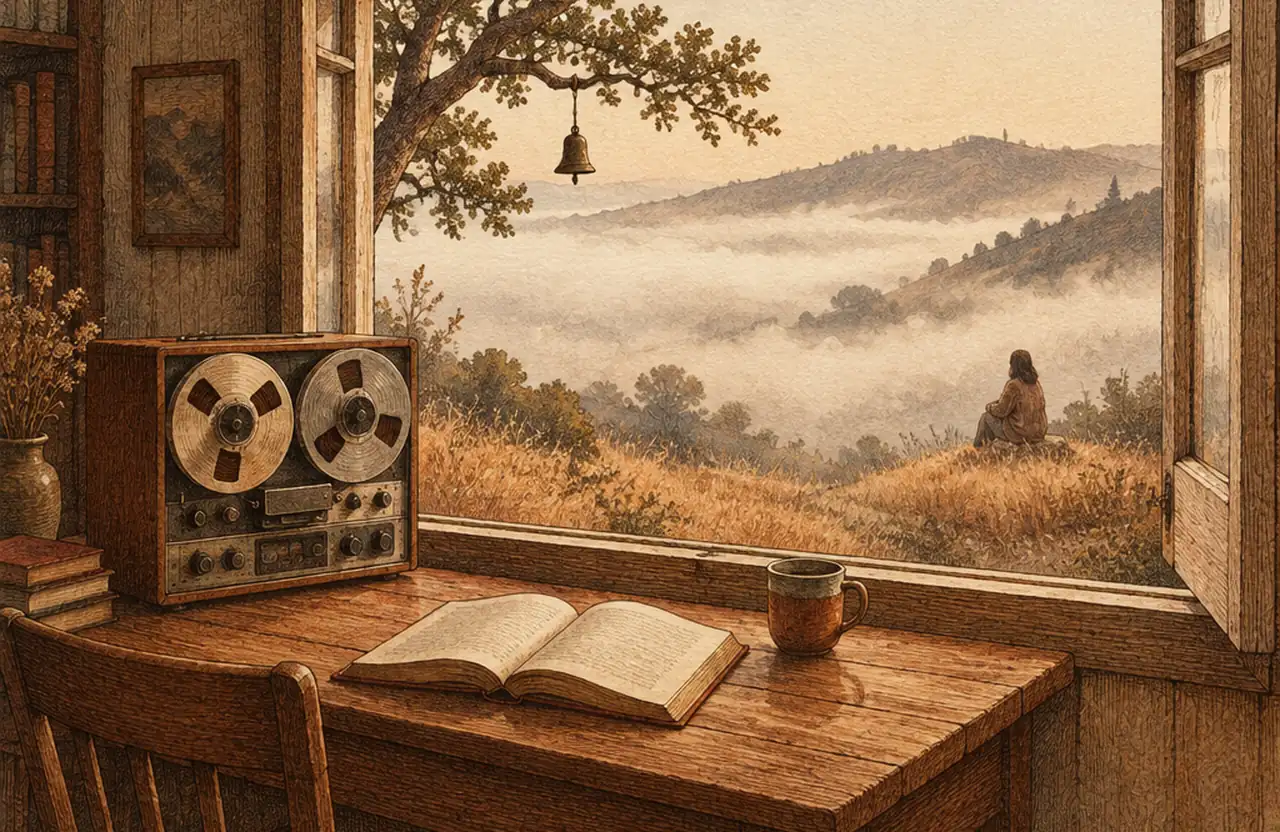
The listening practice, step by step
Watts did not teach a method in the way a meditation teacher does, and he distrusted people who turned meditation into a chore. The closest thing to an instruction is in the talks collected as Still the Mind (2000): watch the breath without steering it, then let your ears take in whatever is going on and listen to it the way you would to music. Our timer keeps that order. He suggested that thoughts be heard the same way, as noise in the head rather than orders to follow.
There is no target state. If you notice you were “trying to listen properly”, that is the very effort he spent his books describing, and it is fine to notice it and carry on. If the exercise makes you more anxious, stop and keep your hands busy with something ordinary.
What Alan Watts taught: five ideas
- The backwards law. In the preface to The Wisdom of Insecurity (p. 9) he calls it “the law of reversed effort”: “When you try to stay on the surface of the water, you sink; but when you try to sink you float.” The book applies this to anxiety. Insecurity, he argues, is the result of trying to be secure.
- The self as a social fiction. The theme of The Book (1966). Its preface says “the prevalent sensation of oneself as a separate ego enclosed in a bag of skin is a hallucination”, out of line with both Western science and Vedanta. Chapter 3, “How To Be a Genuine Fake”, describes how other people teach a child who it is. The phrase “skin-encapsulated ego”, often credited to the book, does not appear in it; the book says “bag of skin”.
- God playing hide-and-seek. Chapter 1 of The Book retells the Hindu idea of lila, divine play, as a game in which God, having no one else to play with, pretends not to be himself and becomes all of us.
- You can’t try to be spontaneous. In The Way of Zen (part two, chapter 2) he describes the double bind of deliberately trying to let go: the effort to be natural is what blocks it. Seeing that trying is unnecessary is, for him, the Zen point.
- Life as music, not a journey. In recorded talks he compared life to music or dancing, done for its own sake, rather than a trip with a destination. On the lecture recording “Coincidence of Opposites”, in the series Tao of Philosophy, he puts it as “you don’t work the piano”, you play it.
The five ideas overlap: grasping at yourself, at safety or at enlightenment pushes each one further away. Our page on self-inquiry covers a practice that asks the same question about the self from the Indian side.
Alan Watts books in order, and which to read first
He wrote more than 25 books in his lifetime, and his son’s organization has published many more from his talks. The table lists the twelve people search for most, oldest first.
| Book | Year | What it is | Read it |
|---|---|---|---|
| The Spirit of Zen | 1936 | His first book, published at 21, popularizing D. T. Suzuki; he later called it out of date | skip unless you want the history |
| Behold the Spirit | 1947 | Christian mystical theology, written while he was a priest | if you care about his Christian period |
| The Wisdom of Insecurity | 1951 | Anxiety, time and the present moment; the backwards law | first for most readers |
| Myth and Ritual in Christianity | 1953 | Christian liturgy read as myth | for the Christianity question |
| The Way of Zen | 1957 | History and principles of Zen, with its Taoist and Buddhist roots | second, or first if you want history |
| Nature, Man and Woman | 1958 | Nature, sexuality and the split between spirit and body | later |
| Psychotherapy East and West | 1961 | Asian “ways of liberation” compared with psychotherapy | if you work in therapy |
| The Joyous Cosmology | 1962 | Essay on his experiments with LSD and mescaline; history, not a guide | for the 1960s context |
| The Book: On the Taboo Against Knowing Who You Are | 1966 | His argument about the self, in plain language, about 150 pages | third, or first if the self is your question |
| In My Own Way | 1972 | Autobiography to 1965 | after the others |
| Tao: The Watercourse Way | 1975 | Unfinished at his death, completed by Al Chung-liang Huang | later |
| Still the Mind | 2000 | Talks on meditation, edited after his death | if you want the practical side |
Reading guides disagree on the first book. Most put The Wisdom of Insecurity first because it is short and practical; some start with The Book, a few with The Way of Zen. None of them is the publisher or a biographer, so treat the order as a suggestion. We found no checkable sales figures for any of his books.
What is inside The Wisdom of Insecurity and The Book
The Wisdom of Insecurity (about 150 pages) has nine chapters: The Age of Anxiety, Pain and Time, The Great Stream, The Wisdom of the Body, On Being Aware, The Marvelous Moment, The Transformation of Life, Creative Morality and Religion Reviewed. The middle three are the core: that life is change, that the body already “knows” more than the planning mind, and that awareness of the present is simply what is left when you stop running ahead. Chapter 3 holds the line people quote most: “The only way to make sense out of change is to plunge into it, move with it, and join the dance.”
The Book (1966) has six chapters: Inside Information, The Game of Black-and-White, How To Be a Genuine Fake, The World Is Your Body, So What? and IT. It reads as a letter to a teenager on what nobody told him about who he is. The third chapter is the one to try if you want a sample.
Which Alan Watts quotes are really his
His name is attached to thousands of quote images and video clips, and the family’s own site now warns that AI imitations of his voice risk distorting his ideas. Below are the lines people search most, and where each comes from.
| Quote as shared online | What we found |
|---|---|
| “The only way to make sense out of change is to plunge into it, move with it, and join the dance.” | His. The Wisdom of Insecurity (1951), chapter 3. |
| “Zen spirituality is just to peel the potatoes.” | His, paraphrased. The original in The Way of Zen (part two, chapter 2) says Zen “does not confuse spirituality with thinking about God while one is peeling potatoes.” |
| “Trying to define yourself is like trying to bite your own teeth.” | His image, wording unconfirmed. The Book, chapter 1, has “you certainly can’t bite your own teeth”; the short form is credited to Life magazine, 1961, which we could not open. |
| “This is the real secret of life: to be completely engaged with what you are doing in the here and now…” | From a posthumous collection, The Essence of Alan Watts (1977), not from The Wisdom of Insecurity, as some quote sites say. |
| “Through our eyes, the universe is perceiving itself…” | Not found in his books or recorded talks. Readers tracing it end at Werner Herzog’s 2007 documentary Encounters at the End of the World, where someone else says it. |
Our rule of thumb: if a quote has no book or talk named beside it, assume it is a paraphrase until you find the source.
The lectures, YouTube and the film Her
Most people now meet Watts through his voice. He gave radio talks on KPFA in Berkeley from 1953, made a television series, Eastern Wisdom and Modern Life, in 1959, and lectured across the United States until his death. His son Mark Watts preserved the recordings and runs alanwatts.org, which publishes them and an official YouTube channel; much of what circulates elsewhere is clips of those tapes set to music.
Two things raised his profile after 2010. In Spike Jonze’s film Her (2013), the operating system Samantha tells the hero that a group of AIs has built a version of Alan Watts. And short clips spread widely on YouTube. One of the most shared, the Chinese farmer who answers every piece of news with “maybe”, is not his own story: it is an old Taoist tale from the Huainanzi, which he retold in his lecture series Philosophy of the Tao.
What research says
We searched PubMed on October 23, 2026: no paper has “Alan Watts” in its title. Five mention him in the abstract, as a quotation in essays on psychology, psychedelics and philosophy; none tests anything he taught. The closest evidence is general. In the 2014 JAMA Internal Medicine review of meditation programs, the benefit for anxiety and depression was moderate, and meditation did no better than exercise, medication or therapy. Listening to ambient sound as he describes it has not been studied on its own as far as we could find.
Criticism: Zen, drinking and credibility
- Zen from books. His formal Zen training was eight or nine months of koan study with Sokei-an Sasaki in New York around 1938–39, which ended, by Furlong’s account, when he shouted at his teacher that he was right. He never received authorization to teach. The Zen teacher Robert Aitken (Original Dwelling Place, 1997) recalled D. T. Suzuki saying: “I regret to say that Mr. Watts did not understand that story.” Writing in Tricycle in 1994, David Guy summed up the common view among practitioners: “He had learned his Buddhism from books, and his view of liberation was facile.”
- “He never sat.” Overstated. Guy writes that Watts “never underwent—or particularly believed in—rigorous Zen training”, but his friend David Chadwick (Lion’s Roar, 2020) says he did sit, and The Way of Zen recommends “sitting just to sit” for Western minds.
- Drinking and family. By his biographer’s account he drank heavily from the late 1950s; in 1968 a doctor warned him about his liver, and Gary Snyder remembered “a bottle of vodka a day” (Furlong, p. 188). Britannica adds that he was a chain-smoker and an unfaithful husband, called himself a neglectful father, and fell into deep depression in his last years. Chadwick quotes him: “I can’t change.”
- Credibility. He had no university degree; the “Dr” sometimes put before his name is an honorary doctorate of divinity from the University of Vermont (1958). He described himself as a “philosophical entertainer” and said he was not a Zen Buddhist and was not selling Zen.
His defenders answer that he never claimed to be a teacher. Shunryu Suzuki, founder of the San Francisco Zen Center, called him “a great bodhisattva”, and Chadwick writes that he was the inspiration most often cited by the center’s early students.
If you are struggling. Insight on the page did not protect him from addiction or depression. If drinking or low mood is a problem for you, the books are not the help you need; our help page has free lines to call.
His life: what is documented
Alan Wilson Watts was born on January 6, 1915, in Chislehurst, Kent, the only child of a Michelin sales representative and a teacher. At school at King’s School, Canterbury, he took to Buddhism; by 16 he was secretary of the Buddhist Lodge in London, and in 1936 he published The Spirit of Zen and met D. T. Suzuki. In 1938 he married Eleanor Everett and moved to New York.
Without a first degree, he was admitted to Seabury-Western Theological Seminary near Chicago and was ordained an Episcopal priest. Sources disagree on the year: Furlong gives Ascension Day 1944 and says his autobiography got the date wrong; other accounts say 1945. He served as chaplain at Northwestern University until 1950, when his marriage was annulled and he left the priesthood. From 1951 to 1957 he taught at, and for several years ran, the American Academy of Asian Studies in San Francisco.
From there his public career grew: The Way of Zen in 1957, radio on KPFA, television in 1959, and lecture tours through the 1960s, when he also took part in early experiments with LSD and mescaline and wrote about them in The Joyous Cosmology. He married three times and had seven children. He spent his last years at Druid Heights, a bohemian community near Mount Tamalpais in Marin County.
How Alan Watts died
He died in his sleep on the night of November 15–16, 1973, at Druid Heights, at 58, about a month after returning from a lecture tour in Europe. His biographer Monica Furlong writes that the doctor who came in the morning certified heart failure, and the New York Times obituary reported that he had been treated for a heart ailment. He had smoked heavily all his life and drunk heavily for years. There is no documentary support for the stories that he took his own life or died of something else; his son Mark has said only that theories circulated afterwards. He was cremated, and his ashes were divided between Druid Heights and the Green Gulch Zen center.
Where his ideas come from
He named his sources openly. The preface of The Book says it draws on Vedanta, “the central and germinal Vedanta philosophy of Hinduism”, read alongside Western science. For Zen he relied first on D. T. Suzuki: in The Way of Zen he calls his first book, The Spirit of Zen, “a popularization of Suzuki’s earlier works”, and he argues there that Zen’s origins are as much Taoist as Buddhist. His formal training was short: eight or nine months of koan study with Sokei-an Sasaki (Furlong, p. 74). The “law of reversed effort” he traces in The Wisdom of Insecurity (preface) both to the Gospel saying that whoever would save his soul shall lose it and to Lao-tzu. He also said what he was not: in the same preface to The Way of Zen he writes that he cannot represent himself “as a Zenist, or even as a Buddhist”.
Alan Watts on Christianity and Jesus
He served as an Episcopal priest from the mid-1940s to 1950, and he never dismissed Christianity. Behold the Spirit (1947) argues for a mystical Christianity; Myth and Ritual in Christianity (1953) reads the church year as myth. In The Wisdom of Insecurity (chapter 9, “Religion Reviewed”) he treats “Christ” as a name for the realization that there is no separate “I”, not as a fact about history to be believed. In his autobiography he wrote that he was not formally a member of any creed or sect.
For a teacher who came to similar questions through Buddhist practice rather than books, see Thich Nhat Hanh; for the American who went to India and stayed with a guru, Ram Dass.
What this page does not promise. The listening exercise is one idea from his talks in our words; it will not fix anxiety and does not stand for his whole teaching. We take no position on whether his reading of Zen was right. No one in the Watts family or at his publishers asked for this page, and we earn nothing from it.
Frequently asked questions
What was Alan Watts’ main message?
He argued that the feeling of being a separate self inside a bag of skin is a social habit, and that chasing security makes us anxious. More: What Alan Watts taught: five ideas ↑
Which Alan Watts book should I read first?
Most guides start with The Wisdom of Insecurity; read The Book for his idea of the self and The Way of Zen for history. More: Alan Watts books in order, and which to read first ↑
How did Alan Watts die?
In his sleep on November 16, 1973, at 58; the doctor certified heart failure. More: How Alan Watts died ↑
Was Alan Watts a heavy drinker?
Yes, by the account of his biographer, his friends and himself, from the late 1950s until his death. More: Criticism: Zen, drinking and credibility ↑
What are some criticisms of Alan Watts?
That he learned Zen from books, never trained formally, played down discipline, and did not live as he wrote. More: Criticism: Zen, drinking and credibility ↑
How credible is Alan Watts?
As a clear explainer of Asian ideas, widely read; as a scholarly or Zen authority, no. He said so himself. More: Criticism: Zen, drinking and credibility ↑
What did Alan Watts think about Jesus?
He was an Episcopal priest in the 1940s and read Christ as the realization that there is no separate “I”. More: Alan Watts on Christianity and Jesus ↑
What did Alan Watts say before he died?
No last saying is documented. His friend Al Chung-liang Huang recalled a phone call the evening before, in which Watts talked about dancing tai chi and playing with helium balloons; his widow Mary Jane later wrote that he used to say “the secret of life is knowing when to stop”.
Sources (20)
- Alan Watts. The Wisdom of Insecurity: A Message for an Age of Anxiety. New York: Pantheon, 1951 (chapter list of the Vintage edition)
- Alan Watts. The Way of Zen. New York: Pantheon, 1957
- Alan Watts. The Book: On the Taboo Against Knowing Who You Are. New York: Pantheon, 1966
- Alan Watts. Still the Mind: An Introduction to Meditation, ed. Mark Watts and Marc Allen. Novato, CA: New World Library, 2000
- Alan Watts. Beat Zen, Square Zen, and Zen. Chicago Review 12(2), 1958 (full text)
- Books and Articles (list of his books by year)
- About Alan Watts (official biography)
- Alan Watts (biography)
- Monica Furlong. Zen Effects: The Life of Alan Watts. Woodstock, VT: Skylight Paths, 2001 (first published 1986)
- David Guy. Alan Watts Reconsidered. Tricycle, Fall 1994
- David Chadwick. Celebrating the Life & Teachings of Alan Watts. Lion’s Roar, 16 November 2020
- Robert Aitken. Original Dwelling Place: Zen Buddhist Essays. Washington, DC: Counterpoint, 1997, p. 30 (quoted via Wikipedia)
- Alan Watts, Zen Philosopher, Writer and Teacher, 58, Dies. The New York Times, 17 November 1973, p. 38
- Mark Watts, oral history interview. Mill Valley Public Library Oral History Program, 15 April 2018 (transcript)
- Alan Watts (quotations, with sources and a misattributed section)
- Alan Watts quotes with sources: checked and unverified
- Alan Watts Quotations (thread tracing “the universe is perceiving itself”), 12 March 2009
- Alan Watts – Maybe (the farmer story, from the lecture series Philosophy of the Tao)
- Her (2013 film): plot and the Alan Watts character
- M. Goyal et al. Meditation programs for psychological stress and well-being: a systematic review and meta-analysis. JAMA Internal Medicine 174(3): 357–368