Self-Inquiry: How to Practice “Who Am I?”
Self-inquiry (ātma-vicāra) is Ramana Maharshi’s practice of asking “Who am I?” and, when a thought appears, “To whom has it come?”. Try it below for 5 or 10 minutes.
“Who am I?” practice with a timer
- Minute 1. Settle. Sit comfortably. Let the breath be ordinary. Then look at who is doing the thinking.
- Minute 2. Ask once. Ask silently: “Who am I?” Don’t answer with a name, a job or a theory. Turn your attention toward the plain sense of “I” that is doing the asking.
- Minute 3. A thought comes. Soon a thought arrives: a plan, a worry, a memory. Don’t follow it and don’t fight it. Ask: “To whom has this thought come?” The honest answer is “to me”.
- Minute 4. Back to the source. Then ask again: “Who am I?” and turn back to that sense of “I”. Another thought? Same step, as many times as it takes. That is the practice.
- Minute 5. Let the question go. Drop the question and rest in whatever is here. If you feel agitated, spinning or unreal, stop: feel your feet on the floor and look around the room.
- Minute 1. Settle. Sit comfortably. Let the breath be ordinary. Then look at who is doing the thinking.
- Minute 2. Ask once. Ask silently: “Who am I?” Don’t answer with a name, a job or a theory. Turn your attention toward the plain sense of “I” that is doing the asking.
- Minute 3. A thought comes. Soon a thought arrives: a plan, a worry, a memory. Don’t follow it and don’t fight it. Ask: “To whom has this thought come?” The honest answer is “to me”.
- Minute 4. Back to the source. Then ask again: “Who am I?” and turn back to that sense of “I”. Another thought? Same step, as many times as it takes. That is the practice.
- Minute 5. Another thought. When the next thought comes, ask again: “To whom has this come?” Notice the answer, “to me”, without arguing with the thought.
- Minute 6. Back again. “Who am I?” Turn back to the sense of being the one who is aware. Keep it light; a gentle question works better than a forced one.
- Minute 7. One more round. Thought, “to whom?”, “to me”, “who am I?”. If the same thought keeps returning, that is normal. You don’t need to solve it now.
- Minute 8. Stay with the “I”. If the mind is quieter, stay with the sense of “I” without asking anything. If it gets busier, go back to the question.
- Minute 9. Let the question go. Drop the question and rest in whatever is here. If you feel agitated, spinning or unreal, stop: feel your feet on the floor and look around the room.
- Minute 10. Come back. Open your eyes if they were closed. Notice the room, the sounds and your body. Write one line about what you noticed, if you like.
One minute per step, no sound; the highlighted step is the one to do now. The timer is our format: in Nan Yar the inquiry is meant to go on all day, not for five minutes.
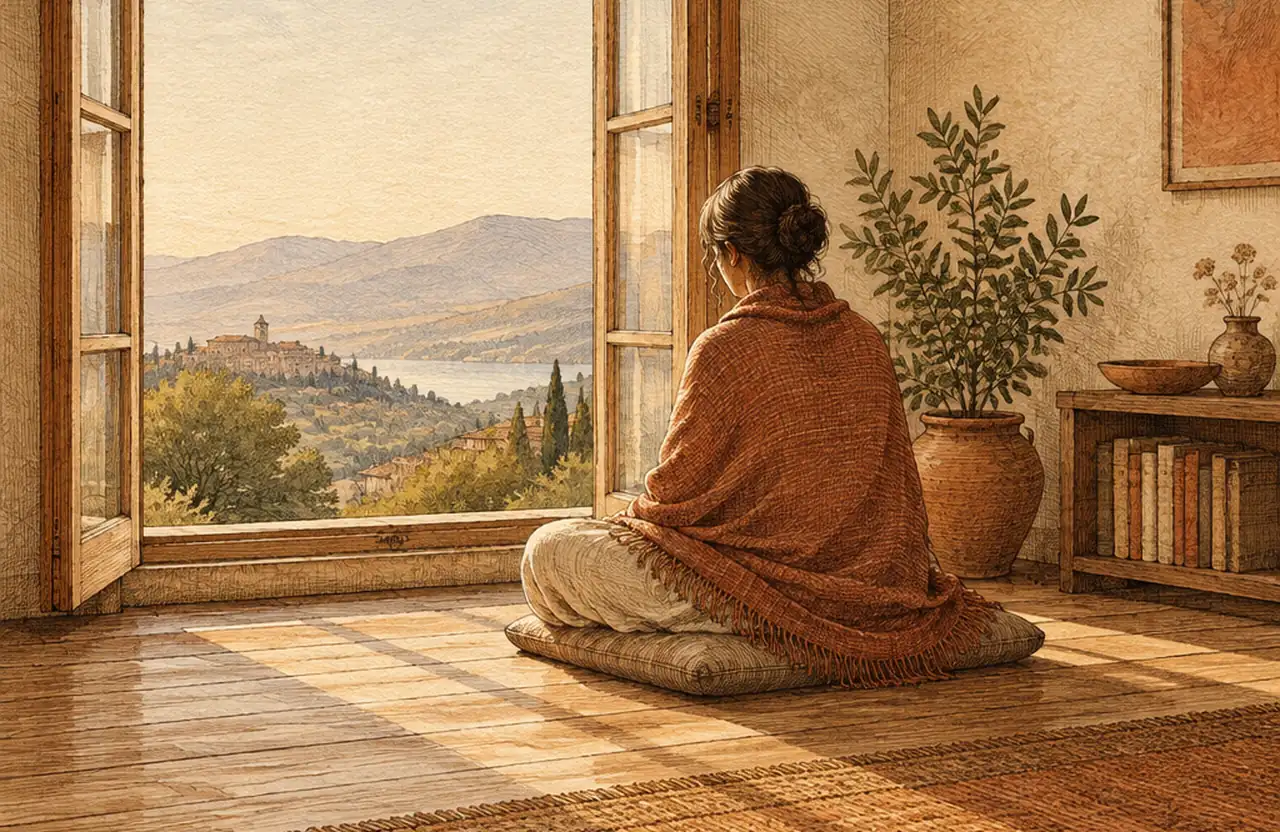
The practice comes from a short text called Nan Yar? (“Who am I?”). You use the question to turn attention back to the one who is asking, again and again, whenever a thought pulls you away.
Will it calm you down? No trial has tested that. Many people find a few minutes settling; some find the question stirs more thoughts. If it makes you spin, stop, feel your feet and look around the room (step 5), and see when it isn’t helping.
Self-inquiry step by step: the lines behind each step
Below are the five steps of the timer, each with the passage of Nan Yar it comes from. The quotes are from the ashram’s English edition, translated by T. M. P. Mahadevan (Sri Ramanasramam, 8th edition, 2010), with the question number.
- Settle. Breath control and other methods are “auxiliary practices” in this tradition, says Mahadevan’s introduction. So the first minute is only for arriving.
- Ask “Who am I?” and look at the sense of “I”. The text calls this inquiry “the principal means” and explains why: “Of all the thoughts that arise in the mind, the ‘I’-thought is the first. It is only after the rise of this that the other thoughts arise” (Q9).
- When a thought comes, ask to whom. “When other thoughts arise, one should not pursue them, but should inquire: ‘To whom do they arise?’ It does not matter how many thoughts arise” (Q11). The answer, the text says, “would be ‘to me’”.
- Go back to the source. “Thereupon if one inquires ‘Who am I?’, the mind will go back to its source… With repeated practice in this manner, the mind will develop the skill to stay in its source” (Q11).
- Let the question go. The question is only a tool. In the text’s image, the thought “Who am I?” is “like the stick used for stirring the burning pyre”, which “will itself in the end get destroyed” (Q10).
Read step 3 this way: each thought is a reminder to turn around, so a busy session is not a failed one.
Where “Who am I?” comes from: Ramana Maharshi and Nan Yar
Ramana Maharshi (1879–1950) was a South Indian sage who lived at the holy hill of Arunachala in Tiruvannamalai, Tamil Nadu. According to the ashram’s introduction, “about the year 1902” a revenue official named M. Sivaprakasam Pillai climbed to Virupaksha Cave and put questions to him. Ramana, then in his early twenties, “was not talking then, not because of any vow he had taken but because he did not have the inclination to talk”, so “he answered questions put to him by writing”.
Pillai published the record in Tamil in 1923. The text has come down in more than one shape, and sources disagree on the details:
- the ashram’s 2010 edition says some editions have thirteen questions and others twenty-eight, and translates the 28-question version;
- the ashram’s own online text of the same translation says fourteen instead of thirteen;
- the translator and writer Michael James dates Pillai’s first visit to 1901, says the 1923 edition had 27 questions, and that the 28-question form first appeared in 1932;
- there is also a prose version without questions. James and Wikipedia both say Ramana wrote it himself; the ashram notes that the two forms are “the only prose pieces among Bhagavan’s works”.
We quote the 28-question translation. You can read the whole of it for free: the ashram publishes a PDF of the printed edition and an online text. It takes about twenty minutes.
Atma vichara, the “I-thought” and other terms
| Term | Meaning | Where you meet it |
|---|---|---|
| ātma-vicāra (atma vichara) | “inquiry into the Self”: ātman, Self, and vicāra, inquiry | the usual name for the method in books and online; not used in Mahadevan’s English text, which just says “inquiry” |
| Nāṉ Yār? | Tamil for “Who am I?” | the title of the question-and-answer text |
| the “I”-thought (aham-vritti) | the first thought, “I”, to which all others are referred | Nan Yar Q9; the Sanskrit form appears in other sayings compiled by the ashram |
| the Self | what remains when the I-thought subsides; the “source” the mind returns to | Nan Yar Q11 and the closing answers |
| Advaita Vedanta | the Hindu non-dual school that the method is usually linked to | histories of the tradition; Wikipedia |
One trap with the word “Self”: in this teaching it doesn’t mean your personality or a better version of you. That popular sense of “higher self” is a different idea, with a different history; we explain it on our page about the higher self.
Self-inquiry vs meditation vs overthinking
People who try this often ask whether it is just thinking about themselves. Ramana separated inquiry from meditation: “Inquiry consists in retaining the mind in the Self. Meditation consists in thinking that one’s self is Brahman, Existence-Consciousness-Bliss” (Q27). Psychology adds a third neighbor, rumination: repetitive thinking about your distress, its causes and consequences, which Susan Nolen-Hoeksema linked to longer depressions (1991).
The table is our reading of the texts and the research, not a finding from any study.
| Self-inquiry | Meditation (as Ramana uses the word) | Overthinking / rumination | |
|---|---|---|---|
| What you look at | the one who is thinking | a chosen idea or form | the problem: why, what if, what it says about you |
| What you do with a thought | ask to whom it came, then drop it | bring the mind back to the object | follow it, argue with it, add to it |
| Level of thinking | almost no content | one content | abstract and repetitive, the kind Edward Watkins (2008) found less helpful |
| How it usually feels after | quieter, or neutral | steadier | tired, heavier, more worried |
Psychologists Paul Trapnell and Jennifer Campbell (1999) showed that looking at yourself comes in two kinds that a single scale had been mixing up: reflection, driven by curiosity, and rumination, driven by threat. They called the result a “self-absorption paradox”: people high on self-attention knew themselves better and were also more distressed. A practical test: if after a session you feel more knotted than before, and the same worry keeps returning, you have slipped from inquiry into rumination. Stop for today; it doesn’t mean you did it wrong.
When self-inquiry isn’t helping
Mahadevan’s introduction says plainly that “the process of enquiry, of course, is not an easy one”. Some discomfort is normal. These are signs to stop the practice for now:
- you feel agitated, panicky or as if you are spinning, during or after;
- you feel unreal or detached from your body or surroundings for hours or days;
- the question “Who am I?” turns into anxious thoughts about your identity or your life;
- sleep, work or time with people is getting worse.
What to do: open your eyes, feel your feet on the floor, name five things you can see, and do something ordinary. The NHS advice for anxiety is to see a doctor if you are struggling to cope or if what you are trying yourself is not helping. If you want to talk to someone today, our help page lists free lines. A practice that grounds you in the body, like the one in the app panel above, may be a better place to start for a while.
What research says about self-inquiry
Very little research looks at this practice directly. When we searched PubMed on October 20, 2026, we found no trials of “Who am I?” self-inquiry, and no papers at all mentioning “atma vichara” or Ramana Maharshi.
- A 2026 paper in Frontiers in Psychology proposes self-inquiry as a method for consciousness research and notes that it “has not received prior empirical study”.
- A 2015 review by Dahl, Lutz and Davidson groups meditation styles into families and lists self-inquiry as a likely mechanism of the “deconstructive” family. It is a framework, not a test.
- Studies of other meditation practices show that difficult effects are not rare. In one study of 96 people in an eight-week mindfulness program, 83% reported at least one meditation-related effect, and 6–14% had lasting bad effects, linked to too much arousal or to dissociation. A 2020 review of 83 studies put the overall rate of adverse events at 8.3%.
Self-inquiry is a spiritual practice with a long tradition behind it and almost no lab data either way.
A related voice: Nisargadatta Maharaj
Many people meet “Who am I?” through I Am That, talks with the Mumbai teacher Nisargadatta Maharaj (1897–1981), translated by Maurice Frydman and first published in 1973. The book opens: “Give up all questions except one: ‘Who am I?’ After all, the only fact you are sure of is that you are.” In the first talk he says: “The sense of being, of ‘I am’ is the first to emerge. Ask yourself whence it comes, or just watch it quietly.”
Nisargadatta came from a different lineage, and his instructions are not the same as Ramana’s “to whom has this thought come?”. We quote him here only because readers often mix the two up. The quotes are from the 1981 third edition.
What this page does not promise. The timer won’t give you realization, an answer in words or a calmer mind on any schedule. The practice is not a treatment for anxiety, depression or trauma, and if it makes those worse, the right move is to stop.
Frequently asked questions
What does self-inquiry mean?
Ramana Maharshi’s practice of asking “Who am I?” and turning attention to the sense of “I”. More: The five steps and the lines behind them ↑
What does “atma vichara” mean?
Sanskrit for “inquiry into the Self”, the usual name for Ramana Maharshi’s method. More: Atma vichara, the I-thought and other terms ↑
What is “Who am I?” (Nan Yar) by Ramana Maharshi?
Questions a visitor put to Ramana around 1902, published in 1923. Free to read on the ashram’s sites. More: Where “Who am I?” comes from ↑
What is the Self according to Ramana Maharshi?
What remains when the I-thought subsides; the text calls it the source of the mind. More: Atma vichara, the I-thought and other terms ↑
Did Ramana Maharshi ever speak?
Yes. Around 1902 he was not talking and answered in writing; later he talked with visitors. More: Where “Who am I?” comes from ↑
What questions should I ask myself for self-inquiry?
Only “Who am I?” and “To whom has this thought come?”. Question lists are a different practice. More: Self-inquiry vs meditation vs overthinking ↑
Is self-inquiry the same as overthinking?
No. Overthinking circles a problem; self-inquiry drops the content and looks at who is thinking. More: Self-inquiry vs meditation vs overthinking ↑
Can self-inquiry be harmful?
Rarely, but studies of other meditation practices found lasting problems in some people. More: When it isn’t helping ↑
Sources (16)
- Ramana Maharshi. Who am I? (Nan Yar?), trans. T. M. P. Mahadevan. 8th edition, ISBN 978-81-8288-113-6
- Ramana Maharshi. Who am I? (Nan Yar?), trans. T. M. P. Mahadevan, online text with the 1982 introduction
- Sri Ramana Maharshi on Self-Enquiry (compilation of his sayings)
- M. James. Nan Yar? (Who am I?): a translation with notes on the history of the text
- Sri Nisargadatta Maharaj. I Am That, trans. M. Frydman, ed. S. S. Dikshit (3rd ed. 1981; first published 1973)
- S. Nolen-Hoeksema. Responses to depression and their effects on the duration of depressive episodes. Journal of Abnormal Psychology 100(4): 569–582
- S. Nolen-Hoeksema, B. E. Wisco, S. Lyubomirsky. Rethinking rumination. Perspectives on Psychological Science 3(5): 400–424
- E. R. Watkins. Constructive and unconstructive repetitive thought. Psychological Bulletin 134(2): 163–206
- P. D. Trapnell, J. D. Campbell. Private self-consciousness and the five-factor model of personality: distinguishing rumination from reflection. JPSP 76(2): 284–304
- S. Tirumalasetti. Who am I? Self-inquiry as a neurophenomenological approach to consciousness. Frontiers in Psychology 17: 1951193
- C. J. Dahl, A. Lutz, R. J. Davidson. Reconstructing and deconstructing the self: cognitive mechanisms in meditation practice. Trends in Cognitive Sciences 19(9): 515–523
- J. R. Lindahl, N. E. Fisher, D. J. Cooper et al. The varieties of contemplative experience. PLOS ONE 12(5): e0176239
- W. B. Britton, J. R. Lindahl, D. J. Cooper et al. Defining and measuring meditation-related adverse effects in mindfulness-based programs. Clinical Psychological Science 9(6): 1185–1204
- M. Farias, E. Maraldi, K. C. Wallenkampf, G. Lucchetti. Adverse events in meditation practices and meditation-based therapies: a systematic review. Acta Psychiatrica Scandinavica 142(5): 374–393
- Get help with anxiety, fear or panic
- Self-enquiry (Ramana Maharshi)