What Is Astral Projection, and Is It Real?
Astral projection is the belief that a subtle “astral body” can leave the physical body and travel, usually during sleep or deep relaxation. The idea comes from 19th-century Theosophy. Science studies the same experience as an out-of-body experience (OBE): real as a feeling, most common at the edge of sleep, linked to one area of the brain, with no proof that anything leaves.
What did I experience? Seven questions
What did I experience? Think of one episode and answer what you remember. You’ll see which known experience it matches.
Example: Your answers fit sleep paralysis best (for a sample night: woke up stuck, buzzing, a presence; yours appears here when you press the button)
No other experience came close on your answers.
In the US, call or text 988 (Suicide & Crisis Lifeline), free, any time.
In the UK and Ireland, call Samaritans on 116 123, free, any time.
If you are in danger right now, call your local emergency number (911 in the US, 999 in the UK, 112 in the EU). Lines for other countries are on our help page.
- Sleep paralysis. Your mind woke up while your body was still in the paralysis of dream sleep. The NHS lists a presence in the room and pressure on the chest as typical, and calls it scary but harmless. About 1 in 13 adults has had at least one episode (Sharpless and Barber, 2011). Floating or leaving the body is one of its known forms (Cheyne and Girard, 2009).
This sorts your answers against published descriptions; it can’t say what really happened. Sources for each reading are in What science knows and When to see a doctor. Frightened right now? Our help page has free lines.
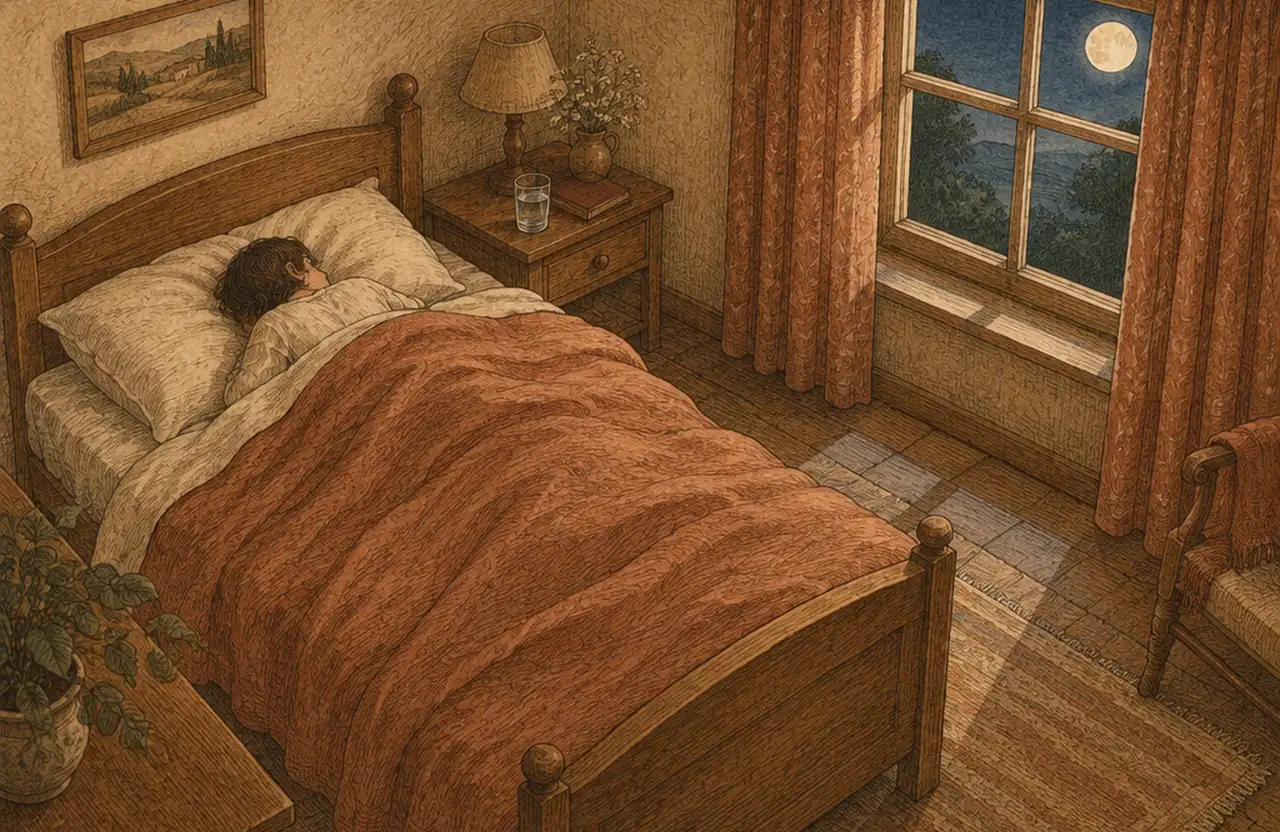
Astral projection in one line
| Word | astral, from Latin astrum, “star”; its sense of “supersensible” was popularized in the late 19th century by Theosophy (Etymonline) |
|---|---|
| The idea | a second, finer body that can separate from the physical one and move on its own |
| First in English | “astral projection” is first recorded in 1885–90 (Dictionary.com) |
| Science calls it | an out-of-body experience (OBE): the feeling of being outside your body, often seeing it from above, with no claim about what leaves |
| How common | roughly 1 adult in 10 reports at least one; survey estimates run from about 6 to 20 percent |
The two names describe one experience from two sides. “Astral projection” assumes something travels. “Out-of-body experience” describes what it feels like and leaves the question open. Below, “astral projection” means the belief and “out-of-body experience” means the experience.
Is astral projection real?
The experience is real. People who have it are not lying or crazy: about one in ten report it, most of them once or twice, and many say it felt more real than a dream. What nobody has shown is that anything leaves the body. For more than fifty years researchers have hidden numbers and pictures where only someone floating near the ceiling could see them. One woman read a number correctly in 1968. No one has done it since under tighter conditions. That includes two large hospital studies of people whose hearts had stopped. And the “CIA file” often quoted as proof is a 1983 Army report on Robert Monroe’s training method, not a test of it (more below).
What has been shown is where the feeling comes from in the brain, and when it tends to happen: at the edge of sleep, in sleep paralysis, in lucid dreams, in deep relaxation, and sometimes under great stress or in illness.
What science knows about out-of-body experiences
It can be switched on in the brain. In 2002 a team in Geneva led by the neurologist Olaf Blanke was mapping the brain of a woman being assessed for epilepsy surgery. They stimulated one spot on the right side, the angular gyrus. She first felt she was “sinking into the bed” and then said: “I see myself lying in bed, from above, but I only see my legs and lower trunk.” It happened again when they repeated the stimulation. The authors wrote in Nature that out-of-body experiences “may reflect a failure by the brain to integrate complex somatosensory and vestibular information”, that is, signals about touch, position and balance.
The same area shows up in patients. In 2004 Blanke’s group described six neurological patients with out-of-body experiences. In five, the damage or abnormal activity sat at the temporo-parietal junction, the area where the temporal and parietal lobes meet, roughly above and behind the ear. A 2005 review argued that when this area fails to join up signals from the body, a person can feel they are in a different place from their body and seeing it from there.
Some people can do it at will. In 2014 two Ottawa researchers, Andra Smith and Claude Messier, scanned a woman who said she could produce the feeling of her body moving outside itself whenever she wanted, while staying aware of her real body lying still. The scan showed activity different from ordinary imagining of movement, partly in the same temporo-parietal region. It is one person. The authors called it an “extra-corporeal experience”. Still, it shows the state is not always an accident.
Hidden-target tests, 1968 to 2023: one hit, never repeated
| Test | What they did | What happened |
|---|---|---|
| Tart, 1968 | “Miss Z” slept 4 nights in a sleep lab; a random 5-digit number lay on a shelf about 6.5 feet up | On the last night she woke at 6:04 a.m. and gave the number, 25132, correctly. Tart wrote that this could not be taken as conclusive. Critics, among them Susan Blackmore, note the number was in the same room |
| Tart, 1998 (report) | Robert Monroe in 8 lab sessions, and 4 more studies with other people | Monroe did not name the number; in the other studies none of the participants identified the targets |
| AWARE, 2014 | Pictures on high shelves in hospital wards; 2,060 cardiac arrests, 101 survivors interviewed in depth | 9 had near-death experiences, 2 recalled seeing or hearing things; both arrests happened in areas without shelves, so no picture could be checked |
| AWARE II, 2023 | 567 in-hospital cardiac arrests, a hidden image and a sound played during resuscitation | 28 survivors interviewed; “Nobody identified the visual image” |
Researchers who take out-of-body experiences seriously, Tart among them, answer that the lab is a poor place for them. People who manage it at home often can’t in a strange room with wires on their heads. That may be true. It also means the claim that something travels is still untested, not confirmed.
Astral projection, sleep paralysis and lucid dreams
Most people meet astral projection by accident, at the edge of sleep. In sleep paralysis the mind wakes up while the body is still held still by dream sleep. The NHS lists the usual signs: you are awake but can’t move or speak, you feel someone is in the room or something is pressing you down, and you are frightened. It calls it “scary but … harmless”. A review of 35 studies with 36,533 people found that 7.6 percent of the general population have had at least one episode, and 28.3 percent of students. Allan Cheyne and Todd Girard ran a large survey of people with sleep paralysis. They found that floating, flying, spinning and leaving the body form one group of its sensations, separate from the “intruder” fear.
Lucid dreams overlap too. In a 1991 study at the Lucidity Institute, 10 of 107 lucid dreams counted as out-of-body experiences because the dreamer felt they had left their body. Stephen LaBerge wrote the same year that “the only necessary feature distinguishing lucid dreams and OBEs is how the person interprets the experience.”
| Sleep paralysis | Hypnagogic sensations | Lucid dream | Out-of-body experience | |
|---|---|---|---|---|
| When | waking up or falling asleep | falling asleep | during a dream | sleep, relaxation, stress, sometimes awake |
| Can you move? | no | usually yes | in the dream, yes | you feel you can, “outside” |
| Typical signs | presence, chest pressure, fear | buzzing, rushing, falling, floating | you know it’s a dream | seeing your body or the room from above |
| Do you know it’s a dream? | no, you know you’re awake | half-aware | yes | no, it feels real |
Robert Monroe, who published Journeys Out of the Body in 1971, wrote that it began in 1958, after a short sleep. He felt hit by a beam of warm light that paralyzed him and made his body “vibrate violently”. A sleep doctor reading the same lines would think of sleep paralysis with vestibular sensations. Monroe read it as the start of travel, and the “vibration stage” has been in astral projection guides ever since. Both readings fit what he felt; they disagree about what it means.
If this feels frightening right now
If you woke up unable to move, felt something in the room, or saw yourself from above and are scared to sleep again, a few facts may help:
- It ends on its own. Sleep paralysis lasts up to several minutes at most (NHS). No one is known to have failed to “get back”, though the fear of it is one of the most common things people report.
- It is common and has a name. About 1 in 13 adults has had sleep paralysis at least once.
- Sleep habits make it less likely. The NHS suggests 7 to 9 hours of sleep at regular times, no big meal, alcohol or caffeine just before bed, and not sleeping on your back.
- You don’t have to decide what it was tonight. Whether you see it as a spiritual event or a sleep event, the advice on fear and rest is the same.
How to tell it from depersonalization, dissociation or sleep paralysis: when to see a doctor
A single out-of-body experience is not a diagnosis. The DSM-5 criteria for depersonalization-derealization disorder require experiences that are persistent or recurrent and cause real distress or trouble functioning. They also note that the person knows the feeling is not reality. See a doctor if any of these fit:
- Sleep paralysis happens often and you feel very anxious or scared to go to sleep, or tired all the time from lost sleep. That is the NHS’s line for seeing a GP; a doctor can treat what sets it off, such as insomnia, anxiety or PTSD.
- You feel outside yourself in the daytime, as if watching your body, thoughts or actions from a distance, and it keeps coming back, upsets you, or gets in the way of work or relationships. Mayo Clinic lists “feeling like you’re floating in the air above yourself” among the symptoms of depersonalization; talk therapy is the main treatment. The NHS describes the same feeling under dissociation.
- Sleep paralysis comes with sudden daytime sleep, or your knees or face go weak when you laugh or get excited. Mayo Clinic lists these as signs of narcolepsy.
- The out-of-body feeling comes with déjà vu, a sudden odd smell or taste, staring, or a gap you can’t remember, and lasts seconds to two minutes. Cleveland Clinic describes these as possible focal seizures from the temporal lobe, which sits next to the area Blanke’s team stimulated. See a doctor, ideally a neurologist.
If you hear voices, feel controlled from outside, or have thoughts of harming yourself, don’t wait for any of the above: get help today.
If things are hard for you right now
If you are in danger or thinking about harming yourself, call your local emergency number (112 in the EU, 911 in the US) or, in the US, call or text 988. Please do not stay alone with it: tell someone close to you.
If the feeling has lasted a long time and gets in the way of life, please talk to a doctor or a therapist. The practices on this site do not replace them.
Crisis lines for the US, Canada, the UK, Ireland, Australia, India and other countries, checked against official sites, are on our page Get help now.
Is astral projection dangerous?
The experience itself is not known to damage the body. Sleep paralysis, its most common setting, is harmless in the NHS’s words. The risks sit around it:
- A frightening night can make people afraid to sleep, and lost sleep makes sleep paralysis more likely.
- Waking up on purpose night after night to try again cuts into sleep.
- For people with depersonalization, narcolepsy, a seizure disorder or psychosis, frequent “leaving the body” can be a symptom a doctor should look at before anyone tries to train it.
- Some guides add herbs or drugs. Anything that changes consciousness has its own risks, and we don’t cover them here.
Where the idea comes from: Theosophy, Muldoon and Monroe
The phrase is younger than it sounds. Helena Blavatsky’s Isis Unveiled (1877) wrote of the “astral light” and of the “soul (astral body)”, and quoted Paracelsus to the effect that in sleep “the astral body is free” and can “hover round in proximity with its sleeping vehicle” or travel far. Her later Theosophical Glossary (1892) defined the astral body as “the ethereal counterpart or shadow of man”, the “Doppelganger”, and gave it a Sanskrit name, linga sharira.
Her followers made it a body you could use. Annie Besant’s Man and His Bodies (1896) said that in sleep “the astral body slips out” of the physical one, and that “comparatively few work in it separated from the physical.” Charles Leadbeater’s The Astral Plane (1895) described the place it was supposed to go, with its scenery and inhabitants.
The practical manual came in 1929: The Projection of the Astral Body by Sylvan Muldoon, an American who described his own projections, and the psychical researcher Hereward Carrington. Its index runs through the “astral cable”, “astral catalepsy” and the role of the subconscious will. Then in 1971 Robert Monroe, an American radio executive, published Journeys Out of the Body. He later patented Hemi-Sync, a binaural-beat sound method, and founded the Monroe Institute to teach his methods. Researchers by then preferred a neutral term. Celia Green’s 1968 survey was called Out-of-the-Body Experiences, and the same year Charles Tart published one of the first sleep-lab tests.
Indian parallels
Theosophy took much of its vocabulary from India, so the parallels are real, but the ideas are not the same.
- The subtle body. Hindu texts distinguish the gross body (sthūla śarīra) from a subtle body (sūkṣma śarīra, also liṅga śarīra) made of the senses, mind and breath. In the Mahanirvana Tantra it “contains in itself the cause of rebirth”: it carries a person from one life to the next. It is not described as a double that goes out at night.
- Yogic powers. The Yoga Sutras of Patanjali list, among many siddhis, the mind’s “entrance into another body” (3.38) and “travelling in ether” through meditation on the body’s lightness (3.42). Just before them, the text warns that such powers are “obstacles in the meditative condition” (3.37). Numbering differs by one between editions.
So the old texts treat leaving the body as a rare power of advanced yogis, and an obstacle in meditation. The modern idea that anyone can learn it in a few nights is Western and recent.
Is astral projection in the Bible? The silver cord
The Bible never mentions astral projection. The passage people quote most is Paul’s: “I knew a man in Christ above fourteen years ago, (whether in the body, I cannot tell; or whether out of the body, I cannot tell: God knoweth;) such an one caught up to the third heaven” (2 Corinthians 12:2). Paul describes a vision. He says plainly that he doesn’t know how it happened, and he teaches no method.
The “silver cord” that many guides say ties the astral body to the physical one comes from Ecclesiastes 12:6: “Or ever the silver cord be loosed, or the golden bowl be broken”. In context it is a poem about old age and death. Whether trying to leave the body is wrong is a question for your own church or tradition; we don’t answer it for them.
What came later: the CIA file, methods and films
- The “CIA astral projection” document is a 1983 U.S. Army report by the officer Wayne McDonnell, Analysis and Assessment of Gateway Process, about Monroe’s training program, later released in the CIA’s online reading room. It is one officer’s assessment of the method and the theory behind it, not a controlled test showing that anyone left their body.
- Named methods such as the “rope” and “roll-out” techniques fill modern guides and videos. All of them work at the edge of sleep: lie still, let the body fall asleep, keep the mind awake. That is the same state in which sleep paralysis and hypnagogic sensations happen. So people who try them often report both. We describe them here as history and don’t teach them.
- Films and games such as Insidious (2010) and Doctor Strange (2016) gave the idea its current look: a glowing double, a cord, a threat of not getting back.
What this page does not promise. We don’t say whether a soul or astral body exists, and we don’t teach how to leave the body. The check is not a diagnosis and can’t tell you what really happened to you. Nothing here treats sleep paralysis, anxiety or any illness.
How the check works
The check has seven questions about one episode: when it happened, whether you could move, vibration or floating, seeing yourself from outside, knowing you were dreaming, fear or a presence, and how often. Each answer adds points to one or more of four well-described experiences, using the signs named in the sources above: the NHS and Cheyne and Girard for sleep paralysis, Cleveland Clinic for hypnagogic sensations, Levitan and LaBerge for lucid dreams, Blanke’s papers for out-of-body experiences. The result names the closest match. When the scores are close, it names a second one, because these states often overlap. Four optional ticks add doctor notes from NHS, Mayo Clinic and Cleveland Clinic; the crisis tick shows help lines at once. The example above uses one sample night. Nothing is saved or sent.
Frequently asked questions
Is astral projection real?
The experience is real and common. No test has shown that anything leaves the body. More: Is astral projection real? ↑
Is astral projection just sleep paralysis?
Often it starts there. Floating out of the body is a known part of sleep paralysis, but it also happens without it. More: Sleep paralysis and lucid dreams ↑
What is the difference between astral projection and lucid dreaming?
In a lucid dream you know you are dreaming; in astral projection you feel you are awake outside your body. Researchers see a big overlap. More: Sleep paralysis and lucid dreams ↑
Can you get stuck while astral projecting?
No case is known. Sleep paralysis, the usual setting, ends on its own within minutes. More: Is it dangerous? ↑
Is astral projection dangerous?
The experience itself is not known to cause harm. Fear, lost sleep and some health conditions are the main issues. More: Is it dangerous? ↑
Is astral projection a sin?
The Bible never names it. Paul’s “whether in the body, or out of the body, I cannot tell” is the nearest passage. More: The Bible and the silver cord ↑
What does astral projection feel like?
People describe vibration or buzzing, a rushing sound, floating, and seeing the room or their body from above. More: What science knows ↑
What is the silver cord in astral projection?
A cord said to tie the astral body to the physical one. The phrase comes from Ecclesiastes 12:6, a passage about death. More: The Bible and the silver cord ↑
Sources (35)
- astral (etymology)
- astral projection (definition; first recorded 1885–90)
- H. P. Blavatsky. Isis Unveiled, vol. I, ch. V “The Ether, or ‘Astral Light’”
- Linga-Sharira (with H. P. Blavatsky, The Theosophical Glossary, 1892)
- Annie Besant. Man and His Bodies (Theosophical Manual VII)
- C. W. Leadbeater. The Astral Plane: Its Scenery, Inhabitants and Phenomena
- S. J. Muldoon, H. Carrington. The Projection of the Astral Body
- Robert Monroe (on Journeys Out of the Body, Doubleday 1971, and the Monroe Institute)
- W. M. McDonnell. Analysis and Assessment of Gateway Process (U.S. Army, declassified)
- Mahanirvana Tantra, trans. Arthur Avalon (sthula- and sukshma-sharira)
- Yoga Sutras 3.37, 3.38 and 3.42 with Bhoja’s Rajamartanda, trans. Rajendralal Mitra
- 2 Corinthians 12:2 (King James Version)
- Ecclesiastes 12:6 (King James Version)
- O. Blanke, S. Ortigue, T. Landis, M. Seeck. Stimulating illusory own-body perceptions. Nature 419: 269–270
- O. Blanke, T. Landis, L. Spinelli, M. Seeck. Out-of-body experience and autoscopy of neurological origin. Brain 127(2): 243–258
- O. Blanke, S. Arzy. The out-of-body experience: disturbed self-processing at the temporo-parietal junction. The Neuroscientist 11(1): 16–24
- A. M. Smith, C. Messier. Voluntary out-of-body experience: an fMRI study. Frontiers in Human Neuroscience 8: 70
- Out-of-body experiences: interpretations through the eyes of those who live them (prevalence 10–20%, after Alvarado 2000). Frontiers in Psychology
- Out-of-Body Experience (OBE): survey prevalence 6–14%
- From laboratory targets to experiential authenticity: reframing the study of veridicality in OBEs (on Tart 1968 and Tart 1998). Frontiers in Psychology
- C. T. Tart. Six studies of out-of-body experiences. Journal of Near-Death Studies 17(2): 73–99
- S. Blackmore. Out-of-body experiences are not evidence for survival (in The Myth of an Afterlife)
- S. Parnia et al. AWARE: awareness during resuscitation, a prospective study. Resuscitation 85(12): 1799–1805 (University of Southampton summary)
- S. Parnia et al. AWAreness during REsuscitation II. Resuscitation 191: 109903
- J. A. Cheyne, T. A. Girard. The body unbound: vestibular-motor hallucinations and out-of-body experiences. Cortex 45(2): 201–215
- B. A. Sharpless, J. P. Barber. Lifetime prevalence rates of sleep paralysis: a systematic review. Sleep Medicine Reviews 15(5): 311–315
- L. Levitan, S. LaBerge. Other worlds: out-of-body experiences and lucid dreams. NightLight 3(2–3)
- S. LaBerge. Comments on OBEs and lucid dreams. Lucidity Letter 10(1–2)
- Sleep paralysis
- Dissociative disorders
- Depersonalization-derealization disorder: symptoms and causes
- Depersonalization/derealization disorder (DSM-5-TR criteria)
- Narcolepsy: symptoms and causes
- Hypersomnia vs. narcolepsy (hypnagogic hallucinations)
- Temporal lobe seizures