Kundalini: Meaning, Origins and What the Old Texts Say
Kundalini is the Sanskrit name for a power that tantra and hatha yoga picture as a snake asleep at the base of the spine, woken with a teacher’s help and led up to the crown for liberation. Much of what is said about it today was added in the 20th century.
Old text or added later?
Old text or added later? Ten things people say about kundalini. Guess where each one comes from, then see the source.
-
Kundalini sleeps coiled at the base of the spine, three and a half times around.
Answer
In the old texts. Ṣaṭ-cakra-nirūpaṇa (1577), verses 10–11. The text pictures her asleep in the lowest center, “fine as the fibre of the lotus-stalk”, wound three and a half times around a linga, with a lustre like “young strong lightning”. The coil is an image to meditate on, and the text makes no anatomy claim.
-
Kundalini is taught in the Vedas, more than 3,000 years ago.
Answer
Added later. Tantric texts from about the 8th century on; a hatha yoga term by the 15th. The Vedic hymns do not teach a coiled power in the body. The scholar David Gordon White points to an 8th-century tantra as an early use of the term, and hatha yoga took it up by the 15th century. The Yoga-kundalini Upanishad people quote is a medieval “yoga Upanishad”, not a Vedic text.
-
Kundalini wakes up by the grace of a teacher.
Answer
In the old texts. Hatha Yoga Pradipika 3.2; Ṣaṭ-cakra-nirūpaṇa, verses 50 and 54. The Pradipika says the sleeping kundalini awakens “by favor of a guru”. The 1577 text says the method is learned “from the mouth of his Guru” and from the teacher’s “two Lotus Feet”. Neither text imagines learning it alone from a book or a video.
-
You can tell kundalini is rising by heat, tingling and currents up the spine.
Answer
Added later. Symptom lists: Gopi Krishna (1967), then clinicians from the 1970s on. The Pradipika does mention a burning feeling, but as the effect of one specific breath-and-lock technique. Checklists of “kundalini symptoms” come from Gopi Krishna’s 1967 memoir and from Western clinicians who wrote about his kind of experience.
-
The goal is liberation: kundalini rises to the crown and unites with Shiva.
Answer
In the old texts. Ṣaṭ-cakra-nirūpaṇa, verses 51–54; Hatha Yoga Pradipika 3. In the 1577 text she pierces the centers, reaches Shiva at the crown, which brings “the bliss of Liberation” (v. 51), and then returns to her place (v. 53). The Pradipika says the yogi opens “the door of mukti”, release from rebirth, by opening kundalini. Money, sex appeal and manifesting are not on the list.
-
The practices should be kept secret.
Answer
In the old texts. Hatha Yoga Pradipika, chapter 3. The Pradipika says these mudras “should be kept secret by every means, as one keeps one’s box of jewelry”. It was a manual for initiates living with a teacher, which is one reason it reads so oddly as a self-help guide.
-
Kundalini Yoga, with breath of fire and white clothes, is an ancient unbroken lineage.
Answer
Added later. Yogi Bhajan, North America 1968–69; Deslippe (2012). This style was put together by Yogi Bhajan after he moved to Canada in 1968 and founded 3HO in Los Angeles in 1969. The historian Philip Deslippe traced its parts to earlier teachers and to stories Bhajan revised after 1970.
-
Kundalini is a biological energy in the nervous system that drives human evolution.
Answer
Added later. Gopi Krishna, Kundalini: The Evolutionary Energy in Man (1967). This is Gopi Krishna’s own hypothesis. He spent his later life asking scientists to test it. No study has found such an energy; the texts themselves speak of a subtle body that is not the physical one.
-
Kundalini is a map of the unconscious mind.
Answer
Added later. C. G. Jung, seminar in Zurich, 1932. Jung read the chakras as stages of psychological growth in a 1932 seminar and said the idea had “only one use” for Westerners: describing experiences with the unconscious. It is a useful reading, and it is Jung’s, not the tantras’.
-
Kundalini is the Holy Spirit described in the Bible.
Answer
Added later. The word is Sanskrit; the comparison is modern. The Bible never uses the word or describes a coiled power at the spine. Writers who equate the two, and Christian writers who warn against kundalini, are both making modern comparisons; neither is reading an old text.
4 of the 10 claims are in the medieval texts. Nothing you choose is stored or sent.
If you are here because a yoga teacher mentioned it: the class called Kundalini yoga is a school founded in 1969, not the practice of the old texts. What it is and what one trial found about it is in Kundalini yoga below.
What does kundalini mean?
The Sanskrit word kuṇḍalinī comes from kuṇḍala, a ring or coil, so it means “she who is coiled”. The feminine ending matters: in the texts kundalini is a goddess, a form of Shakti, the power of the god Shiva, and not an impersonal force. The Hatha Yoga Pradipika lists her other names, among them Bhujangi, “the she-serpent”, Ishwari, “the sovereign”, and Arundhati.
“Kundalini energy”, the phrase most people search for, is a modern way of putting it. The medieval authors speak of Shakti and of a sleeping goddess. The word “energy” came in with 20th-century writers who wanted to describe kundalini in terms a Western reader would accept as physical. Neither word refers to anything a scan can show. The texts never claim it could.
Kundalini in tantra and hatha yoga
The idea is tantric. The scholar David Gordon White points to an 8th-century tantra as an early use of the term, and by the 11th century it named the goddess in Shakta texts. By the 15th century it was a core term of hatha yoga. Two sources stand behind most modern accounts, often without saying so:
- The Hatha Yoga Pradipika of Svatmarama (15th century). Its third chapter opens: “As the chief of the snakes is the support of the earth with all the mountains and forests on it, so all the Tantras (Yoga practices) rest on the Kundalini.” The next verse: “When the sleeping Kundalini awakens by favor of a guru, then all the lotuses … and all the knots are pierced through.”
- The Ṣaṭ-cakra-nirūpaṇa (“Description of the Six Centers”) of the Bengali teacher Purnananda, finished in 1577. Verses 10 and 11 give the picture: she sleeps in the lowest center, “fine as the fibre of the lotus-stalk”, goes “three and a half times round Śiva” like the spiral of a conch shell, and her lustre is “as that of a strong flash of young strong lightning”.
The same texts describe what waking her involves, and the methods are harsh. The Pradipika’s method is a set of mudras: breath holds, muscle locks and postures. In one of them, mula bandha, the text says the inner fire and breath meet and cause “burning sensation in the body”, and kundalini, “well heated by this means”, awakens. Another, khechari mudra, requires cutting the fold of skin under the tongue “as much as a hair’s thickness” each week for six months. The Pradipika also says the mudras “should be kept secret by every means, as one keeps one’s box of jewelry”. This is a manual for ascetics who lived with a teacher, written for them.
Show the verse-by-verse reading
The 1577 text lays out the path. In verse 50 the student first learns the method “from the mouth of his Guru”, then rouses the goddess with the syllable Hūṃ. In verse 51 she pierces the centers and reaches Shiva, the “Supreme Bliss”, producing “the bliss of Liberation”; in verse 53 she drinks the nectar there and returns along the same path to the root center. Verse 54 names the result: a yogi who learned this “from the two Lotus Feet” of his teacher “is never born again in this world”.
| What the old texts say | How it is often retold today |
|---|---|
| A goddess asleep in the lowest center, coiled around a linga (ŚCN 10–11) | “Energy stored at the base of everyone’s spine” |
| Wakes “by favor of a guru” (HYP 3.2); the method comes from a teacher (ŚCN 50, 54) | “Awaken your kundalini in 21 days”, practices from a video |
| Burning is the effect of a specific breath-and-lock practice (HYP 3, mula bandha) | Heat and tingling as proof that kundalini is rising |
| Practices kept secret (HYP 3) | Free online courses and certifications |
| Goal: union with Shiva and release from rebirth (ŚCN 51–54) | Energy, sexuality, creativity, manifesting |
The serpent symbol: why kundalini is a snake
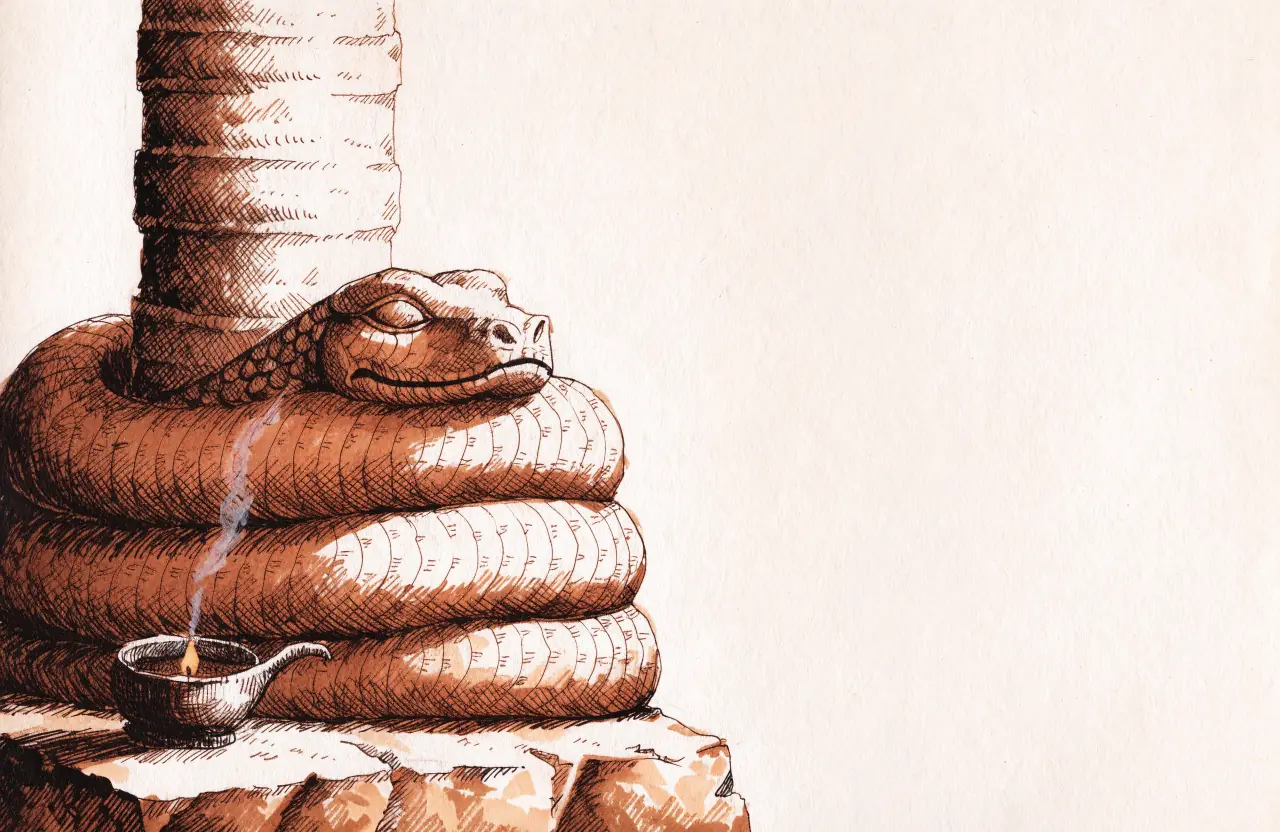
The snake comes from the texts themselves. The name means “she who is coiled”, the Hatha Yoga Pradipika calls her Bhujangi, “the she-serpent”, and the 1577 text pictures her asleep in the root center, wrapped “three and a half times round Śiva”, her body covering the opening of the central channel. A sleeping snake is coiled, still and closed; an awakened kundalini, in the same picture, uncoils and rises up the spine. That is the whole of the serpent symbolism in the old sources: rest and closure at the bottom, movement and release at the top.
Woodroffe put the image in the title of his 1919 translation, The Serpent Power, and the coiled snake became the standard kundalini symbol in Western books. Some modern images show two snakes winding up a staff, like the caduceus of Hermes. The tantric texts describe one goddess, not two snakes, so that picture is a later comparison.
What about an “awakened” or “activated” kundalini today? Paid “kundalini activation” sessions, and anything sold as a “kundalini activator”, promise to wake it or keep it active. They borrow the old idea that a teacher can wake her, the Pradipika’s “by favor of a guru”. In the texts that favor came inside years of practice with one teacher; nothing in them describes activating her in a one-off session with a stranger. We can’t test either claim, and we don’t recommend trying to activate it yourself or chasing the experience. If you think your kundalini is already awake, the signs people report, and the ones that need a doctor, are on the kundalini awakening page.
Kundalini and the chakras
Kundalini and the chakras come as one system in these texts. She sleeps in Muladhara, the root center, where her coiled body covers the opening of the central channel, sushumna. When she wakes, she enters that channel and passes the six centers one by one: root, sacral, navel, heart, throat and the center between the eyebrows. Above them is the thousand-petalled lotus at the crown, which the 1577 text counts separately and does not call a chakra. In the texts the centers matter as stations on her path.
Each center has its own image in the same text, and our guides to the root chakra, where she sleeps, and the crown, where she is meant to arrive, go through them verse by verse. All seven are compared on the chakras overview.
What the West added: from 1919 to today
Most of what people now mean by kundalini comes from five moments in the 20th century:
- 1919. John Woodroffe, a British judge in Calcutta who wrote as Arthur Avalon, published The Serpent Power, an English translation of the 1577 text with a long introduction. It is still the source for most English writing on kundalini and the chakras.
- 1932. Carl Jung gave a seminar on kundalini yoga in Zurich and read the chakras as stages of psychological growth. In his view the idea had for Westerners “only one use”: to describe our own experiences with the unconscious. That psychological reading is Jung’s, not the tantras’.
- 1967. Gopi Krishna, a government clerk from Kashmir who meditated for years without a teacher, published Kundalini: The Evolutionary Energy in Man. He described a sudden rise of power at the age of 34 and twelve years in which light and joy alternated with unbearable heat and depression. He believed kundalini was a biological mechanism driving human evolution. That hypothesis has never been confirmed, but his story became the model for “spontaneous kundalini awakening”.
- 1968–1969. Yogi Bhajan moved to Toronto in 1968 and in 1969 founded 3HO in Los Angeles, teaching what he called Kundalini Yoga. More on this below.
- From the 1970s. Psychiatrists and psychologists began to describe a “kundalini syndrome” in patients and research subjects, and New Age writers turned the idea into lists of symptoms, stages and crystals.
The scholar of religion Anya Foxen sums up where this led in an April 2026 essay for Harvard’s Center for the Study of World Religions: “In contemporary global spirituality, Kundalini behaves as a catch-all category. Every experience of energy within the body becomes Kundalini.” That is the best one-line answer we found to why the word now means so many different things.
Kundalini yoga: what it is and is it good for you?
Kundalini yoga, the class with breath of fire, chanting and white clothing, is the system Yogi Bhajan (Harbhajan Singh Puri, 1929–2004) taught through 3HO. It is not the practice of the Pradipika. The historian Philip Deslippe, working from 3HO archives, showed in 2012 how Bhajan put it together from the teachers he had studied with and how he revised the story of his own lineage after a trip to India in 1970. It is a modern school with a recent founder, which is fine as long as nobody sells it to you as an ancient unbroken line.
In 2020 a report commissioned by the 3HO community’s own leadership found it “more likely than not” that Bhajan had sexually abused followers, as Religion News Service reported in August 2020. The allegations concern the founder. They are worth knowing if you are choosing a school and hear that a method was “passed down by a master”.
As exercise and relaxation, the classes have one solid trial behind them. In 2021 JAMA Psychiatry published a study of 226 adults with generalized anxiety disorder: after 12 weeks, 54% of those in Kundalini yoga had improved, against 33% with stress education and 71% with cognitive behavioral therapy. The authors concluded that the yoga worked, but that CBT should stay the first-line treatment. If you live with panic attacks or have had psychosis, tell the teacher before class and skip the fast breathing and long holds.
What research has found about kundalini experiences
No study has measured a kundalini energy. What researchers do study is what people report, and several findings are solid enough to quote:
- The “physio-kundalini syndrome”. The psychiatrist Bruce Greyson built a checklist of the bodily and mental signs linked with kundalini and in 1993 found that people who had been through a near-death experience reported significantly more of them than a comparison group.
- A scale for it. Laura Sanches and Michael Daniels published a 76-item Kundalini Awakening Scale in 2008 and gave it to yoga teachers, yoga students, followers of other spiritual paths and people from the general population. Kundalini-type experiences rose with years of yoga practice, and the group following less structured paths reported more of the negative and disruptive ones.
- Kundalini or not. In a 2017 study of 60 Western Buddhist meditators who had had difficult experiences, 63% described “somatic energy”, currents or voltage moving through the body, although they practiced in Buddhist traditions, not kundalini yoga. The same sensations turn up whatever the person believes.
- How people judge it afterwards. In 2021 Jessica Corneille and David Luke surveyed 152 people who had had a spontaneous awakening; 40% chose to describe theirs as a kundalini awakening. Those reported more involuntary postures and more physical symptoms, and were more likely to have practiced yoga beforehand. Across the whole sample, 91% called the experience mostly positive in the short term and 98% in the long term.
Two cautions about that last number. The participants were recruited through social media and chose to take part, so people who had a bad time are likely underrepresented. And “positive in the long term” is not the same as “safe”: the same literature describes people who went through months of fear and sleeplessness before it turned out well. The difficult side is covered in detail on our page on kundalini awakening.
Kundalini vs spiritual awakening
People use the two phrases for overlapping experiences, and researchers have only started to separate them. The clearest difference so far is the body. In the 2021 survey, people who called their experience a kundalini awakening reported more physical symptoms and involuntary movements, but did not score differently on the scales of mystical experience and altered states. So the inner change sounds alike; what differs is how much the body joins in.
| Kundalini awakening | Spiritual awakening | |
|---|---|---|
| Where the word comes from | Tantra and hatha yoga; the modern sense from Gopi Krishna (1967) | A broad modern term used across religions and none |
| What people describe first | Heat, currents along the spine, shaking, pressure in the head | A change in how they see themselves and the world |
| Typical trigger in the 2021 survey | More often yoga practice | More often no clear trigger |
| The inner experience | Similar on the scales of mystical experience and altered states | |
Many people have one without the other. A quiet shift in perspective with no bodily drama is common, and so is intense heat and shaking during breathwork that changes nothing else. If you are trying to sort out what is happening to you, our guide to spiritual awakening symptoms covers the broader experience.
Does the Bible mention kundalini?
No. The word is Sanskrit and the idea belongs to tantra, and the Bible never mentions a coiled power at the base of the spine. The question comes up because two modern camps both use the Bible: some spiritual writers equate kundalini with the Holy Spirit, and some Christian writers warn that kundalini practice is spiritually dangerous. Both are present-day readings. Neither rests on an old text that links the two.
When it is not about kundalini
Kundalini pages draw readers who feel something strong and want a name for it. A name can wait; some signs cannot. Please see a doctor, and do not wait for anything to “rise and pass”, if you notice:
- almost no sleep for three nights or more;
- hearing voices, or a strong sense of being watched or controlled;
- a sudden severe headache, numbness or weakness on one side, or trouble speaking or seeing (call 911 or your local emergency number);
- panic or a feeling that the world is unreal that lasts more than two weeks;
- thoughts of death or of harming yourself.
The full list, with what to do and why, is on the kundalini awakening page. If you have felt flat and empty for a long time rather than overwhelmed, the page on the dark night of the soul explains how that differs from depression.
If things are hard for you right now
If you are in danger or thinking about harming yourself, call your local emergency number (112 in the EU, 911 in the US) or, in the US, call or text 988. Please do not stay alone with it: tell someone close to you.
If the feeling has lasted a long time and gets in the way of life, please talk to a doctor or a therapist. The practices on this site do not replace them.
Crisis lines for the US, Canada, the UK, Ireland, Australia, India and other countries, checked against official sites, are on our page Get help now.
What this page does not promise. We do not claim kundalini exists as a physical energy; no measurement has found one, and the texts describe a subtle body, not the physical one. We teach no technique for raising it. We recommend none to beginners. The myth check tests where an idea comes from. Kundalini yoga can help some people with anxiety. It is not a replacement for treatment.
How the myth check works
The ten claims at the top of the page are ones we met again and again on the pages that rank for “kundalini” and in the questions people ask about it. Each one we checked against the medieval texts, in Avalon’s 1919 translation of the Ṣaṭ-cakra-nirūpaṇa and Pancham Sinh’s 1914 translation of the Hatha Yoga Pradipika, and against the dated sources for the later ideas. 4 of the 10 come from the old texts, and the answer to each names the verse or the year. Nothing you click is stored or sent anywhere.
Frequently asked questions
What is kundalini in simple words?
In tantra and hatha yoga, kundalini is a power pictured as a snake asleep at the base of the spine. The old texts say that a student, guided by a teacher, wakes it and leads it up through the chakras to the crown, and that this ends in liberation. No one has found such a power in the body; researchers study the experiences people link with it.
How can I awaken my kundalini?
The texts the idea comes from answer that you do not do it alone: the Hatha Yoga Pradipika says it wakes “by favor of a guru”, and the 1577 Ṣaṭ-cakra-nirūpaṇa says the method is learned from a teacher. We give no technique for it. If you want a practice, calm attention to the body and breath needs nothing to be raised.
Is kundalini yoga good for you?
For most people it is a demanding class of movement, breathing and chanting. In a 2021 trial of 226 adults with generalized anxiety disorder, 54% improved with Kundalini yoga against 33% with stress education, but cognitive behavioral therapy did better still (71%). People with a history of panic or psychosis should tell the teacher and skip fast breathing and long breath holds.
What is the history of kundalini?
The term shows up in tantric texts from around the 8th century, becomes central in hatha yoga in the 15th, and is described in detail in the Ṣaṭ-cakra-nirūpaṇa of 1577. The West learned it from John Woodroffe’s translation in 1919, Carl Jung’s seminar in 1932, Gopi Krishna’s memoir in 1967 and Yogi Bhajan’s Kundalini Yoga from 1969.
What color is associated with kundalini?
The 1577 text gives her no single color. It compares her lustre to “a strong flash of young strong lightning” and to “a chain of brilliant lights”. Modern art often paints her as a golden or red snake; that is an artistic choice.
Is kundalini the Holy Spirit?
No old source says so. The word is Sanskrit and the idea is tantric; the Bible never mentions it. Some modern writers compare the two, and some Christian writers warn against kundalini practice. Both are present-day readings.
Which chakra is kundalini in?
In the texts she sleeps in the lowest center, Muladhara, at the base of the spine, coiled around a linga and covering the opening of the central channel. When she rises, she passes through the other centers to the thousand-petalled lotus at the crown.
Is kundalini real?
The experiences are real: people in many traditions report heat, currents, shaking and strong emotion during intense practice. Whether a “kundalini energy” causes them is a different question, and no study has measured one. The texts themselves describe a subtle body that is not the physical one.
Sources (19)
- Ṣaṭ-cakra-nirūpaṇa, verses 10–11 (the sleeping kundalini in the lowest center), Arthur Avalon’s translation
- Ṣaṭ-cakra-nirūpaṇa, verse 50 (the method learned from the guru), Arthur Avalon’s translation
- Ṣaṭ-cakra-nirūpaṇa, verse 51 (the rise through the centers), Arthur Avalon’s translation
- Ṣaṭ-cakra-nirūpaṇa, verse 53 (the return to the root center), Arthur Avalon’s translation
- Ṣaṭ-cakra-nirūpaṇa, verse 54 (the method from the guru’s feet; liberation), Arthur Avalon’s translation
- Arthur Avalon (John Woodroffe). The Serpent Power: being the Ṣaṭ-cakra-nirūpaṇa and Pādukā-pañcaka (scan of the 4th edition)
- Hatha Yoga Pradipika, chapter 3 (mudras, mula bandha, shakti chalana), transl. Pancham Sinh
- Kundalini: Etymology (summarizing D. G. White, The Alchemical Body, 1998, on the 8th-century Tantrasadbhava)
- A. Foxen. Kundalini (Archive of Mystical Experiences series)
- Gopi Krishna. Kundalini: The Evolutionary Energy in Man
- C. G. Jung. The Psychology of Kundalini Yoga: Notes of the Seminar Given in 1932, ed. S. Shamdasani
- P. Deslippe. From Maharaj to Mahan Tantric: the construction of Yogi Bhajan’s Kundalini Yoga. Sikh Formations 8(3): 369–387
- Yogi Bhajan, yoga guru and founder of 3HO, ‘more likely than not’ sexually abused followers, says report
- B. Greyson. Near-death experiences and the physio-kundalini syndrome. Journal of Religion and Health 32(4): 277–290
- L. Sanches, M. Daniels. Kundalini and transpersonal development: development of a Kundalini Awakening Scale and a comparison between groups. Transpersonal Psychology Review 12(1): 73–83 (preprint)
- J. S. Corneille, D. Luke. Spontaneous spiritual awakenings: phenomenology, altered states, individual differences, and well-being. Frontiers in Psychology 12: 720579
- J. R. Lindahl et al. The varieties of contemplative experience: a mixed-methods study of meditation-related challenges in Western Buddhists. PLoS ONE 12(5): e0176239
- N. M. Simon et al. Efficacy of yoga vs cognitive behavioral therapy vs stress education for the treatment of generalized anxiety disorder: a randomized clinical trial. JAMA Psychiatry 78(1): 13–20
- D. Lukoff, F. Lu, R. Turner. Toward a more culturally sensitive DSM-IV: psychoreligious and psychospiritual problems. Journal of Nervous and Mental Disease 180(11): 673–682