Crown Chakra (Sahasrara): Meaning, Symbol and Opening Signs
Sahasrara, the crown chakra, is the lotus of a thousand petals above the head. In the 1577 text it is not the seventh chakra: the text counts six centers and places this lotus above all of them. Western books later numbered it seventh and colored it violet.
Jump to: stones and mudra · signs of a blockage · 5-minute practice
Self-check: how much quiet is in your days?
This is not a diagnosis and not a test of a chakra. It is six questions about the last two weeks, sorted into the three themes modern books attach to the crown. Your answers stay in your browser.
Example result (for one set of answers: Often, Often, Rarely, Sometimes, Rarely, Sometimes)
Where to start: Quiet. Tonight, spend 5 minutes with no screen, no music and no talk. Sit near a window if you can, and let whatever comes up pass by.
A few of these sound familiar. Ordinary habits usually shift them more than anything said about the top of the head, so begin with the area that scored highest.
Crown chakra at a glance
The left column is what the classical text says. The text is the Ṣaṭ-cakra-nirūpaṇa, “Description of the Six Centers”, by the Bengali teacher Purnananda, part of a larger work completed in 1577 (some catalogues give 1526, and the date is disputed). Arthur Avalon, the pen name of John Woodroffe, translated it in 1919, and the Sahasrara verses are 40 to 49. The right column is what modern books added.
| In the 1577 text | Added later in the West | |
|---|---|---|
| Name (v. 40) | Sahasrāra, “thousand-petaled”; the lotus of a thousand petals | “Crown chakra”, “seventh chakra” |
| Place (v. 40) | “Above all these, in the vacant space”, below the Visarga; summary: at the end of the central channel | The top of the head, sometimes “just above the head” |
| Petals (v. 40, summary 41–49) | 1,000, whiter than the full moon, head turned downward; the 50 letters of the alphabet go round them 20 times | 1,000, drawn violet or white |
| Element and shape (v. 41) | No element. Inside: a full moon without the hare mark, a triangle, the Great Void | “Thought” or “pure consciousness” |
| Seed sound | None given | OM, sometimes silence |
| Figures (summary 41–49, v. 44) | Haṃsaḥ, the Guru, Para-śiva; each school names the place its own way | “Divine”, “universal consciousness” |
| Said to give (v. 45) | Never born again; control of the mind; pure and sweet speech | Enlightenment, connection, spiritual awareness |
| Color (v. 40) | White, with filaments “tinged with the colour of the young Sun” | Violet or white (rainbow chart, 1930s on) |
| Life themes | None | Meaning, connection, purpose, spirituality |
| Body links | None | Pineal gland, brain, nervous system (20th century) |
| Stones | None | Clear quartz, amethyst, selenite (late 20th century; see stones) |
The text describes this lotus after the six centers, as something above them. The table keeps it in the same format only so the two columns can be compared.
What is the crown chakra? The meaning of Sahasrara
In the 1577 text, the thousand-petaled lotus is the goal of the whole path. Verse 40 puts it above everything else, with its head turned downward. In this picture the sleeping power called kundalini is led up through the centers to this place and rests there (vv. 51–53).
The verses give it no function in everyday life. They give it an image: a white lotus, a moon, a triangle, an empty space (vv. 40–41). Verse 44 says that different schools name the same place differently. Shaivas call it the abode of Shiva, Vaishnavas call it Parama Purusha, and those devoted to the Goddess call it her abode. The text itself treats this as a place named by belief, not as an organ with one function.
The Western meaning is simpler and newer. Modern books call the crown the center of meaning, connection and spirituality. It is the part of you that feels part of something larger. This is a 20th-century reading, and the one most people want when they search, so this page covers both and says which is which.
Is the crown the seventh chakra?
On modern charts, yes: seven colors, seven centers, the crown at the top. In the text it is different. The title, Ṣaṭ-cakra-nirūpaṇa, means the description of six centers (ṣaṭ is six). Verses 4 to 38 describe Muladhara, Svadhisthana, Manipura, Anahata, Vishuddha and Ajna. Then verse 40 begins with “Above all these…” and describes a seventh thing, the thousand-petaled lotus, as something that sits apart from the others, in “the vacant space”.
The six-plus-one pattern was easy to turn into seven rainbow colors once colors were attached to the chakras in the 20th century. In the text, though, the six are stations on the way and the thousand-petaled lotus is where the way ends, so “just another chakra” misses something. We still say “seventh chakra” in places on this page because that is how people search for it.
Some modern lists add chakras above the head. Those are recent inventions. The 1577 text stops at the lotus.
Where is the crown chakra located?
At the top of the head. The text puts the lotus above the six centers, at the end of the central channel. Western books say “the crown” of the head, and some put it a little above the scalp.
To find it while sitting, rest a hand flat on the top of your head for a few breaths, then remove it and keep your attention where the hand was. Then lift your attention a little higher, to the air over your head. As with every center, the place is a point for attention, and a scan would show no chakra there.
Crown chakra color and symbol
On most charts the crown chakra color is violet, and sometimes white. The text agrees on white. Verse 40 calls the lotus “whiter than the full Moon” and says its filaments take “the colour of the young Sun”. No violet appears anywhere in the verses.
Violet came in through the rainbow. Kurt Leland, who traced the history of the Western chakra system, reports that color therapists attached rainbow colors to the chakras in spectrum order from the 1930s on, and the seventh step of the spectrum is violet. C. W. Leadbeater, in The Chakras (1927), saw it differently. He described the crown as showing “all the colours of the spectrum, though on the whole violet predominates”, with an inner circle of white and gold and 960 spokes.
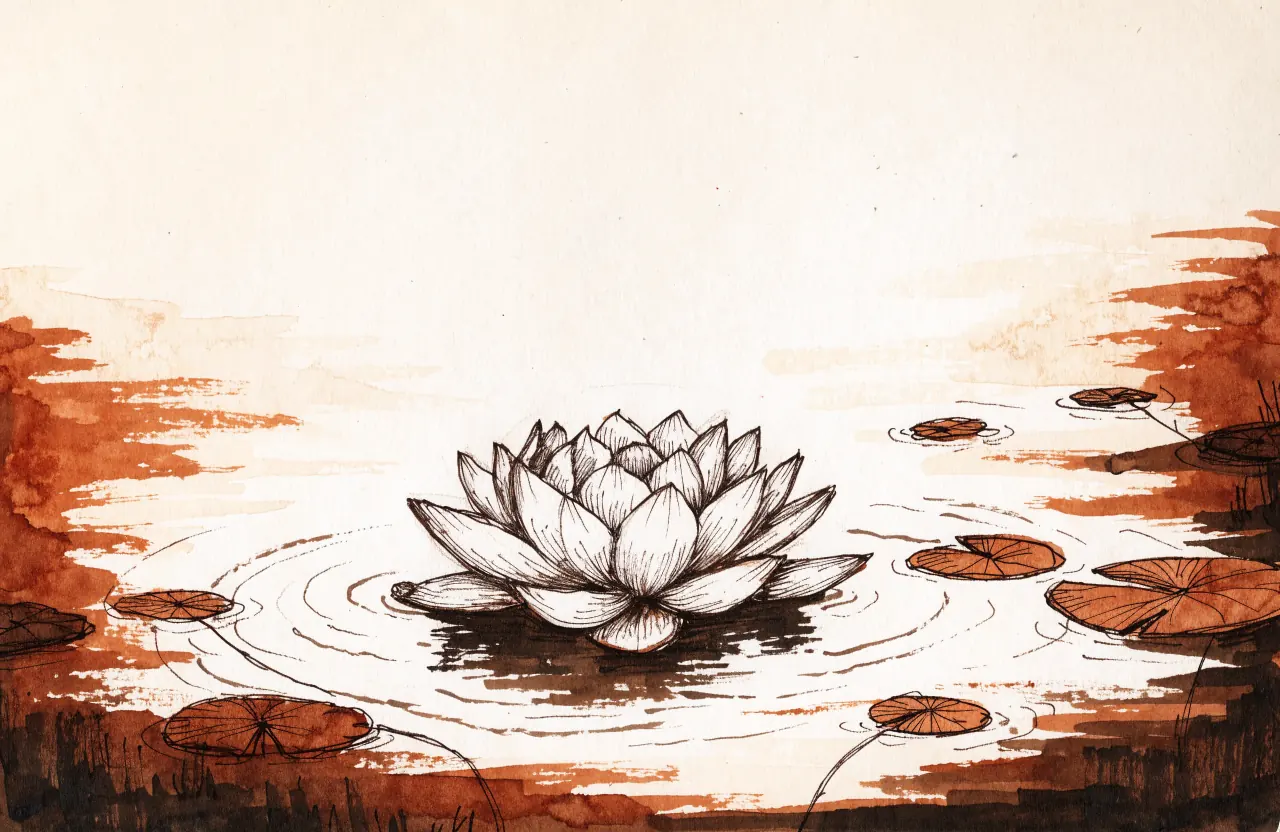
Crown chakra symbol. The classical picture is a large lotus with a thousand petals, white, with the head turned downward, the fifty letters of the Sanskrit alphabet running round it twenty times (fifty times twenty gives the thousand), and inside it the full moon, a triangle and a space called the Great Void. The downward turn is in the verse. The idea that each petal “stands for” something is modern commentary.
What is the crown chakra responsible for?
In Western chakra books, this chakra is responsible for meaning: your sense of purpose, your connection to other people and to something bigger than you, and the feeling of being part of the world instead of watching it. We use that list as the questions in the self-check above, translated into plain daily terms: quiet, meaning and belonging.
The old text does not assign it any area of life. What verse 45 says is that someone who has controlled the mind and knows this place is “never again born in the Wandering”, nothing in the three worlds binds him, and his speech “is ever pure and sweet”. Woodroffe reads promises like these as praise of the practice (stuti-vāda). They describe release at the end of a path, so when a site tells you the crown governs your career or your luck, it is bridging a very big gap.
Blocked crown chakra: signs and what they point to
Lists of blocked crown chakra symptoms usually include feeling disconnected, cynicism, a lack of purpose, apathy, confusion, sensitivity to light and sound, headaches and trouble sleeping. These fall into two kinds.
- Life signs such as feeling that nothing matters, being cut off from people, not seeing the point of your work. They are real and common, and they usually point to something concrete: loneliness, burnout, grief, a life that has outgrown its shape. Start with people and routines. Call a friend or take a walk.
- Body signs such as headaches, migraines, insomnia, dizziness, sensitivity to light. They have causes that no chakra practice can find. Persistent or new ones are a reason to see a doctor.
The idea of a “blocked” crown chakra is not in the 1577 text. It belongs to 20th-century energy healing. If the phrase helps you say “I feel cut off”, fine; then ask what you are cut off from. And if feeling cut off has lasted for weeks, or comes with low mood, hopelessness or numbness, talk to a doctor or therapist rather than reading it as a spiritual sign.
The crown and kundalini
In the text, the crown is where the path of kundalini ends. Verse 52 describes the yogi who, “devoted to the Lotus feet of his Guru”, leads the power together with the individual soul to Para-shiva in the abode of liberation. Verse 53 says she drinks the red nectar there and returns by the same road to the Muladhara, where she began. The movement is up and back. It is not a one-way “ascent” of energy.
The text also says who this is for. Verse 54 says the method is learnt “from the two Lotus Feet” of the initiating guru, after practice of yama and niyama (the ethical rules and disciplines that come first in yoga). The verses describe slow practice, with a teacher, prepared long in advance. The Hatha Yoga Pradipika (chapter 4) says something similar about samadhi: it is very difficult to reach without the favor of a true guru.
So this page contains no exercise for raising kundalini, and we recommend none to beginners. Breath holds, forced postures and long intense sessions are the usual ways people get into trouble, and the next section is about that. Where the idea of kundalini comes from is on our kundalini page, and what people report after a sudden “awakening” is on kundalini awakening.
When it is not awakening: signs that need a doctor or therapist
Intense meditation can be hard. A 2017 PLoS ONE study by Lindahl and colleagues interviewed Western Buddhist meditation practitioners and experts in the Theravāda, Zen and Tibetan traditions about experiences that were challenging, distressing or got in the way of daily life. According to its abstract, the interviews yielded a list of 59 meditation-related experiences across seven areas: cognitive, perceptual, affective, somatic, conative, sense of self and social. The distress and impairment linked to them ranged from minimal and passing to severe and lasting, and the same kind of experience was read very differently by different people.
Two limits to keep in mind. The study is about Buddhist meditation, not chakra or kundalini work, and it looked at difficult experiences on purpose, so it cannot tell you how often they happen. What it does show is that meditation-related difficulty, sometimes severe and lasting, is a documented thing and not something to wave away.
Whatever name you give it, please talk to a doctor or a therapist, and don’t wait for it to “pass as energy”, if you notice any of these:
- headaches or pressure in the head that are new, severe or keep returning;
- very little sleep for several nights in a row;
- the world or your own body feels unreal or far away, and this frightens you;
- panic, dread or shaking that appears after intense practice and does not settle;
- hearing voices, seeing things others do not, or a strong sense of being watched;
- low mood or fear that lasts more than two weeks;
- thoughts of death or of harming yourself.
Stop the practice for now. If you are already under a doctor’s care, don’t change treatment because of a spiritual practice. Make any change together with the doctor.
If things are hard for you right now
If you are in danger or thinking about harming yourself, call your local emergency number (112 in the EU, 911 in the US) or, in the US, call or text 988. Please do not stay alone with it: tell someone close to you.
If the feeling has lasted a long time and gets in the way of life, please talk to a doctor or a therapist. The practices on this site do not replace them.
Crisis lines for the US, Canada, the UK, Ireland, Australia, India and other countries, checked against official sites, are on our page Get help now.
How to open and balance the crown chakra
In everyday language, “opening the crown” mostly means making room for quiet and for other people. In the tradition, the opening of the highest center is the end of a long path. It is no technique. Some things you can do yourself:
- Five minutes of silence. Same time each day, no phone, no music. Sit and listen to the sounds around you.
- Look up. Go outside and look at the sky for two minutes without thinking about it.
- One sentence at night. Write down one thing from today that mattered to someone.
- One person. Talk to someone for ten minutes without looking at a screen. Belonging is not something you can meditate your way into alone.
- Service. An hour of help for someone else, a neighbor or a shelter. It is the most practical form of “connection to something larger”.
- Come back down. If your head feels light or floaty, feel your feet and walk for a few minutes. The tradition climbs from the bottom, through every center, so a head without a ground under it is a signal to slow down.
Crown chakra yoga poses. Teachers usually suggest easy seated poses and rest poses: easy pose (Sukhasana), lotus or half lotus if your knees allow, and corpse pose (Savasana) at the end. Headstand (Sirsasana) is the classic “crown” pose, and we don’t recommend it for beginners: it puts the body’s weight on the neck and is best learned from a teacher. You lose nothing by sitting still instead.
Crown chakra affirmations. Short lines such as “I am part of something larger”, “I make room for quiet” or “I belong here” work best when they describe something you can feel right now. If “I am connected to everything” feels false, try a statement that is accurate: “Right now I am sitting under the sky, and I am breathing.”
Crown chakra stones, mudra and signs of a blockage
Stones. Modern lists of crown chakra stones name clear quartz, amethyst and selenite, white or violet crystals that match the rainbow chart and the white of the old text’s thousand petals. The thousand-petaled lotus has no stone in the 1577 text; crystals and gemstones came into chakra books in the late 20th century. No study shows that any stone acts on a chakra or on the mind. A clear stone in an open palm can be a plain way to hold attention during the practice below.
Mudra. No hand gesture belongs to this center in the old text either. Modern chakra lists differ; the usual choice for the crown chakra is a “thousand-petal” gesture or plain dhyana mudra, hands resting in the lap. Hands at rest suit this center best; the mudras guide tells the older gestures from the newer ones.
Signs of a block. Crown chakra blockage symptoms belong to the same 20th-century energy-healing vocabulary; no scan or test can see a chakra. Ask what has lost its meaning, and let a doctor look at headaches or sleep trouble (see above).
A 5-minute crown chakra meditation
This meditation uses the image from verses 40 and 41, a wide white lotus over the head, whiter than the moon, and a slow out-breath. There is no energy to raise and no breath to hold. Press Start and follow the highlighted step, each lasting a minute. If you prefer, read the steps and use your own timer.
- Minute 1. Sit and settle. Sit on a chair or a cushion with your back supported. Rest your hands in your lap and let your eyes stay open on a quiet spot, or close them. Notice the floor under your feet.
- Minute 2. Let the out-breath be slow. Breathe in through your nose and let the out-breath run a little longer than the in-breath, without holding at either end. Keep it easy, around 5 breaths.
- Minute 3. Notice the space above. Turn your attention to the air just above your head. You are not pulling anything up or sending anything out. You are only noticing that the space is there, and that you are sitting under it.
- Minute 4. Picture the white lotus. Picture a wide white lotus up there, whiter than a full moon, with its petals hanging down like a canopy (verse 40). If a picture does not come, think of a bright, still sky.
- Minute 5. Let the picture go. Drop the image and sit in the quiet it leaves. Thoughts will come. Each time, name it silently as a thought and come back to the breath. Before you stand, feel your feet and look around the room.
If the practice leaves you restless, lightheaded or unsettled, open your eyes, feel your feet and name a few objects in the room. You don’t have to finish. If strong fear, unreality or a headache comes back, stop and read the section “When it is not awakening” above.
Crown chakra vs third eye chakra
The two sit next to each other in every chart, and lists often fold them into one idea of “spirituality”. The text separates them: Ajna is the last of the six, and Sahasrara is above them. The third eye chakra page covers Ajna in detail.
| Third eye chakra (Ajna) | Crown chakra (Sahasrara) | |
|---|---|---|
| Place in the text | Between the eyebrows (v. 32) | Above all the others, in the “vacant space” (v. 40) |
| Petals | 2, white | 1,000, whiter than the full moon |
| Letters and sound | Ha and Kṣa; OM | The alphabet, 20 times round; no seed syllable |
| What is there | The subtle mind (v. 33) | The moon, the triangle and the Great Void (v. 41) |
| Western color | Indigo | Violet or white |
| Western themes | Intuition, clarity, imagination | Meaning, connection, spirituality |
One way to hold the difference: the brow is a point you can look at, and the crown is an open space you can sit under. Both belong to the larger map on the chakras overview.
What comes from the old texts and what was added later
Common claims about the crown are traced below to the earliest source we could find.
| Claim about the crown chakra | Where it comes from |
|---|---|
| Thousand petals, head turned down, white, 50 letters 20 times round | Ṣaṭ-cakra-nirūpaṇa, 1577 (English 1919), v. 40 and the summary of vv. 41–49 |
| Above the six centers, not one of them | The title and v. 40 of the same text |
| Different schools name it differently | Verse 44 |
| Kundalini reaches it and returns | Verses 51–53, only with a guru (v. 54) |
| All colors, mostly violet, white and gold at the center | Leadbeater, clairvoyant description, 1927 |
| Violet | Western color therapists, rainbow order, 1930s on |
| Meaning, spirituality, connection | Western psychology-flavored list, in print with the rainbow from 1977 |
| “Blocked”, “opening symptoms” | 20th-century energy healing; not in the text |
| Chakras above the crown, “soul star” | Recent New Age writing |
| Clear quartz, amethyst, 963 Hz | New Age and solfeggio music, late 20th century |
What this page does not promise. We don’t claim that the crown chakra exists as a body part, that you can awaken it, or that any practice here will bring enlightenment, a sign or a state. The classical text describes a goal at the end of a long, guided road, and we offer five quiet minutes. The self-check does not measure a chakra or your health. Cleveland Clinic describes chakras as a possibly useful metaphor and not something medicine has found. If you have been low, cut off or unwell for weeks, a doctor or a therapist will help more than any chakra page.
How the self-check counts
The self-check looks at three parts of ordinary life that modern books file under the crown. The six questions cover them two each: quiet (questions 1 and 2), meaning (questions 3 and 4), belonging (questions 5 and 6). “Rarely” gives 0 points, “Sometimes” 1 and “Often” 2, so each area scores 0 to 4. The area with the most points is where the result suggests you begin. If areas tie at the top, you see all of them. If no area has more than 1 point, the result says nothing stands out.
We ran the rule on every possible set of answers, all 729 of them, when the page was built. Each area comes out alone on top in 22.4% of answer sets, 29.2% end in a tie between areas, and 3.7% show no area above 1 point. The three areas are built symmetrically, so none is favored. The note under the bars depends on the total: 0–3 points (10.7% of answer sets), 4–8 (78.6%) or 9–12 (10.7%), and the highest band suggests talking to a professional if it has lasted.
The questions ask what happened, not what you believe about yourself, because people tend to answer the second kind with who they would like to be. Nothing is sent anywhere. Close the page and the answers are gone.
Frequently asked questions
What is the crown chakra? A short definition
The crown chakra (Sahasrara, “thousand-spoked”) is the lotus of a thousand petals that tantric yoga places at or just above the top of the head. In the 1577 text it sits above the six chakras and is where kundalini is meant to arrive; Western books count it as the seventh chakra and tie it to meaning and spirituality.
What is the function of the crown chakra?
In the 1577 text, the thousand-petaled lotus is the end of the path: the place where the practitioner is said to reach the highest reality, which Shaivas, Vaishnavas and devotees of the Goddess each name differently (v. 44). In modern books it stands for meaning, connection and a sense of belonging to something larger than yourself. Both are ideas to hold lightly. No bodily function has been tied to it.
What is the chakra above the crown chakra called?
The 1577 text has none. It counts six centers and puts the thousand-petaled lotus above them. A few modern teachers add “transpersonal” points above the head with names such as “soul star”. Those come from recent New Age writing and are not part of the classical system.
What are the signs that your crown chakra is opening?
Sites list tingling at the top of the head, pressure, a feeling of peace, vivid dreams or unity. The text lists no signs of opening. It describes an image, a lotus with white petals and red filaments, and a state of liberation, and it ties that state to long practice with a teacher. Pressure or tingling at the scalp usually comes from attention and tension. Headaches, sleeplessness or feeling unreal call for a doctor, not for more practice (see the section “When it is not awakening”).
Which crystals are for the crown chakra?
Modern lists name clear quartz, amethyst and selenite. Crystals do not appear in the classical description; they come from late 20th-century New Age practice. A smooth stone in the hand can be a plain way to hold your attention during the practice above.
Is 963 Hz the crown chakra frequency?
We found no traditional source that links 963 Hz, or any frequency, to a chakra. The number comes from modern “solfeggio frequency” music. If you like the sound, enjoy it as music, and know it is a recent pairing.
Which mudra is for the crown chakra?
There is none in the 1577 text. Modern teachers often suggest a “lotus” gesture, hands together in front of the chest with fingers spread like petals, or hands resting in the lap. Pick whatever lets your shoulders drop and your hands be still.
Which planet is the crown chakra on?
None, in the text. Planets were attached to chakras in modern writing, and the lists disagree with each other, so we don’t give one. The text’s own image for this center is the full moon (v. 41).
What trauma is stored in the crown chakra?
No tradition we know of and no study shows that a chakra stores trauma. Feeling cut off, numb or unreal is a real experience and can follow stress or trauma. If it keeps returning, talk to a trauma-informed therapist or your doctor; a meditation on the crown will not stand in for that.
How do I activate the crown chakra?
In the tradition, rousing the highest center is the work of kundalini practice learnt from a teacher over years (vv. 51–54), and we give no exercise for it. In everyday language “activating the crown” can mean setting aside quiet time, which is what the practice on this page does. There is nothing to force, push up or hold.
Sources (16)
- Arthur Avalon (John Woodroffe). The Serpent Power: being the Ṣaṭ-cakra-nirūpaṇa and Pādukā-pañcaka (scan of the 4th edition)
- Ṣaṭ-cakra-nirūpaṇa, verse 40 (the lotus of a thousand petals, “above all these”), Avalon’s translation
- Ṣaṭ-cakra-nirūpaṇa, verse 41 (the full moon, the triangle, the Great Void)
- Ṣaṭ-cakra-nirūpaṇa, summary of verses 41–49 (fifty letters going round twenty times, the pericarp)
- Ṣaṭ-cakra-nirūpaṇa, verse 44 (what Shaivas, Vaishnavas and devotees of the Devi call this place)
- Ṣaṭ-cakra-nirūpaṇa, verse 45 (what knowing this place is said to give)
- Ṣaṭ-cakra-nirūpaṇa, verse 52 (leading Kundalini to Para-shiva, with a guru)
- Ṣaṭ-cakra-nirūpaṇa, verse 53 (Kundalini returns to the Muladhara)
- Ṣaṭ-cakra-nirūpaṇa, verse 54 (the method is learnt from the guru after yama and niyama)
- Hatha Yoga Pradipika, chapter 4 (samadhi is hard to reach without a true guru)
- C. W. Leadbeater. The Chakras: a monograph
- K. Leland. The Rainbow Body: How the Western Chakra System Came to Be. Quest 105(2): 25–29
- J. R. Lindahl et al. The varieties of contemplative experience: a mixed-methods study of meditation-related challenges in Western Buddhists. PLoS ONE 12(5): e0176239
- The 7 Chakras: What They Mean and How To Use Them
- Crystal healing: the 2001 test with real and fake quartz by C. French and colleagues (Goldsmiths, University of London), as reported
- Mudras & Mantras to Balance & Awaken Your Chakras (an example of a modern chakra-mudra list)