Flower of Life: Meaning, Origin and How to Draw It
The Flower of Life is a pattern of 19 equal circles that overlap so each passes through its neighbours’ centres. You can draw it with a compass alone. The pattern is at least 2,600 years old; the name “Flower of Life” and its spiritual meaning come from New Age teaching of the 1980s.
Build it circle by circle
Each new circle is centred where earlier ones cross, exactly as with a compass.
Seven circles: the figure now called the Seed of Life. The six outer centres make a regular hexagon, because its side equals the radius (Euclid IV.15).
The Flower of Life in one line
| What it is | 19 equal circles on a hexagonal grid; each circle passes through the centres of its neighbours |
|---|---|
| How it is made | With a compass only: every new centre is a point where two earlier circles cross |
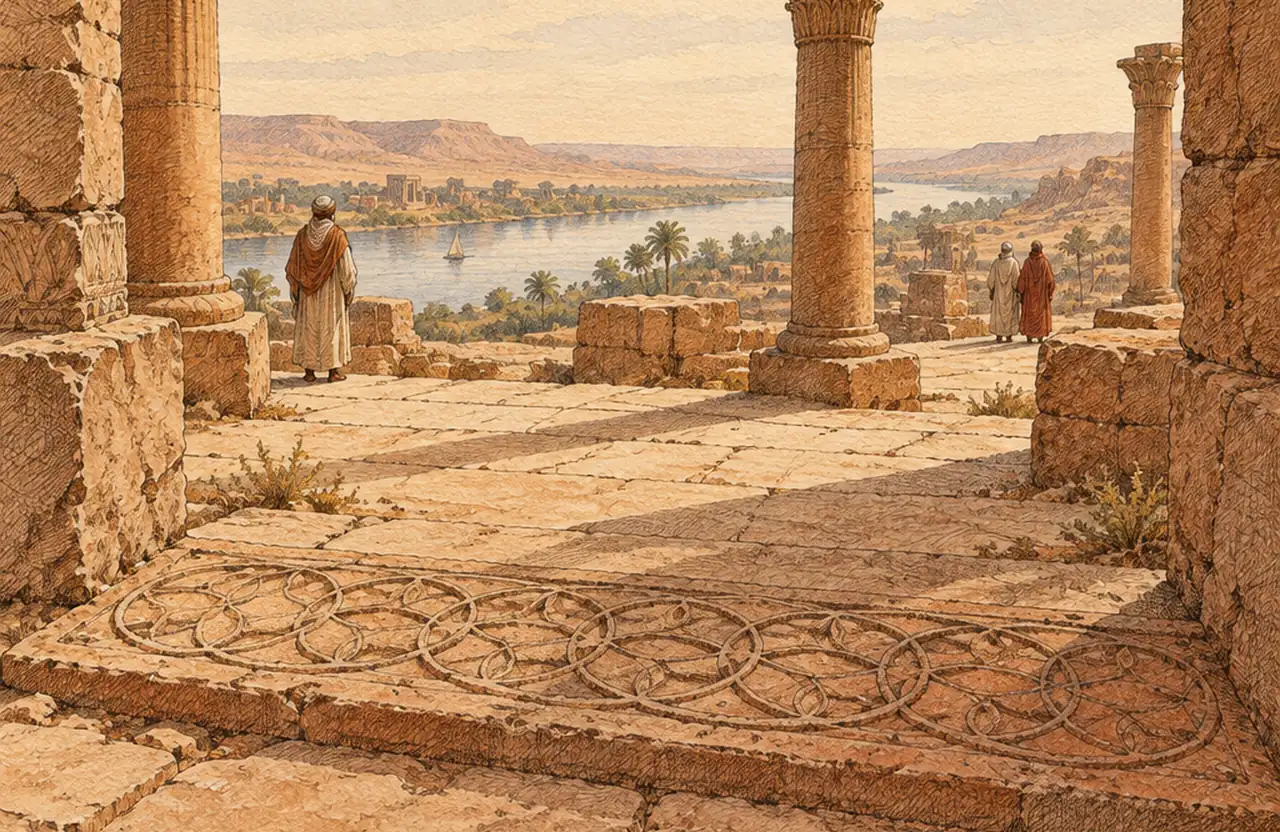
| Oldest dated example | A stone door-sill from Ashurbanipal’s palace at Nineveh, 645–640 BCE |
| The name | Modern; spread by Drunvalo Melchizedek’s workshops from 1985 and his book of 1999 |
The pattern is old and the name is new. Much of what is written about the Flower of Life online gives the old pattern’s age to the new name and the new meaning.
What the Flower of Life means
- In New Age teaching, the source of today’s meaning, it is a picture of creation. Drunvalo Melchizedek wrote that the ancients “called the Flower of Life” a flame that seven giants placed “into the womb of the Earth”, and that the pattern holds every shape in the universe. He gives no ancient text that uses the name.
- In jewelry and tattoo shops it means unity, harmony or “the oneness of all life”. These are modern readings, usually listed without a source.
- In old objects the pattern meant what decoration means: a stone copy of a woven carpet at Nineveh, a floor mosaic in Herod’s palace, a flower carved into church stone as a protective mark.
None of these is wrong as a personal meaning. But no source older than the 1980s says the pattern is a code of creation.
How people use the Flower of Life
- As jewelry and tattoos. The most common use by far. People pick their own meaning. Unity is the usual one. Nothing in the pattern requires it.
- As something to draw. You need a compass and ten to twenty minutes. It holds attention well. Some use it the way others use a mandala or a colouring book. The builder above is a quick version.
- As a focus for meditation. Resting the eyes on a symmetric pattern is an old way to steady attention. Any simple figure works. We know of no study of this one.
- Under water bottles and crystals, “to charge” them. This is a shop claim. We found no test that shows a change.
How to draw the Flower of Life
You need a compass and a pencil. The tool above does the same steps one circle at a time.
- One circle. Put the compass point anywhere and draw.
- The second circle. Put the point anywhere on the first circle and draw another of the same size. Each now passes through the other’s centre. The almond shape between them is the vesica piscis, and this step is the very first construction in Euclid’s Elements (I.1).
- Keep going around. Put the point where the two circles cross and draw again. Repeat around the first circle. After six circles around the middle one you are back where you started, because the side of a hexagon equals its radius (Euclid IV.15). That is the 7-circle Seed of Life.
- The second ring. The outer crossing points now give twelve new centres. Draw a circle on each: 19 in all.
- The outer circle. Most drawings add one larger circle around the whole figure, with a radius three times the small one, and cut off the arcs that stick out.
People also ask how to draw it without a compass. You can trace a round lid or use a printed grid of dots in a triangle pattern, but the figure is only exact if every circle has the same radius. That is easiest with a compass or on a screen.
The counts 1, 7 and 19 are the first “centred hexagonal numbers”: a dot, then one ring of 6, then a ring of 12. The next ring would give 37.
Where the Flower of Life really appears
The same figure turns up in many places because anyone with a compass can make it. Here is what we could date:
| Where | Date | What it is |
|---|---|---|
| Nineveh, North Palace of Ashurbanipal (British Museum; Louvre AO 19915) | 645–640 BCE | Stone door-sills carved with “a field of interlocking circles, drawn with a compass, giving the effect of flowers with six petals”. The British Museum calls them imitation carpets. |
| Herod’s palace, Judea | 1st century BCE | Seven overlapping circles in a bath-house mosaic; common in Roman floors |
| Abydos, Egypt (the Osireion) | Disputed, probably Greek or Roman era or later | Small figures high on granite pillars, next to Greek letters (see below) |
| Leonardo da Vinci, Codex Atlanticus f. 307v | Between 1478 and 1519 | Pages of circle-and-arc patterns; the library calls the sheet part of a “ludo geometrico”, a geometric game of “stars and roses” |
| English churches and houses | Medieval to 19th century | Six-petal “daisy wheels” scratched into stone and wood; “several thousand” recorded in Norfolk alone |
| Forbidden City, Beijing | Qianlong era, about 1740–1800 | Patterned balls under bronze guardian lions. Often dated to 1420, but the lions are later (Katz and Jin, 2016) |
Leonardo did draw many circle patterns, but nothing in his notes calls one a flower of life or gives it a spiritual meaning. The name on the Wikimedia copy of f. 307v was added by its modern editors.
Abydos: what the drawings really are
The Abydos figures are the reason for the most repeated claim about the Flower of Life: that it is 6,000 years old, or older. Melchizedek wrote of “a temple that’s almost 6000 years old” and called the figures a “wall carving”. Here is what the people who have looked closely report:
- Where they are. On granite pillars in the Osireion, the sunken hall behind the temple of Seti I. The figures sit about 4 metres up, roughly 15 cm across.
- What is next to them. Greek letters. David Furlong, who studied them on site, read the words “Theos Nilos”, God of the Nile, and the letters “IXCX” near the top of one pillar. The designer Malcolm Stewart, writing on Furlong’s site, noted: “Greek writing certainly did not exist 6000 years ago.”
- How they got so high. The hall was filled with sand for long periods, and Murray’s 1904 excavation report says it was “filled up again in Roman times”. Someone standing on the fill could reach the top of the pillars.
- The date. Estimates run from the Greek period after Alexander to the 5th or 6th century CE. No pigment test or peer-reviewed study has dated them, and we found no source that links them to Seti I, let alone to 4000 BCE.
You will also read that the figures are drawn in red ochre. Furlong calls them “inscribed” and Stewart “wall engraving”; we found no test of the pigment, so we leave that open.
Who named it the Flower of Life
The name became widespread through one teacher, Drunvalo Melchizedek. He opened his first “Flower of Life” class to the public in the spring of 1985, sold the workshop on video from 1992 (by his count about 100,000 sets by 1993) and published it as The Ancient Secret of the Flower of Life, volume 1 in 1999 and volume 2 in 2000. The publisher’s web page says 1990, but the book itself mentions events of 1997. MathWorld and Wikipedia both describe the name as modern.
Melchizedek says the image came to him through Thoth, the Egyptian god, who “told me that I would find this image of the Flower of Life in Egypt.” In a 2011 court case over copies of his work, he stated that he claimed no exclusive rights to the phrases “Fruit of Life”, “Seed of Life”, “Egg of Life” or “Metatron’s Cube”, so those names were in his teaching by then. We found no use of the name “Flower of Life” for this pattern before the 1980s, though that does not prove there was none.
The actor Terrence Howard has talked about the figure too. In a 2024 interview with Joe Rogan he said it shows that parts of ordinary geometry are wrong, and he has said he could “open the flower of life properly”. None of this has been published for review by mathematicians.
Seed of Life, Egg of Life and Fruit of Life
These are stages or parts of the same grid, all named in Melchizedek’s books.
- Seed of Life: the first 7 circles, one in the middle and six around it. As a single six-petal flower inside a circle it is the old “daisy wheel” or hexafoil.
- Egg of Life: in Melchizedek’s second volume, eight spheres arranged in the shape of a star tetrahedron, a three-dimensional figure; see our page on the merkaba.
- Fruit of Life: 13 circles that touch without overlapping, taken from a larger version of the grid. Join their centres with straight lines and you get Metatron’s Cube.
Is the Flower of Life biblical, Christian or demonic?
The phrase is not in the Bible: a search of the King James and the NRSVUE finds nothing. The pattern, though, is all over Christian buildings. In medieval English churches compass-drawn flowers are “by far the most common single motif” among the scratched graffiti, and the Norfolk survey had recorded several thousand. Most historians read them as protective marks, and the National Trust adds that, despite the popular name “witch marks”, they have “very little to do with witches”.
People who ask whether it is demonic are usually asking about the New Age teaching that came with the name. That is a fair question for your own church, and we don’t speak for any. The circles themselves are what a compass draws.
Some also ask whether it is Jewish or a mandala. It is neither in origin: no Jewish text uses the figure, and a mandala is a specific Hindu or Buddhist diagram. It is a fractal only in a loose sense, since the grid repeats but does not shrink into smaller copies of itself.
What this page does not promise. We don’t say the Flower of Life heals, protects, raises vibration or holds energy, and we don’t suggest wearing, drawing or meditating on it for any effect. Drawing it slowly can be pleasant and absorbing, as any careful handwork can be.
How the builder works
All 19 circles are drawn at radius 1 in the order a compass would draw them: the centre, the six of the first ring, then the twelve of the second. Before the page is built, a check confirms that every new circle is centred on a point of an earlier circle, that there are no duplicates and that the centres fall on rings of radius 0, 1, √3 and 2. If any of that failed, the page would not build. The captions at 2, 7 and 19 circles quote Euclid’s construction and the modern names.
Frequently asked questions
What does the Flower of Life symbolize?
Today: creation and unity, a meaning from the 1980s. Older makers used it as decoration. More: What it means ↑
How old is the Flower of Life?
At least 2,600 years: a door-sill from Nineveh, 645–640 BCE. More: Where it really appears ↑
Is the Flower of Life in the Bible?
No. The phrase is not in the KJV or NRSVUE, though the pattern is carved in many churches. More: Is it biblical or demonic? ↑
Is the Flower of Life demonic?
The pattern is plain geometry. Objections are usually to the New Age teaching around it. More: Is it biblical or demonic? ↑
How do you draw the Flower of Life?
One circle, then keep putting the compass point where circles cross. 7 = Seed, 19 = Flower. More: How to draw it ↑
What is the difference between the Seed of Life and the Flower of Life?
Seed = 7 circles; Flower = 19. Both names are modern. More: Seed, Egg and Fruit of Life ↑
What did Terrence Howard say about the Flower of Life?
He claims it overturns standard math; nothing has been peer-reviewed. More: Who named it ↑
Sources (17)
- E. W. Weisstein, “Flower of Life” and “Overlapping Circles Grid”
- Euclid, Elements I.1 (the first construction), ed. D. E. Joyce
- Euclid, Elements IV.15 and corollary: the side of the hexagon equals the radius, ed. D. E. Joyce
- Door-sill from the North Palace of Ashurbanipal, Nineveh, 645–640 BCE (1856,0909.44)
- Seuil de porte, Kouyoundjik (Nineveh), North Palace, room I (AO 19915)
- M. A. Murray, The Osireion at Abydos (Egyptian Research Account, 9th year), with a preface by W. M. F. Petrie
- D. Furlong, “The Osirion and the Flower of Life” (updated 2008)
- M. Stewart, “The ‘Flower of Life’ and the Osirion: Facts are more interesting than Fantasy”
- Codex Atlanticus, f. 307 verso: “ludo geometrico”, caption in the masterpieces page
- Norfolk Medieval Graffiti Survey, Volunteer Handbook, p. 10 (compass-drawn designs)
- “Warding off evil with witch marks”
- M. Kennedy, “Witches’ marks: public asked to seek ancient scratchings in buildings”, The Guardian, 31 October
- E. A. Katz, B.-Y. Jin, “Fullerenes, Polyhedra, and Chinese Guardian Lions”, The Mathematical Intelligencer 38(3): 61–68
- Drunvalo Melchizedek, The Ancient Secret of the Flower of Life, vol. 1 (Light Technology), catalogue record
- Melchizedek v. Holt, 792 F. Supp. 2d 1042 (D. Ariz. 2011)
- “Terrence Howard Claims He Can ‘Kill Gravity’ in Off-the-Charts Joe Rogan Chat”
- Bible Gateway search for “flower of life” in the KJV and NRSVUE (no results, checked 23 October 2026)