Merkaba Meaning: The Chariot, the Star and Where They Part
Merkaba means two different things. Merkavah, or merkabah, is Hebrew for “chariot”: the throne-chariot of God in Ezekiel’s vision and the subject of an ancient Jewish mystical tradition. The merkaba of New Age teaching is a star tetrahedron, two pyramids through each other, named in the 1980s. No old text joins the two.
Turn the star tetrahedron
Drag the shape, or focus it and use the arrow keys. One tetrahedron points up, the other down.
Arrow keys turn it by 15°.
Two tetrahedra pushed through each other: eight corners, twelve edges. Kepler called this shape the stella octangula, the “eight-pointed star”.
Two words, two meanings
| Merkavah (Jewish) | Merkaba (New Age) | |
|---|---|---|
| What it is | God’s throne-chariot in Ezekiel’s vision | A star tetrahedron, said to be a body of light |
| Language | Hebrew מרכבה, from the root r-k-b, “to ride” | Said to be Egyptian: “Mer-Ka-Ba” |
| Oldest text | 1 Chronicles 28:18; Ben Sira 49:8, about 180 BCE | Drunvalo Melchizedek’s workshops from 1985; book 1999 |
| Shape | Living creatures, wheels, a throne; no geometry | Two tetrahedra through each other |
| Practice | Study and mystical ascent texts, restricted to the learned | A 17-breath meditation said to “activate” it |
| Purpose | To see the glory of God | Healing, protection, “ascension” |
Searches for “merkaba” and “merkabah” run at about the same volume, and most pages mix the two. The New Age meaning borrowed the Hebrew word, gave it an Egyptian origin and attached it to a shape the Hebrew sources never describe.
Ezekiel’s vision: what the text describes
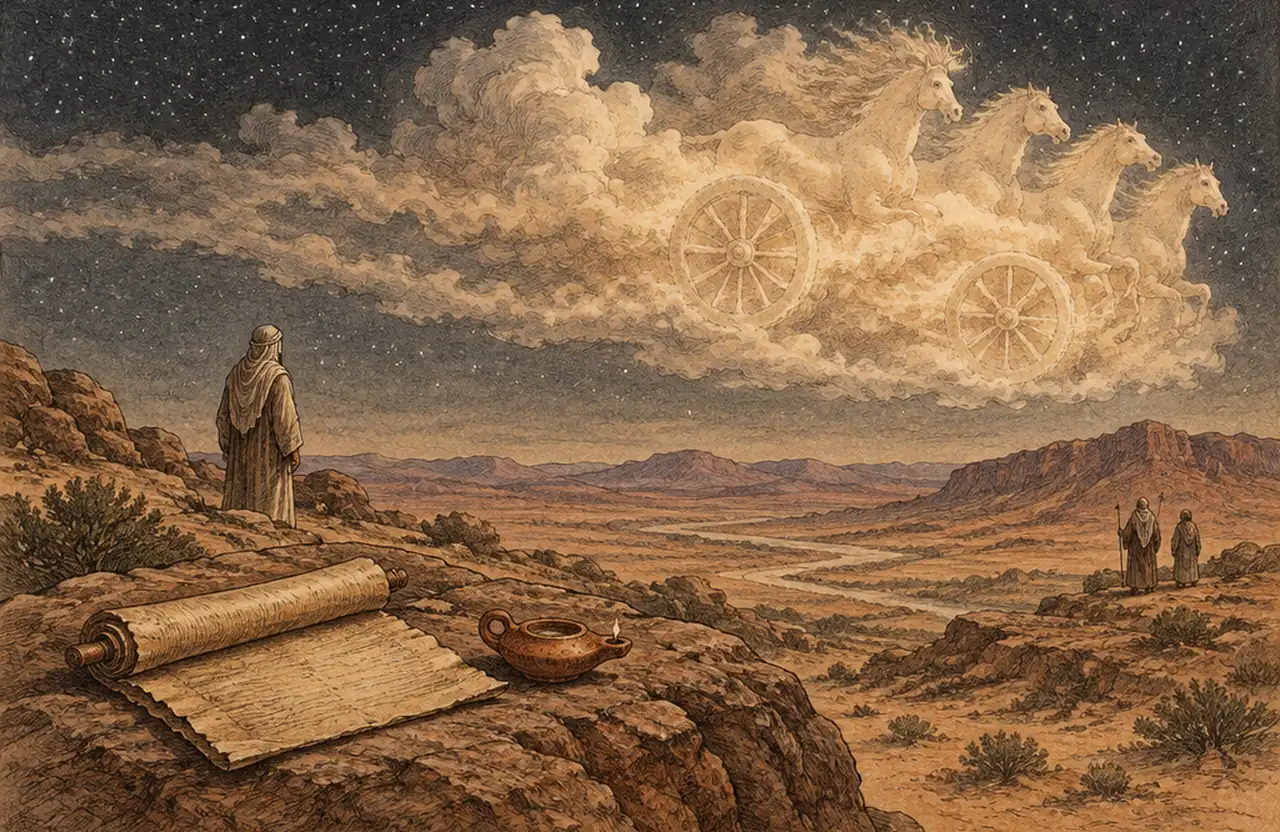
The first chapter of Ezekiel, set among the exiles in Babylonia in the 6th century BCE, is one of the strangest passages in the Bible. The prophet sees “a stormy wind came out of the north, a great cloud, with a fire flashing up” (1:4). Inside are four living creatures, each with four faces: “the face of a man… a lion on the right side… an ox on the left side… also the face of an eagle” (1:10). Beside them are wheels, “as it were a wheel within a wheel” (1:16), and “the spirit of the living creature was in the wheels” (1:20).
Above it all is “the likeness of a throne, as the appearance of a sapphire stone; and upon the likeness of the throne was a likeness as the appearance of a man” (1:26), surrounded by a brightness like a rainbow: “This was the appearance of the likeness of the glory of the LORD” (1:28). In chapter 10 the creatures are named cherubim.
That is the whole “chariot”: creatures, wheels, a throne and a figure of light. There are no triangles, pyramids or tetrahedra in it.
Where the word merkavah comes from
Ezekiel himself never calls the vision a chariot. We went through all 48 chapters of the Hebrew text, 1,273 verses: the word מרכבה does not appear. The root r-k-b shows up only for ordinary chariots and riders of Tyre, Egypt and Gog, never in chapters 1 or 10. The Encyclopaedia Judaica says the same: the term “does not appear in Ezekiel”.
The word does appear in 1 Chronicles 28:18, where King David gives gold “for the pattern of the chariot, even the cherubim” over the Ark. The first text to link it to Ezekiel is Ben Sira, around 180 BCE: “It was Ezekiel who saw the vision of glory, which God showed him above the chariot of the cherubim” (Sirach 49:8). The scholar David Halperin notes that “we do not know what Ben Sira meant” by the Hebrew phrase, and that his own grandson, who translated him into Greek, “evidently did not know either”.
Merkavah mysticism in the Mishnah and Talmud
By the time of the Mishnah, around 200 CE, “the work of the chariot” (ma’aseh merkavah) was a recognized subject, and a guarded one. The Mishnah rules that it may not be expounded “in the presence of one, unless he is a sage and understands of his own knowledge” (Chagigah 2:1). The rule covered who could be taught the subject and how.
The Talmud tells stories to show why. A child reading Ezekiel at his teacher’s house understood the word hashmal (“electrum”) and “fire came out and consumed him” (Chagigah 13a). When Rabbi Elazar ben Arakh expounded the chariot before his teacher, fire surrounded the trees and an angel said, “This is the very Design of the Divine Chariot” (14b). The same page tells of four sages who “entered the orchard”: one died, one was harmed, one turned away from the faith, and only Rabbi Akiva “came out safely”.
Later came the Hekhalot (“palaces”) texts, in which the mystic passes through seven heavenly palaces to the throne, with fasting, divine names and hymns. Their practitioners are called yordei merkavah, “those who go down to the chariot”. Gershom Scholem dated these texts to the early centuries CE; most scholars today place their formation in Byzantine Palestine and Babylonia, about 500–900 CE. None of them describes a geometric figure.
The New Age Mer-Ka-Ba
The star-tetrahedron merkaba comes from Drunvalo Melchizedek, who began teaching “the meditation of the Mer-Ka-Ba” in 1985 and put it in print in The Ancient Secret of the Flower of Life (1999–2000). In his account the merkaba is a “counter-rotating field of light that affects spirit and body simultaneously”, two tetrahedra around the body that spin in opposite directions once “activated” by a sequence of 17 breaths with hand positions.
Shops and wellness sites have since added more. Pages that rank for “merkaba” say it opens the pineal gland, cleanses the chakras, protects against negative energy or even eases depression and helps with weight loss. We found no source for any of these beyond the sellers themselves.
Is the merkaba Egyptian? Mer, Ka and Ba
Melchizedek wrote that “Mer-Ka-Ba is made up of three smaller words, Mer, Ka and Ba, which, as we are using them, came from ancient Egyptian.” The common shorthand is “Mer means light, Ka spirit, Ba body”. The words exist, but not with those meanings:
- mr in Faulkner’s standard dictionary of Middle Egyptian means “pyramid”, “canal”, “to be ill”, “to bind” or “fighting bull”. We found no entry meaning light.
- ka is a person’s life force, the part that receives offerings after death. It is not the spirit as opposed to the body.
- ba is closer to the personality, often drawn as a bird with a human head. The physical body is a different word, khet.
The Hebrew word merkavah was in use more than two thousand years before the Egyptian reading appeared, and needs no Egyptian roots to explain it.
The shape: what a star tetrahedron is
The geometry is real, and you can turn it in the model above. A star tetrahedron is two tetrahedra, three-sided pyramids, pushed through each other so that one points up and the other down. Three things follow, all checked in the model:
- Its eight points are the eight corners of a cube, and each of its twelve edges runs diagonally across a face of that cube.
- The space the two tetrahedra share is an octahedron.
- Looked at straight down the cube’s diagonal, it becomes a flat six-pointed star.
The shape was drawn for Luca Pacioli’s De divina proportione of 1509, illustrated by Leonardo da Vinci, as an octahedron with a small pyramid on each face. Johannes Kepler, in the early 1600s, gave it the name it has in mathematics, stella octangula, “eight-pointed star”. Sources disagree on whether he first used the name in 1611 or 1619. Neither of them connected it with a chariot.
Merkaba and the Star of David
The flat view in the model shows why people link the merkaba with the Star of David. But the history of the six-pointed star runs separately. The historian Gershom Scholem, the founder of the academic study of Jewish mysticism, wrote in 1949 that “the six-pointed star is not a Jewish symbol” in origin. It was used by many peoples as decoration and as a magical sign, entered Jewish use as a protective amulet, and became the accepted emblem only from 17th-century Prague onward. Scholem’s history of the star does not mention the merkavah at all.
How people use the merkaba shape
Most people meet the star tetrahedron as a pendant, a crystal carving or a tattoo, worn for protection or as a sign of ascension. Others build one from paper or sticks, which is the clearest way to see that the two tetrahedra outline a cube. The third use is the guided meditation below. None of these needs the Hebrew word, and none of them comes from the Jewish texts.
Merkaba meditation: what we can and can’t say
The merkaba meditation is a long guided visualization with controlled breathing. We can’t tell you it activates anything, because no study has tested it and the claims behind it rest on one teacher’s account. Slow, paced breathing and focused attention calm many people, and that effect does not depend on the tetrahedra. If you want that part, plain breath meditation does the same without the claims; our page on meditation for spiritual awakening compares the main kinds.
If you are drawn to the Jewish tradition instead, it is a matter of study, usually with a teacher: Ezekiel 1, the second chapter of Mishnah Chagigah and the Talmud pages around it are the place to start.
What this page does not promise. We don’t say the merkaba heals, protects, opens the pineal gland or lifts depression, and we don’t teach the activation. The model shows geometry. If you are struggling with depression, please talk to a doctor or see our help page.
How the model works
The two tetrahedra are built from alternate corners of a cube and drawn in flat projection, so lines don’t shrink with distance. Dragging, the arrow keys (15° per press) or the spin button turn it; “Flat view” looks straight down the cube’s diagonal. Before the page is built, a check confirms the claims in the captions: the two solids have four corners and six edges each, the octahedron’s corners sit at the crossing points of the edges, and the flat view puts six corners on one ring with two in the centre. The starting view is drawn into the page, so it shows even without JavaScript.
Frequently asked questions
What does merkaba mean?
Hebrew “chariot”: the throne-chariot of Ezekiel’s vision. The star-tetrahedron meaning is from the 1980s. More: Two words, two meanings ↑
Is the merkaba Jewish?
The word and the chariot tradition are Jewish. The star-tetrahedron shape is not. More: Where the word merkavah comes from ↑
Is the merkaba in the Bible?
Not in Ezekiel. The word is in 1 Chronicles 28:18 and Sirach 49:8; the shape is nowhere. More: Where the word merkavah comes from ↑
Is the merkaba Egyptian?
No. In Egyptian, mr means pyramid or canal, and ba is not the body. More: Is it Egyptian? ↑
Is the merkaba the same as the Star of David?
Same outline from one angle; no historical link. The star became a Jewish symbol in the 17th century. More: Merkaba and the Star of David ↑
What is a merkaba used for?
A New Age breathing meditation; in Judaism, a subject of mystical study. More: Merkaba meditation ↑
Is the merkaba demonic?
The shape is plain geometry; objections are to the New Age teaching. More: The New Age Mer-Ka-Ba ↑
Sources (15)
- Ezekiel 1 and 10, The Holy Scriptures: A New Translation (JPS 1917), with Hebrew text
- I Chronicles 28:18 (JPS 1917), with Hebrew text
- Sirach 49:8 (NRSVCE)
- Mishnah Chagigah 2:1, trans. J. Kulp (Mishnah Yomit), with Hebrew text
- Babylonian Talmud, Chagigah 13a–14b, William Davidson Edition
- G. Scholem, “Merkabah Mysticism or Ma’aseh Merkavah”, Encyclopaedia Judaica
- K. Kohler, L. Ginzberg, “Merkabah”, Jewish Encyclopedia, vol. 8
- D. J. Halperin, The Faces of the Chariot: Early Jewish Responses to Ezekiel’s Vision (Mohr Siebeck), ch. II
- Hekhalot Literature in Context (publisher’s description)
- G. Scholem, “The Curious History of the Six-Pointed Star”, Commentary 8(3): 243–251
- Drunvalo Melchizedek, The Ancient Secret of the Flower of Life, vol. 1 (Light Technology), catalogue record
- Wiktionary, Egyptian “mr”, citing R. O. Faulkner, A Concise Dictionary of Middle Egyptian (Griffith Institute, 1962), pp. 110–112
- Ancient Egyptian concept of the soul (ka, ba, khet)
- E. W. Weisstein, “Stella Octangula”
- R. Roelofs, “Elevation Stellation” (on Pacioli’s octaedron elevatum, 1509)