Metatron’s Cube: Meaning, the 13 Circles and the Platonic Solids
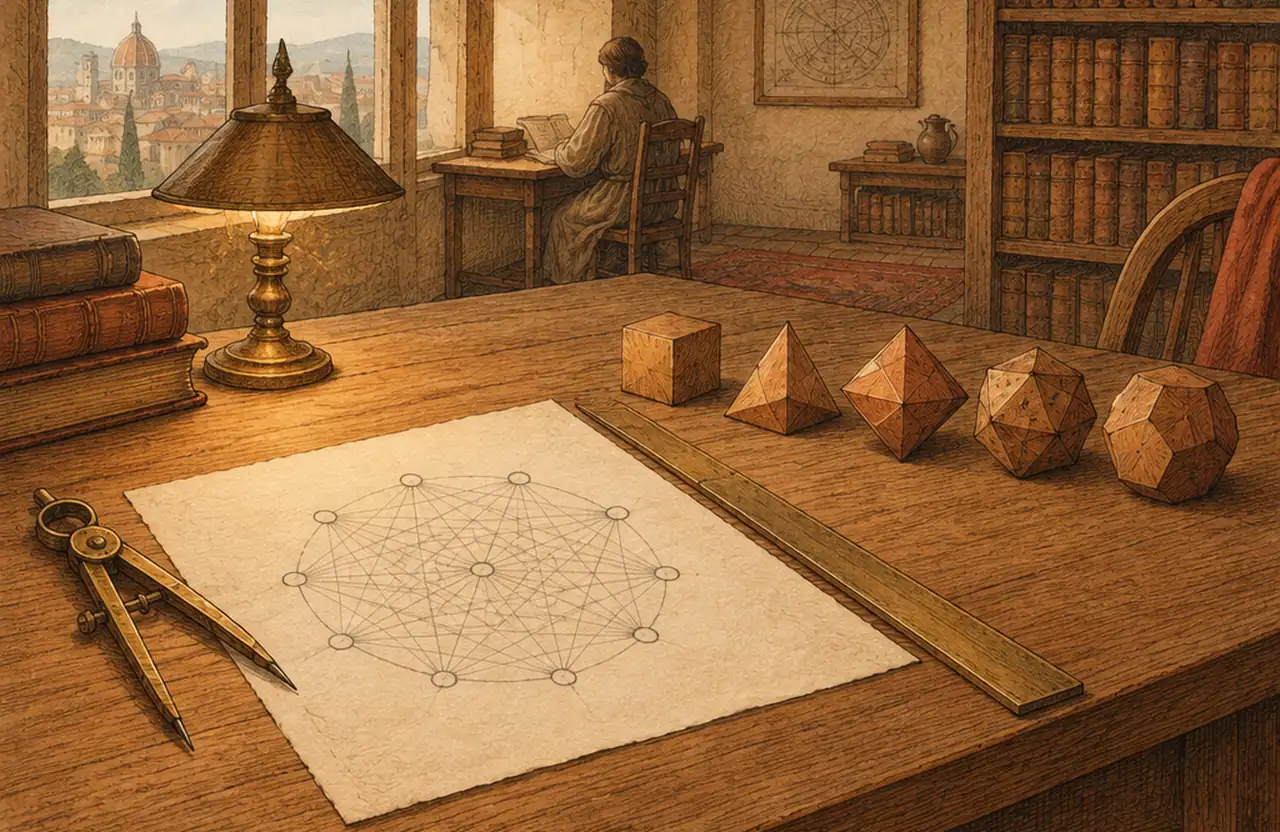
Metatron’s Cube is a flat figure of 13 points, the centres of 13 circles, with every point joined to every other: 78 straight segments. It is said to hold all five Platonic solids. We checked: three fit exactly and two cannot. The name comes from a Jewish angel; the figure is from the 1990s.
Which solids are really in it?
Pick a solid. Its corners are drawn on the 13 centres; a hollow dot means no centre is there.
Cube. Fits. Seen down its diagonal, a cube is a hexagon with two corners stacked in the middle.
Faint lines: all 78 segments between the 13 centres. They lie on 39 different straight lines.
Metatron’s Cube in one line
| What it is | 13 points (a centre and two rings of six) with every pair joined: 78 segments on 39 distinct lines |
|---|---|
| Where the points come from | The centres of the “Fruit of Life”, 13 touching circles from a larger Flower of Life grid |
| The famous claim | All five Platonic solids are inside. Three are; two cannot be |
| The name | From the angel Metatron of Jewish texts; the earliest source for the figure we could check is from 1999 |
It is a drawing on a flat page, not a cube. “Metatron” comes from the angel; “cube” from the way some of its lines look like a cube drawn in perspective.
What Metatron’s Cube means
In New Age writing it stands for the structure of creation: since it is said to contain every Platonic solid, it is taken to contain the building blocks of everything. It is also sold as a protective symbol, a tool to “balance energy” or a way to call on the archangel Metatron. Shops that rank for the name list benefits such as protection “against negative energy”.
Those meanings rest on that claim, which we test below, and on a link to an angel that the old texts never make. The drawing itself follows from one rule, “join every pair”. Three of the solids sit inside it exactly, and the other two cannot.
What religion is Metatron’s Cube?
None. The angel belongs to Jewish tradition, and later to Kabbalah. The figure does not: we read the Talmud passages, the Targum and the chapters of 3 Enoch that deal with Metatron (quoted below), and there is no drawing, no cube and no 13 circles in them. We did not read all of Kabbalistic literature, so this is “not found”, not proof. But nobody who claims an old source for the figure names a manuscript we could check.
If you are asking because you are Jewish or Christian and unsure about using it: the figure is modern geometry with a borrowed name. Whether to use it is a question for your own tradition.
How people use Metatron’s Cube
- As a pendant, print or tattoo, often chosen for protection, after the angel’s role as a guardian in later legend. That is a personal meaning, not one from the Talmud or Enoch.
- As a figure to draw or study. Joining 13 points with 78 lines is a good exercise in patience, and it is the quickest way to see for yourself which solids really fit (the tool above does it).
- As a focus for meditation or a “grid” for crystals. These practices come from the 1990s on. Steady attention on a pattern can calm, as any simple figure can; the claims about energy have not been tested.
How Metatron’s Cube is built: 13 circles, 78 lines
Start from the Flower of Life grid and extend it. Pick the central circle, the six circles two steps out along each of the six directions, and six more four steps out. These 13 circles touch without overlapping: this selection is what New Age books call the Fruit of Life. Note that it does not fit inside the usual 19-circle Flower; its outer ring needs a bigger grid.
Now join every centre to every other centre with a straight line. Thirteen points give 13 × 12 ÷ 2 = 78 segments. Many sources say “78 lines”, which is true if you count segments. But several segments lie on the same straight line, running through a point in between. When you count straight lines, there are 39: 30 lines through two points, 6 through three points and the 3 long diameters through five points each. The tool above draws all 78; the count is checked when the page is built.
To draw it by hand, you don’t need the circles. Mark a centre, six points around it at equal distance like the corners of a hexagon, and six more twice as far out on the same rays. Then join every pair with a ruler.
Which Platonic solids are really in it?
The five Platonic solids are the only solids whose faces are identical regular polygons: tetrahedron, cube, octahedron, icosahedron and dodecahedron. Euclid proved there can be no sixth (Elements XIII.18). Most pages about Metatron’s Cube say all five are hidden in it. We tested this by projecting each solid flat, the way you would draw it, and checking whether every corner lands on one of the 13 points.
| Solid | Fits? | Why |
|---|---|---|
| Tetrahedron | Yes | Seen corner-on, it is a triangle with its fourth corner in the middle |
| Cube | Yes | Seen down its diagonal, it is a hexagon with two corners stacked in the centre: the “cube” of the name |
| Octahedron | Yes | Seen face-on, it is a hexagon crossed by two triangles |
| Icosahedron | No | Its corners fall on two rings in the golden ratio, about 1.618 to 1; the figure’s rings are 2 and 4, a ratio of exactly 2 |
| Dodecahedron | No | Seen this way, 12 corners share one ring; a ring of the figure holds only 6 points |
No other angle works either, for a simple reason. The corners of the icosahedron and the dodecahedron involve the golden ratio, an irrational number, in a way that no flat view can remove. The 13 points all sit on a plain triangular grid, where distances never come out in the golden ratio. We also ran a search over 300 random viewing angles and found no exact fit.
The popular pictures that show all five add points or lines that are not in the figure, or draw the last two only roughly. MathWorld is careful here: claims of “exact projections of all five Platonic solids depend on the particular line segments and projections chosen and are not part of the definition.”
Who is Metatron?
Metatron is an angel found only in Jewish literature. He is not in the Bible. The main early sources are short:
- The Talmud mentions him three times. The sage Elisha ben Abuyah, called Aher, saw Metatron sitting in heaven, “granted permission to sit and write the merits of Israel”, and concluded there might be “two authorities” in heaven; Metatron was then struck “with sixty rods of fire” so no one would repeat the mistake (Chagigah 15a). Another passage says his name “is like the name of his Master” (Sanhedrin 38b), and a third says he teaches children who died young (Avodah Zarah 3b).
- The Targum (an Aramaic paraphrase) on Genesis 5:24, where Enoch “was not, for God took him”, adds: “his name was called Metatron the Great Saphra”, that is, the great scribe.
- 3 Enoch, also called Sefer Hekhalot, completed around the 5th or 6th century CE according to its translator Philip Alexander, tells the story at length. Metatron says, “I am Enoch, the son of Jared” (4:2) and “I have seventy names” (3:2). God gives him a throne and calls him “the lesser YHWH” (12:5).
Where the name comes from is unsettled. The Jewish Encyclopedia of 1906 thought the name came from Latin metator, “guide”, and called this “doubtless correct”. Later scholars have proposed Greek synthronos, “sharing the throne”, among other ideas. The title “archangel” for Metatron is mostly modern.
Where the name Metatron’s Cube came from
The earliest source we could check is Drunvalo Melchizedek’s The Ancient Secret of the Flower of Life (1999), which MathWorld cites for the names Fruit of Life and Metatron’s Cube. In the Google Books corpus the phrase first appears in 1995 and grows after 1999. A search of the Internet Archive for books before 1994 found nothing. Some websites claim the figure is in a 13th-century manuscript or was named by the Golden Dawn in the 1800s; they cite no manuscript, and the two claims contradict each other.
Whether Melchizedek invented the name or picked it up from other teachers of the 1980s, we don’t know.
What this page does not promise. We don’t say Metatron’s Cube protects, heals, balances energy or connects you to an angel, and we don’t suggest using it for any effect. The tool shows what lines and points do.
How the finder works
The 13 points sit at distance 0, 2 and 4 from the centre (circle radius 1). Each solid is viewed down one of its three-fold axes, scaled so its outer corners reach the outer ring and turned to point up; then the page checks whether every corner is within 0.0001 of one of the 13 points. A hollow dot marks a corner with no point under it. The same code runs when the page is built, and the build stops if the counts on this page (78 segments, 39 lines, three solids that fit, a golden-ratio ring for the icosahedron) stop being true.
Frequently asked questions
What is Metatron’s Cube?
13 points, every pair joined: 78 segments. Not a cube. More: How it is built ↑
Does Metatron’s Cube contain all five Platonic solids?
No. Three fit exactly; the icosahedron and dodecahedron cannot. More: Which Platonic solids are in it ↑
What does Metatron’s Cube mean spiritually?
New Age: creation and protection, meanings from the 1990s. No Jewish text has the figure. More: What it means ↑
Who is Metatron?
An angel of the Talmud and 3 Enoch, identified with Enoch. He is not in the Bible. More: Who is Metatron? ↑
What religion is Metatron’s Cube?
None. The angel is Jewish; the figure is a modern New Age name. More: What religion is it? ↑
How do you draw Metatron’s Cube?
A centre, six points around it, six more twice as far out; join every pair. More: How it is built ↑
How many names does Metatron have?
Seventy, in 3 Enoch 3:2, not 72. More: Who is Metatron? ↑
Sources (13)
- E. W. Weisstein, “Metatron’s Cube”
- E. W. Weisstein, “Fruit of Life” and “Flower of Life”
- Euclid, Elements XIII.18 and the remark that no sixth regular solid exists, ed. D. E. Joyce
- Babylonian Talmud, Chagigah 15a, William Davidson Edition
- Babylonian Talmud, Sanhedrin 38b, William Davidson Edition
- Babylonian Talmud, Avodah Zarah 3b, William Davidson Edition
- Targum Pseudo-Jonathan on Genesis 5:24
- H. Odeberg, 3 Enoch, or the Hebrew Book of Enoch (Cambridge University Press), chs. 3, 4, 10, 12, 16
- P. Alexander, “3 (Hebrew Apocalypse of) Enoch (Fifth to Sixth Century A.D.)”, in J. H. Charlesworth (ed.), The Old Testament Pseudepigrapha, vol. 1 (Doubleday), pp. 223–315
- J. Jacobs, L. Blau, “Metatron”, Jewish Encyclopedia, vol. 8
- A. Orlov, “The Origin of the Name ‘Metatron’” (on Lieberman, Scholem, Alexander and others)
- Drunvalo Melchizedek, The Ancient Secret of the Flower of Life, vol. 1 (Light Technology), catalogue record
- Google Books Ngram Viewer, “Metatron’s Cube”, corpus en-2019, 1900–2019 (checked 23 October 2026)