What Is Karma? Meaning in Buddhism, Hinduism and Jainism
Karma (Sanskrit karman, Pali kamma) means “action”. In Hindu and Jain texts it is a deed and the effect it leaves on the doer, often across lifetimes; in early Buddhism it is the intention behind the deed. “What goes around comes around” is a later Western reading.
Karma or not? Eight situations
Karma or not? Give your gut answer for each situation, then see how Buddhism, Hindu texts and everyday use read it.
Example result (for three sample answers)
Of 3 situations you answered, your call matched early Buddhism on 1, the Hindu texts on 0 and everyday use on 2. The three readings disagree with each other on 3 of them, so there is no single “right” score.
- A coworker who took credit for your work is laid off a month later. You said: karma
- Early Buddhism: not karma
- A layoff has many causes. The Buddha called the results of kamma “unthinkable” (AN 4.77), so pinning this one on a past act is a guess.
- Hindu texts: partly
- The Upanishad says “whatever deed he does, that he will reap” (BU 4.4.5), but no text says how to read one event. The Gita tells you to watch your own action, not his fruits.
- Everyday use: karma
- This is the classic case: “what goes around comes around”.
- Someone you know gets a cancer diagnosis. You said: not karma
- Early Buddhism: not karma
- Asked exactly this, the Buddha listed bile, phlegm, weather, carelessness and past deeds as separate causes, and called those who blame everything on past deeds wrong (SN 36.21).
- Hindu texts: partly
- Classical karma theory can count illness among the fruits of past acts (prārabdha, karma already in motion). It never says which act, and it gives no reason to refuse treatment.
- Everyday use: partly
- People do say it, usually about someone else. Used that way, it turns a patient into a culprit.
- A stranger is rude to you, and two minutes later he trips on the curb. You said: karma
- Early Buddhism: not karma
- His fall has its own causes. What is yours here is the intention you form about him.
- Hindu texts: not karma
- Fruits ripen in their own time: “the way of action is hard to understand” (gahanā karmaṇo gatiḥ, BG 4.17).
- Everyday use: karma
- Yes: the everyday “instant karma” idea, that payback comes at once and in kind (see What came later below).
Readings are our short summaries of the texts named in brackets; the full list is in Sources. See how the check works.
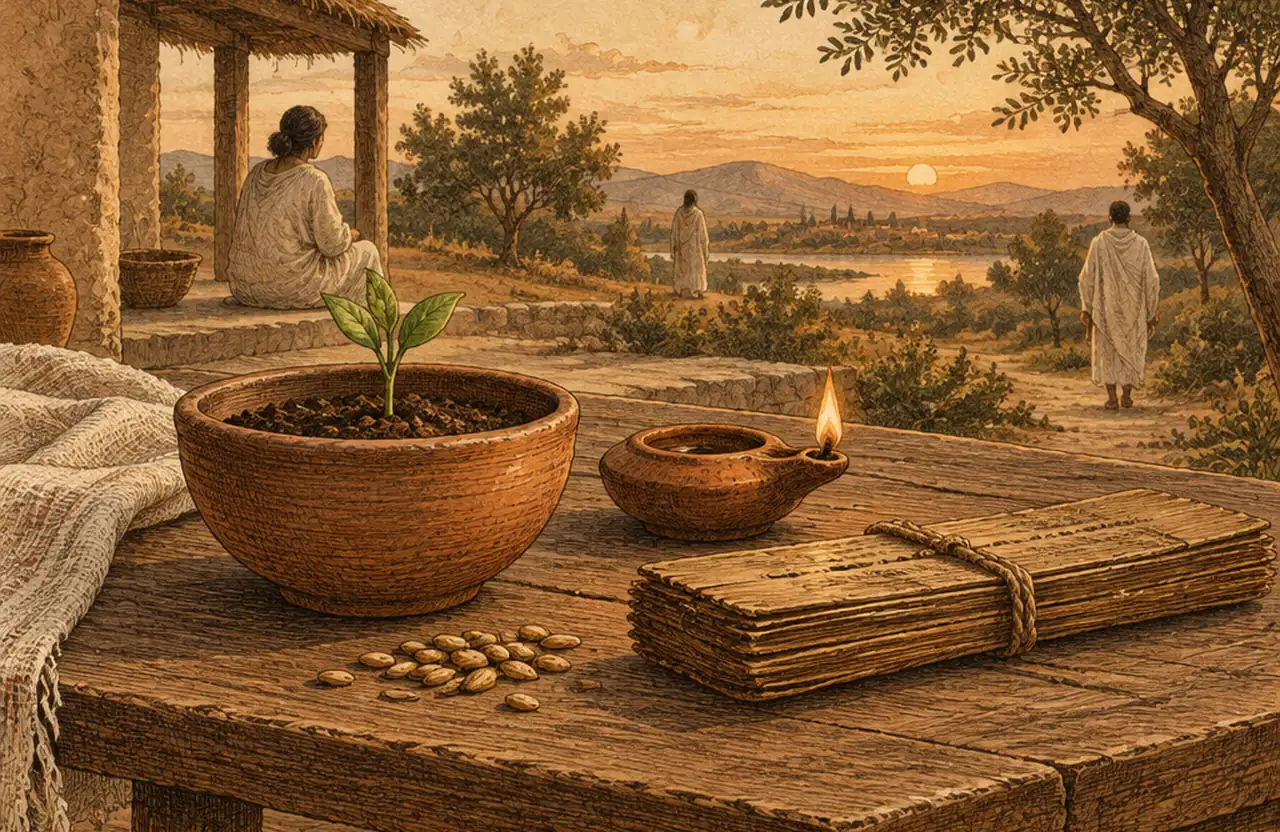
Karma in one line
| Word | Sanskrit कर्म karman (in compounds and in English, karma); Pali kamma |
|---|---|
| Root | √kṛ, “to do, make, perform, cause” |
| Literal meaning | “act, action, performance, business” (Monier-Williams, 1899); also a ritual act in the oldest texts |
| The result | a separate word: vipāka in Pali, “ripening”, or phala, “fruit” |
| In the West | spread mainly through the Theosophical Society (Blavatsky’s The Key to Theosophy, 1889) |
So karma is first the act, not the reward. When people say “that’s karma” about a result, they are using a word for the cause to name the effect. Indian texts keep the two apart, and much of the confusion online comes from mixing them up.
How karma is supposed to work
Hindu, Buddhist and Jain teachers explain it differently, but most of them share three ideas:
- Causality. An action has effects that come back to the one who did it. The Brihadaranyaka Upanishad, one of the oldest texts to state the idea, says: “whatever deed he does, that he will reap” (IV.4.5).
- Ethics. The effect depends on the kind of act. “A man of good acts will become good, a man of bad acts, bad” (same verse, Müller’s translation).
- Rebirth. The effects don’t stop at death. Karma is what carries a person into the next birth, in a cycle called saṃsāra.
What counts as good karma? The Pali canon gives a concrete list of ten kinds of skillful action (MN 41): not killing, not stealing and no sexual misconduct; no lying, no divisive or harsh speech and no idle chatter; and in the mind, no covetousness, no ill will and right view. In everyday terms that looks like keeping a promise when it costs you, telling the truth when a lie would be easier, or not repeating a story that would hurt someone.
Nobody hands out rewards, and the early texts have no judge. Karma works more like a seed that grows into its own plant than like a verdict. No tradition offers a way to calculate it. When people search for how karma is calculated, the sources say it can’t be. The Buddha listed “the results of deeds” among four things that are “unthinkable”: anyone who tries to work them out “will go mad or get frustrated” (AN 4.77).
Is karma real, and does it hit back?
Nobody has shown that karma hits back, and the texts themselves say its timing can’t be worked out. No experiment has tested rebirth or the ripening of past deeds, and it is hard to see how one could. What psychologists have studied is the belief, and what it does to people.
| Study | Who | What it found |
|---|---|---|
| White, Norenzayan and Schaller, 2019 | 8,996 people in Canada, India and the US | belief in karma goes with belief in a just world and in a moralizing God but isn’t the same thing; it also predicts how people explain misfortune |
| Converse, Risen and Carter, 2012 | 4 experiments, including job seekers at a career fair | when people badly want an outcome they can’t control, they give more time and money to others, “as if they can encourage fate’s favor” |
| Lerner and Simmons, 1966 | a laboratory study of observers | observers who watched an innocent person suffer, and could not stop it, tended to devalue the victim; this is the starting point of “just world” research |
Saying “it’s their karma” about someone else’s illness or loss can turn sympathy into blame, as in the “just world” study above. The same goes for revenge: none of the source traditions treats karma as something you send at a person who hurt you, and in Buddhist terms the wish to see him punished is a new intention of your own. The Buddha’s answer to Sīvaka, quoted below, also warns against blaming everything on past deeds, and our page on spiritual bypassing lists this as one of its ten everyday phrases. Used about your own hopes, the belief can also make people kinder: in the 2012 study, job seekers who felt the outcome was out of their hands pledged more to charity.
Karma in Hinduism
In the Brāhmaṇa ritual texts, karman mostly meant a ritual act done correctly. The oldest Upanishads, composed in the first millennium BCE, turned it into a moral idea. In one dialogue a student asks the sage Yājñavalkya what is left of a person after death. They step away to talk in private, and what they praised, the text says, “was karman (work)… that a man becomes good by good work, and bad by bad work” (BU III.2.13).
The longer passage in book IV traces karma back to desire: “as is his desire, so is his will; and as is his will, so is his deed; and whatever deed he does, that he will reap” (IV.4.5). After death one “returns again… to this world of action” (IV.4.6). Only the one who no longer desires is free of the cycle. That freedom, moksha, is the goal; good karma alone doesn’t get you there.
The Bhagavad Gita, a few centuries later, asks a practical question: if every act binds, should you stop acting? Krishna says no. The best-known verse reads karmaṇy-evādhikāras te mā phaleṣhu kadāchana: “you have a right to perform your prescribed duties, but you are not entitled to the fruits of your actions” (2.47). Act without clinging to the result, and the act stops binding you (3.19). This is karma yoga, the yoga of action. The Gita also admits the subject is hard: “gahanā karmaṇo gatiḥ”, the way of action is deep and difficult to understand (4.17).
Later Hindu writers sort karma into kinds. The one people meet most often is prārabdha, the part of past karma already in motion in this life. Schools differ on the details, and one school of Indian philosophy, the materialist Cārvāka (Lokāyata), rejected karma and rebirth altogether.
Karma in Buddhism
The Buddha moved the center of karma from the deed to the mind. In a sutta called “Penetrative” he says: “Intention, I tell you, is kamma. Intending, one does kamma by way of body, speech, & intellect” (AN 6.63, Thanissaro’s translation). The Pali is cetanāhaṁ, bhikkhave, kammaṁ vadāmi; Bhikkhu Sujato translates it as “It is intention that I call deeds.” An accident with no intention behind it is not kamma in this sense.
The first place the effect shows is your own mind. In MN 19 the Buddha says: “Whatever a monk keeps pursuing with his thinking & pondering, that becomes the inclination of his awareness.” Keep thinking angry thoughts and the mind bends toward anger. That is kamma working in this life, before any talk of rebirth.
The Buddha also put limits on the idea. A wanderer named Sīvaka asked him about a popular view that everything a person feels, pleasant or painful, is caused by past deeds. The Buddha answered that some feelings come from bile, phlegm or wind, from the weather, from not taking care of yourself or from overexertion, and some from past deeds. Those who blame everything on past deeds, he said, “go beyond personal experience and beyond what is generally deemed to be true. So those ascetics and brahmins are wrong” (SN 36.21).
For Buddhists, the aim is to end the cycle that kamma keeps turning. The same sutta lists “the cessation of kamma” and a path to it among the things that “should be known” (AN 6.63).
Karma in Jainism
Jainism takes karma most literally. Karma is a substance, a very fine kind of matter (pudgala) that fills the universe and sticks to the soul when the soul is moved by passions. The main Jain text, the Tattvārthasūtra, says: “The individual self attracts particles of matter which are fit to turn into karma, as the self is actuated by passions. This is bondage” (8.2). Freedom means wearing that matter off through restraint and austerity until the soul is clean.
Jains also disagree with Buddhists about intention. Careless harm still binds karma, only less: “intentional act produces a strong karmic bondage and unintentional produces weak, shortlived karmic bondage” (6.7). The philosopher John Koller gives an example. A monk who unknowingly serves poisoned food is not guilty in the Buddhist view, but in the Jain view his carelessness counts.
What came later: Theosophy, “instant karma” and pop culture
Western readers met karma mostly through the Theosophical Society. In The Key to Theosophy (1889), Helena Blavatsky called it “an unerring law of Retribution” and “the Ultimate Law of the Universe… which adjusts effect to cause”. In that move karma became a universal law of nature, like gravity, and the word retribution gave it a tone of payback that the Indian texts don’t stress.
The 20th century made it faster and more personal:
- New Age and Neopagan writing turned it into a law of return: what you send out comes back, in Wicca’s Threefold Law three times over. Wikipedia’s overview notes that some New Age writers stress it is not a system of punishment.
- “Instant Karma!”, John Lennon’s 1970 single, gave English the idea that consequences arrive now, not over lifetimes.
- “Karma is a bitch” and Taylor Swift’s 2022 song “Karma” use the word for someone else getting what they deserve, often with a little satisfaction.
- Merriam-Webster now lists a broad sense, a force “affecting the events of one’s life”, and a looser one, an “aura, or spirit” that something gives off (“bad karma”).
As English, these uses are fine. The Upanishads and the suttas mean something different.
Karma vs fate, dharma and “what goes around”
| Idea | What it means | How it differs from karma |
|---|---|---|
| Fate, destiny | an outcome fixed in advance | karma is made by your own acts and can change; prārabdha is the closest Indian idea to fate |
| Dharma | duty, right order, the teaching | dharma is what you should do; karma is what you do and what follows from it |
| Samsara | the cycle of birth and death | samsara is the wheel; karma is what keeps it turning |
| “What goes around comes around” | the world pays you back in kind | a Western shortcut; the Indian texts stress what the act does to the doer |
People often ask about karma and dharma together. In the Gita they meet: doing your own dharma without chasing results is the karma that doesn’t bind.
Is there karma in Christianity or Islam?
Neither uses the word, and neither teaches rebirth. Both have a line that sounds close. Paul writes, “whatsoever a man soweth, that shall he also reap” (Galatians 6:7). The Quran says, “whoever does an atom’s weight of good will see it, and whoever does an atom’s weight of evil will see it” (99:7–8). The difference is the judge: in both religions God weighs the deeds and can forgive, while karma in Indian thought needs no one to run it. We describe the parallel and don’t speak for any church or school of law.
Related concepts
Four ideas keep coming up next to karma:
- Samsara (saṃsāra, “wandering”): the cycle of birth, death and rebirth that karma drives.
- Dharma: duty and right order in Hindu texts; the Buddha’s teaching in Buddhism.
- Nirvana (nibbāna, “blowing out”): the Buddhist end of the cycle, when no new kamma is made.
- Moksha (“release”): the Hindu and Jain freedom from rebirth.
What this page does not promise. We don’t say whether karma exists, and we don’t tell anyone what caused their illness, loss or luck. The check is not a test of how “karmic” you are. Nothing here is a way to clear karma, attract good karma or speed anything up.
How the check works
We wrote the eight situations ourselves. For each, the three readings are our short summaries of named passages: the Pali suttas AN 6.63, MN 19, SN 36.21 and AN 4.77 for early Buddhism; the Brihadaranyaka Upanishad and the Bhagavad Gita for Hindu texts; and dictionary and pop-culture use for the everyday sense. A Jain line appears where Jainism answers differently. Each reading is marked “karma”, “not karma” or “partly”, and the result counts how often your gut answer matched each reading. The count describes the readings, not you. Hindu and Buddhist schools vary a lot, so these are one fair reading of the oldest texts, not the view of every teacher. Your answers stay in your browser.
Frequently asked questions
What is the real meaning of karma?
Literally “action”, from the Sanskrit root kṛ, “to do”. Cosmic payback is mostly the modern sense. More: Karma in one line ↑
Does karma mean revenge?
No. Revenge is a new act, and in Buddhist terms new kamma for whoever takes it. More: What came later ↑
Does karma really hit back?
Nobody has shown it. The texts say actions bear fruit, but not on a schedule you can watch. More: Is karma real? ↑
How do you know if karma is hitting you?
By the texts, you can’t. The Buddha said some pain comes from bile or weather, not past deeds. More: Karma in Buddhism ↑
What does the Bible say about karma?
The word isn’t there. Galatians 6:7 “whatsoever a man soweth…” is the nearest, but God judges and forgives. More: Christianity and Islam ↑
What are good karma examples?
MN 41 lists ten: no killing, stealing, lying or harsh speech, no ill will, and so on. More: How karma is supposed to work ↑
Is karma the same as fate?
No. Fate is fixed; karma is made by your actions. Prārabdha is the nearest idea to fate. More: Karma vs fate and dharma ↑
What is karma called in Islam?
There is no such word. Quran 99:7–8 is close, but the reckoning is by God. More: Christianity and Islam ↑
Sources (21)
- Monier-Williams Sanskrit–English Dictionary, entry “karman”, p. 258
- The Brihadâranyaka-Upanishad III, 2, 13 and IV, 4, 5–6, trans. F. Max Müller. Sacred Books of the East, vol. 15
- Bhagavad Gita 2.47, 3.19 and 4.17, Sanskrit, transliteration and translation by Swami Mukundananda
- Nibbedhika Sutta, Penetrative (AN 6.63), trans. Thanissaro Bhikkhu
- AN 6.63, Pali text with translation by Bhikkhu Sujato
- Dvedhavitakka Sutta, Two Sorts of Thinking (MN 19), trans. Thanissaro Bhikkhu
- Sāleyyaka Sutta (MN 41), trans. Thanissaro Bhikkhu
- Sīvaka Sutta (SN 36.21), trans. Bhikkhu Sujato
- Acinteyya Sutta, Unthinkable (AN 4.77), trans. Bhikkhu Sujato
- Karma in Jainism (Tattvārthasūtra 6.7, 8.1–8.2; J. Koller on intent)
- Karma
- H. P. Blavatsky. The Key to Theosophy, section “What is Karma?”
- Karma (overview of the concept, Theosophy and New Age reception)
- “Instant Karma!” (John Lennon single, February 1970)
- “Karma” (Taylor Swift song, Midnights, 2022; single May 2023)
- karma (definition)
- C. J. M. White, A. Norenzayan, M. Schaller. The content and correlates of belief in karma across cultures. Personality and Social Psychology Bulletin 45(8): 1184–1201
- B. A. Converse, J. L. Risen, T. J. Carter. Investing in karma: when wanting promotes helping. Psychological Science 23(8): 923–930
- M. J. Lerner, C. H. Simmons. Observer’s reaction to the “innocent victim”: compassion or rejection? JPSP 4(2): 203–210
- Galatians 6:7 (King James Version)
- Quran 99:7–8 (Sahih International)