Maha Mrityunjaya Mantra: Sanskrit Text and Meaning
The Maha Mrityunjaya mantra, also called the Tryambakam mantra, is a verse of the Rigveda (7.59.12) addressed to Tryambaka, “the three-eyed one”, an epithet of Rudra, later Shiva. It asks to be freed from death like a ripe cucumber from its stem, “not from deathlessness”. Hindus recite it for long life and liberation; it is a prayer, not a treatment.
Maha Mrityunjaya Mantra, word by word
line 1
त्र्यम्बकं यजामहे सुगन्धिं पुष्टिवर्धनम्
line 2
उर्वारुकमिव बन्धनान्मृत्योर्मुक्षीय मामृतात्
त्र्यम्बकं tryambakaṃ · dictionary form tryambaka
- Meaning
- the three-eyed one (Rudra, later Shiva)
- Sounds like
- tryum-buh-kum
- Note
- Monier-Williams adds that the word was “originally probably three-mothered”.
- Source
- Monier-Williams, Sanskrit-English Dictionary (Cologne), entry tryambaka
यजामहे yajāmahe · dictionary form yaj
- Meaning
- we worship, we offer to
- Sounds like
- yuh-jaa-muh-hay
- Note
- Griffith: “we worship”; Jamison and Brereton: “we sacrifice to”.
- Source
- Monier-Williams, Sanskrit-English Dictionary (Cologne), entry yaj; Griffith; Jamison and Brereton
सुगन्धिं sugandhim · dictionary form sugandhi
- Meaning
- fragrant, sweet-smelling
- Sounds like
- su-gun-dhim
- Source
- Monier-Williams, Sanskrit-English Dictionary (Cologne), entry sugandhi
पुष्टिवर्धनम् puṣṭivardhanam · dictionary form puṣṭi-vardhana
- Meaning
- who makes things thrive; increaser of prosperity
- Sounds like
- push-ti-vur-dhuh-num
- Note
- puṣṭi, “thriving, nourishment” + vardhana, “increasing”.
- Source
- Böhtlingk and Roth (via Cologne); Griffith “augmenter of prosperity”
उर्वारुकम् urvārukam · dictionary form urvāruka
- Meaning
- a cucumber (or gourd)
- Sounds like
- oor-vaa-ru-kum
- Note
- Griffith and Jamison–Brereton have “cucumber”; German and Russian translators chose a gourd or pumpkin.
- Source
- Griffith; Jamison and Brereton; Geldner and Elizarenkova (via Cologne RV links)
इव iva
- Meaning
- like, as
- Sounds like
- i-vuh
- Source
- Monier-Williams, Sanskrit-English Dictionary (Cologne)
बन्धनान् bandhanān · dictionary form bandhana
- Meaning
- from its bond, from the stalk
- Sounds like
- bun-dhuh-naan
- Note
- bandhana means binding or a tie; here the stalk that holds the fruit to the vine.
- Source
- Monier-Williams, Sanskrit-English Dictionary (Cologne), entry bandhana
मृत्योर् mṛtyor · dictionary form mṛtyu
- Meaning
- from death
- Sounds like
- mri-tyor, the ṛ a short “ri”
- Source
- Monier-Williams, Sanskrit-English Dictionary (Cologne), entry mṛtyu
मुक्षीय mukṣīya · dictionary form muc
- Meaning
- may I be freed, may I come loose
- Sounds like
- muk-shee-yuh
- Source
- Monier-Williams, Sanskrit-English Dictionary (Cologne), entry muc
मामृतात् māmṛtāt · dictionary form mā amṛtāt
- Meaning
- not from the deathless (immortality)
- Sounds like
- maam-ri-taat
- Note
- Two words run together: mā, “not”, and amṛtāt, “from the deathless”.
- Source
- Monier-Williams, Sanskrit-English Dictionary (Cologne), entries mā, amṛta; Jamison and Brereton (“not from deathlessness”)
Tap a word. The verse is Rigveda 7.59.12; many recordings add Om before it.
Mantra counter (mala of 108)
Example: Maha Mrityunjaya, a round of 108. 108 repetitions at 12 seconds each take about 21.5 minutes. The time is our assumption, not a rule from any text.
“Like a cucumber from its stem, might I be freed from death, not from deathlessness.” (Jamison and Brereton, 2014 (second half of the verse))
Source: Ṛgveda 7.59.12. Tradition: Vedic; recited in Shaivism.
Two lines per repetition. The time is our assumption, about 12 seconds a verse; go at your own pace.
One tap, Space or Enter is one repetition. There is no sound, no account, and nothing is sent anywhere. Only your last choice of mantra and round is remembered in this browser.
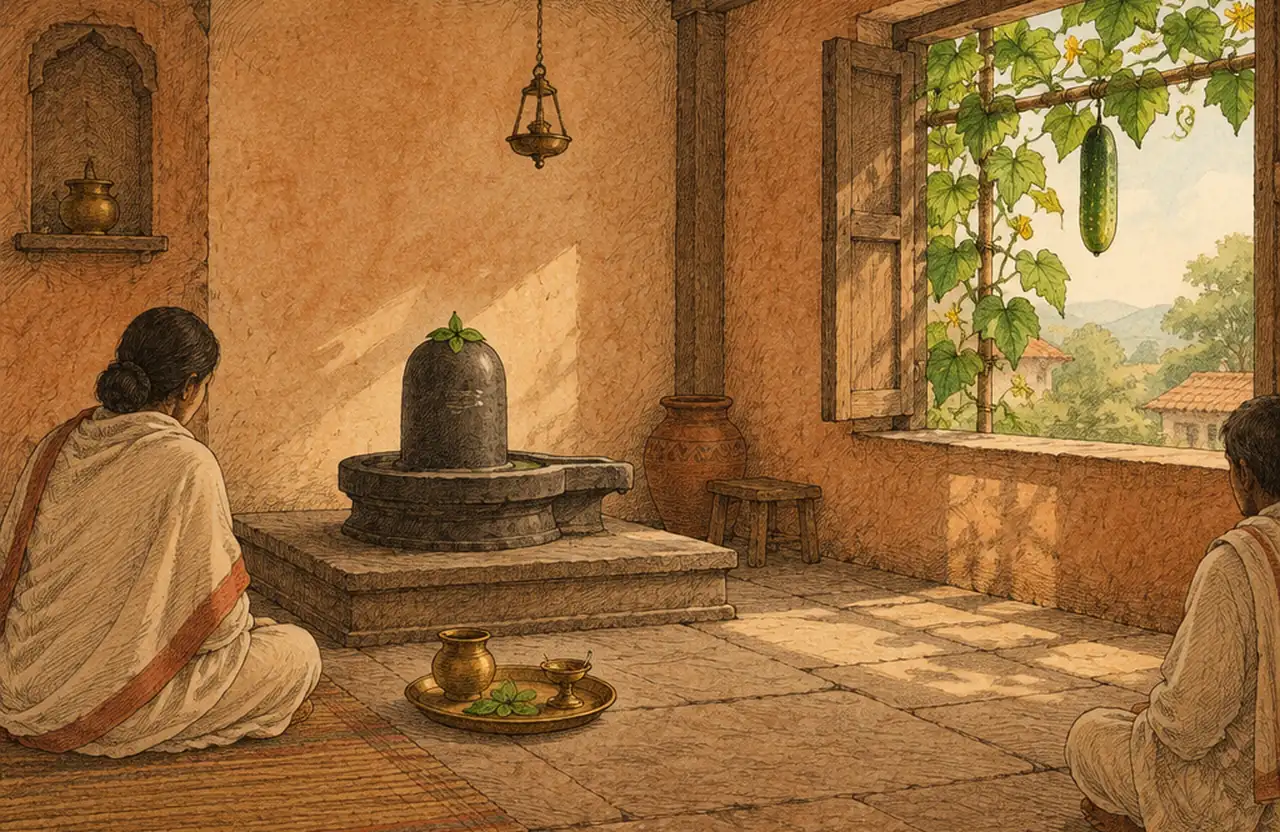
Maha Mrityunjaya mantra lyrics: Sanskrit, transliteration and English
This is Rigveda 7.59.12 as printed in the standard edition (via the Cologne Rigveda links), with the Vedic accent marks. Most recordings add Om before it; the verse itself begins with tryambakaṃ.
| Sanskrit | IAST |
|---|---|
| त्र्य॑म्बकं यजामहे सु॒गन्धिं॑ पुष्टि॒वर्ध॑नम्। | tryambakaṃ yajāmahe sugandhim puṣṭivardhanam |
| उ॒र्वा॒रु॒कमि॑व॒ बन्ध॑नान्मृ॒त्योर्मु॑क्षीय॒ मामृता॑त्॥ | urvārukam iva bandhanān mṛtyor mukṣīya māmṛtāt |
Two English translations:
“Tryambaka we worship, sweet augmenter of prosperity. As from its stem the cucumber, so may I be released from death, not reft of immortality.”
R. T. H. Griffith, 1896
“We sacrifice to Tryambaka the fragrant, increaser of prosperity. Like a cucumber from its stem, might I be freed from death, not from deathlessness.”
Stephanie Jamison and Joel Brereton, 2014, as quoted by Wikipedia
The same verse goes by several names: Maha Mrityunjaya (“great death-conquering”), Tryambakam after its first word, and the Rudra mantra. It is also spelled Mahamrityunjaya, Mahamrityunjay and Trayambakam.
What does the Maha Mrityunjaya mantra mean? Word by word
All the words in one table (same as the tool at the top)
The tool at the top also has each word with its sound and source. “As said” is the form in the verse. Sanskrit merges words at their edges, so bandhanāt becomes bandhanān before m, and mā amṛtāt is written as one word, māmṛtāt.
| Line | As said | Script | Meaning | Sounds like |
|---|---|---|---|---|
| line 1 | tryambakaṃ | त्र्यम्बकं | the three-eyed one (Rudra, later Shiva) | tryum-buh-kum |
| line 1 | yajāmahe | यजामहे | we worship, we offer to | yuh-jaa-muh-hay |
| line 1 | sugandhim | सुगन्धिं | fragrant, sweet-smelling | su-gun-dhim |
| line 1 | puṣṭivardhanam | पुष्टिवर्धनम् | who makes things thrive; increaser of prosperity | push-ti-vur-dhuh-num |
| line 2 | urvārukam | उर्वारुकम् | a cucumber (or gourd) | oor-vaa-ru-kum |
| line 2 | iva | इव | like, as | i-vuh |
| line 2 | bandhanān | बन्धनान् | from its bond, from the stalk | bun-dhuh-naan |
| line 2 | mṛtyor | मृत्योर् | from death | mri-tyor, the ṛ a short “ri” |
| line 2 | mukṣīya | मुक्षीय | may I be freed, may I come loose | muk-shee-yuh |
| line 2 | māmṛtāt | मामृतात् | not from the deathless (immortality) | maam-ri-taat |
Put together: “We worship Tryambaka, the fragrant one who makes things thrive. Like a cucumber from its stalk, may I come loose from death, not from the deathless.” The first line praises the god; the second is the request.
How it is chanted: japa, 108 and when
The verse gives no instructions, and our sources give no fixed rule for number or time. Practical points:
- Number. Sites suggest 1, 3, 11, 21 or 108 repetitions. 108 is the bead count of a standard mala. Pick a round you can say steadily; the counter above offers 27, 54 or 108.
- Time. Some sites say before sunrise; others say any time. We found no rule in the verse about night, and none about periods.
- Om. Many people add Om at the start. That is common practice; the verse does not have it.
- Pace. One verse is two lines, about 30 syllables. Say each line on one out-breath, without forcing; at about 12 seconds a verse, a round of 27 takes about five and a half minutes.
If you belong to a tradition or follow a teacher, their rules are the ones to keep. For counting, malas and why 108, see what a mantra is.
Chanting for someone who is ill
Many families chant it for someone who is sick, as a prayer of care, and nothing in the tradition forbids it. Two cautions:
- It is a prayer, not a treatment. Use it alongside medical care, never instead of it, and never as a reason to delay seeing a doctor.
- If someone is in danger now, call emergency services first; the mantra can wait.
If the worry itself is too much, or chanting leaves you more anxious, unreal or exhausted, stop, breathe normally and talk to someone. Our help page lists free lines.
Does the Maha Mrityunjaya mantra work? What research says
In Hindu traditions, Wikipedia says, the mantra is recited for longevity and immortality and for mental, emotional and physical health. That is a religious practice and a hope people bring to it. It is not a medical claim we can confirm.
On October 23, 2026, a PubMed search for the mantra by name found two records. One studied 60 people with neck pain: adding a relaxation technique that included chanting A-U-M, Om and the Maha Mrityunjaya mantra to physiotherapy reduced pain and anxiety more than physiotherapy with supine rest (Yogitha et al., 2010). The effect of the mantra alone was not measured. The other record was not a study of people. We found no trial showing that the mantra treats illness, prevents accidents or extends life.
Sites that call it the “most powerful” mantra or say it “heals” cite no study. If the chanting calms you, that is worth having.
The sections below are for readers who want the scholarship: what tryambaka and urvāruka mean, and where the verse comes from.
Tryambakam: three-eyed or three-mothered?
Almost every page translates tryambaka as “three-eyed”, from tri, three, and ambaka, eye. That is the standard meaning, and later Shaiva tradition pictures Shiva with a third eye. But the Monier-Williams dictionary adds a note: the word was “originally probably ‘three-mothered’”, connected with the threefold call ambe ambike mbālike in the Yajurveda, addressed to mother goddesses. Griffith’s White Yajurveda (3.57) has Rudra take his share “with Ambikā thy sister”.
Both readings are scholarly, and nobody can settle which one the poets meant. We use “three-eyed”, the usual gloss.
Cucumber, gourd or pumpkin: how translators read urvārukam
The fruit in the verse is urvāruka. English translators say cucumber, and the Arthaśāstra, an old Indian manual of statecraft, uses the word for cucumber too. Other translators chose a different fruit:
| Translator | Language | Word for urvāruka |
|---|---|---|
| R. T. H. Griffith, 1896 | English | cucumber |
| Jamison and Brereton, 2014 | English | cucumber |
| K. F. Geldner | German | Kürbis (pumpkin, gourd) |
| T. Elizarenkova | Russian | тыква (pumpkin, gourd) |
The image works the same with any of them. A fruit on a vine is held by its stalk; when it is ripe, it comes off by itself, without tearing. The prayer asks for that kind of release from death.
“Not from immortality”: what māmṛtāt means
The last word is two words joined: mā, “not”, and amṛtāt, “from the deathless”. Amṛta, “not-dying”, is also the word for the drink of immortality. Griffith renders the close “not reft of immortality”, Jamison and Brereton “not from deathlessness”, Geldner “nicht vom Nichtsterben”.
So the verse does not ask never to die, despite the later name “death-conquering”. It asks to come away from death, like ripe fruit from the stalk, while keeping hold of what does not die. What that deathless part is, the Vedic verse does not say; later Hindu traditions read it as liberation (mokṣa), and Wikipedia notes that the verse is counted as a mokṣamantra, a mantra for liberation.
Where does the Maha Mrityunjaya mantra come from?
A hymn of Vasiṣṭha. The verse is the twelfth of hymn 59 in book 7 of the Rigveda, a hymn attributed to Vasiṣṭha Maitrāvaruṇi. Wikipedia, following Jamison and Brereton, says the last four verses of this hymn, including this one, are late additions to it.
A ritual verse. Those last verses belong to the sākamedha, the final rite of the four-monthly sacrifices, which ends with an offering to Rudra Tryambaka. So the verse began as part of a sacrifice, not as a healing formula.
Repeated in the Yajurveda. The verse also appears in the Taittirīya Saṃhitā (1.8.6) and the White Yajurveda (3.60). In Griffith’s translation of the White Yajurveda a second stanza follows with the same image but a different request: “We worship him, Tryambaka, the husband-finder, sweet to smell. As from its stem a cucumber, hence and not thence may I be loosed.”
A mantra of Shiva. Later texts read the verse in Shaiva terms. In the Śiva-purāṇa (2.2.38) the sage Śukra teaches the Mahāmṛtyuñjaya to Dadhīca and explains Tryambaka as “the three-eyed lord … the lord of the three worlds”. Today, Wikipedia notes, the verse is chanted in japa (repetition), in homa (fire offerings) and while applying sacred ash.
The story of Mārkaṇḍeya and other things websites say
Many sites tie the mantra to the boy-sage Mārkaṇḍeya, who was saved from death by Shiva, and give exact rules: a fixed number of repetitions, a count of syllables, a time before dawn. We did not find these in the Vedic sources or the dictionary entries above, and the sites do not name a text. They may still be family or temple customs, but we cannot point you to where they come from.
What this page does not promise. The Maha Mrityunjaya mantra will not treat an illness, prevent death or protect anyone from harm, and no source on this page says it will. The tool shows the words and counts; it plays no audio.
Frequently asked questions
What does the Maha Mrityunjaya mantra mean?
A prayer to Tryambaka: may I come loose from death like ripe fruit from its stem, but not from deathlessness. More: Meaning word by word ↑
Where does the Maha Mrityunjaya mantra come from?
Rigveda 7.59.12, also in the Yajurveda, originally part of an offering to Rudra Tryambaka. More: Where the mantra comes from ↑
Is the Tryambakam mantra the same as the Maha Mrityunjaya mantra?
Yes: three names and several spellings for the same Rigveda verse. More: The text in Sanskrit and English ↑
Does the Maha Mrityunjaya mantra work?
As a prayer, it is what people recite it for. As medicine, nothing shows it works; PubMed has no test of it alone. More: Does it work? What research says ↑
Can I chant it for someone who is sick?
Many families do, as a prayer of care; alongside medical care, never instead of it. More: Chanting for someone who is ill ↑
How many times should you chant the Maha Mrityunjaya mantra?
The verse sets no number; 108 is the length of a mala. The counter offers 27, 54 or 108. More: How it is chanted: japa, 108, when ↑
Can we chant the Maha Mrityunjaya mantra at night, or during periods?
No rule in the verse or our sources; customs differ by family and teacher. More: How it is chanted: japa, 108, when ↑
What is “Om Haum Joom Sah” in the longer version?
A longer form found on websites; we could not find its source. The verse itself starts with tryambakaṃ. More: The text in Sanskrit and English ↑
Sources (11)
- Rigveda 7.59.12, Sanskrit text with accents (Aufrecht; van Nooten and Holland), with Griffith, Geldner and Elizarenkova translations
- The Hymns of the Rigveda 7.59, trans. R. T. H. Griffith
- The Texts of the White Yajurveda 3.60, trans. R. T. H. Griffith
- Mahamrityunjaya Mantra (RV 7.59.12; Taittirīya Saṃhitā 1.8.6.i; Vājasaneyi Saṃhitā 3.60; hymn of Vasiṣṭha, late verses, sākamedha, after Jamison and Brereton 2014, pp. 953–954; uses in japa, homa, vibhūti)
- Monier-Williams. A Sanskrit-English Dictionary, entry tryambaka (“three-eyed”, originally probably “three-mothered”), via Wisdom Library
- Śiva-purāṇa 2.2.38: Śukra gives the Mahāmṛtyuñjaya to Dadhīca (entry tryambaka)
- Urvāruka: cucumber (Arthaśāstra II.15.19), via Wisdom Library
- Monier-Williams. A Sanskrit-English Dictionary (entries yaj, sugandhi, bandhana, mṛtyu, muc, mā, amṛta)
- B. Yogitha et al. Complimentary effect of yogic sound resonance relaxation technique in patients with common neck pain. International Journal of Yoga 3(1): 18–25
- PubMed search: “maha mrityunjaya” OR mahamrityunjaya OR “mrityunjaya” in titles and abstracts (2 records)
- M. Farias et al. Adverse events in meditation practices and meditation-based therapies: a systematic review. Acta Psychiatrica Scandinavica 142(5): 374–393