Om Mani Padme Hum: Meaning, Syllables and Origin
Om Mani Padme Hum is the six-syllable mantra of Avalokiteśvara, the bodhisattva of compassion, and the most widespread mantra in Tibetan Buddhism. Word for word it is “Om, jewel, lotus, Hum”; “the jewel in the lotus” is one disputed reading.The Dalai Lama explains the syllables as a path joining method and wisdom; Tibetan teachers encourage anyone to recite it.
Om Mani Padme Hum, syllable by syllable
ཨོཾ་མ་ཎི་པདྨེ་ཧཱུྃ
ཨོཾ oṃ
- Meaning
- the sacred syllable; for the Dalai Lama, body, speech and mind
- Sounds like
- ōm
- Note
- Dilgo Khyentse Rinpoche ties it to generosity. On mani stones it is painted white.
- Source
- Dalai Lama, Kindness, Clarity, and Insight; Dilgo Khyentse (via Wikipedia); Wikipedia, “Mani stone”
མ ma · dictionary form maṇi
- Meaning
- first half of maṇi, “jewel”
- Sounds like
- muh
- Note
- Ethics, in Dilgo Khyentse’s list. Painted green.
- Source
- Monier-Williams, Sanskrit-English Dictionary (Cologne), entry maṇi (“a gem, a pearl”); Wikipedia, “Mani stone”
ཎི ṇi · dictionary form maṇi
- Meaning
- second half of maṇi, “jewel”
- Sounds like
- ni, tongue curled back; Tibetans say “ni”
- Note
- Patience, in Dilgo Khyentse’s list. Painted yellow.
- Source
- Monier-Williams, Sanskrit-English Dictionary (Cologne); Wikipedia, “Mani stone”
པད pad · dictionary form padme
- Meaning
- first half of padme, “lotus” in a case form
- Sounds like
- pud; Tibetans often say “pe”
- Note
- Perseverance, in Dilgo Khyentse’s list. Painted light blue.
- Source
- Monier-Williams, Sanskrit-English Dictionary (Cologne), entry padma (“a lotus”); Wikipedia, “Mani stone”
མེ me · dictionary form padme
- Meaning
- end of padme: “in the lotus” or “O lotus”, scholars disagree
- Sounds like
- may
- Note
- Concentration, in Dilgo Khyentse’s list. Painted red.
- Source
- Wikipedia, “Om mani padme hum” (Lopez, Studholme); Wikipedia, “Mani stone”
ཧཱུྃ hūṃ
- Meaning
- a syllable with no dictionary meaning, used in incantations
- Sounds like
- hoom; Tibetans say “hung”
- Note
- For the Dalai Lama it stands for indivisibility. Wisdom, in Dilgo Khyentse’s list. Painted dark blue.
- Source
- Monier-Williams, Sanskrit-English Dictionary (Cologne), entry hūṃ; Dalai Lama; Wikipedia, “Mani stone”
Tap a syllable. Tibetan teachers read each of the six syllables on its own; the colours are the ones painted on mani stones.
Mantra counter (mala of 108)
Example: Om Mani Padme Hum, a round of 108. 108 repetitions at 5 seconds each take about 9 minutes. The time is our assumption, not a rule from any text.
oṃ maṇi padme hūṃ
“Homage to the jewel in the lotus.” (the common Western reading (Britannica)) “O jewel-lotus.” (the reading many scholars suggest (Britannica))
Source: Kāraṇḍavyūha Sūtra, compiled around the 4th–5th century CE (Wikipedia). Tradition: Tibetan Buddhism (Vajrayāna); addressed to Avalokiteśvara, the bodhisattva of compassion.
Six syllables, said evenly, aloud or in a whisper. The translation is disputed, so use whichever reading you can be honest with.
One tap, Space or Enter is one repetition. There is no sound, no account, and nothing is sent anywhere. Only your last choice of mantra and round is remembered in this browser.
What does Om Mani Padme Hum mean?
Only two of its words have an ordinary meaning. Maṇi is “jewel” and padme is a form of padma, “lotus”. Om is the sacred syllable that opens many mantras (see Om), and hūṃ is a syllable with no dictionary meaning, used in incantations.
Tibetan teachers rarely stop at the words. The best-known explanation is the Dalai Lama’s, in Kindness, Clarity, and Insight:
- Om, made of three letters, A, U and M, stands for body, speech and mind: our ordinary, impure ones and the pure ones of a Buddha.
- Mani, the jewel, stands for method: “the altruistic intention to become enlightened, compassion, and love”.
- Padme, the lotus, stands for wisdom, because a lotus “grows forth from mud but is not sullied by the faults of mud”.
- Hum stands for the indivisibility of method and wisdom.
Together, he says, the six syllables mean that by a path joining method and wisdom “you can transform your impure body, speech, and mind into the pure exalted body, speech, and mind of a Buddha”. He also says to recite it “thinking on its meaning”. This is a Buddhist teaching about the path, not a translation of the grammar.
Translation: why scholars disagree
“The jewel in the lotus” is the version most people know, but the grammar of maṇipadme is unclear, and the sūtra where the mantra first appears does not explain it. The 84000 translation team notes that the sūtra “gives no explanation of the meaning of the mantra as a whole, a meaning that has been understood in various ways”. Wikipedia summarizes four readings:
| Reading | Whose | Grammar | What it says |
|---|---|---|---|
| “O jewel-lotus” | Donald Lopez, citing Tibetan grammatical sources | a name, addressed in the vocative | calls on Avalokiteśvara under the name Maṇipadma; a 9th-century Tibetan grammar and a 17th-century work by the Fifth Dalai Lama’s prime minister (“O, you who have the jewel and the lotus”) read it this way |
| “O Maṇipadmī” | Damien Keown; Alexander Studholme on the grammar | feminine vocative | addresses a female deity of the mantra, as the sūtra itself pictures the mantra as a goddess |
| “in the jewel-lotus” | Alexander Studholme (2002) | locative compound | refers to rebirth in a lotus of jewels in the Pure Land |
| “the jewel in the lotus” | Sten Konow | locative | the popular Western reading; Konow saw Shaiva imagery behind it |
Lopez also notes that most Tibetan texts treat the translation as secondary. What they explain is how the six syllables match other sets of six. We did not open Lopez’s book itself; his reading here is as Wikipedia reports it.
Is Om Mani Padme Hum Sanskrit or Tibetan?
The words are Sanskrit. The mantra first appears in an Indian sūtra, the Kāraṇḍavyūha, whose oldest fragments are in Buddhist Hybrid Sanskrit, a mix of Sanskrit and Middle Indic. Tibet received the sūtra in a 9th-century translation, and the mantra became the heart of Tibetan lay practice. The language is Sanskrit; the script you usually see and the usual pronunciation are Tibetan.
How to pronounce and write it
| Written | Said roughly as | |
|---|---|---|
| Sanskrit (IAST) | oṃ maṇi padme hūṃ | “ōm muh-ni pud-may hoom”; the ṇ with the tongue curled back |
| Devanagari | ॐ मणि पद्मे हूँ | as above |
| Tibetan | ཨོཾ་མ་ཎི་པདྨེ་ཧཱུྃ | “om mani peme hung” |
| Chinese | 唵嘛呢叭咪吽 | “ong ma ni bei mei hong” |
Wikipedia gives the Sanskrit in phonetic letters as [õː mɐɳɪ pɐdmeː ɦũː]. The Tibetan “peme” and “hung” are not mistakes; they are how the syllables sound in Tibetan. Some practitioners add a seventh syllable, hrīḥ, often said silently; Wikipedia cites Bucknell and Stuart-Fox (1986) for this longer form.
In the tool at the top, tap each syllable to see it in Tibetan script with both readings.
How to chant it, and how it is used: mani stones, prayer wheels, malas
In Tibet the mantra is carved and printed as well as spoken.
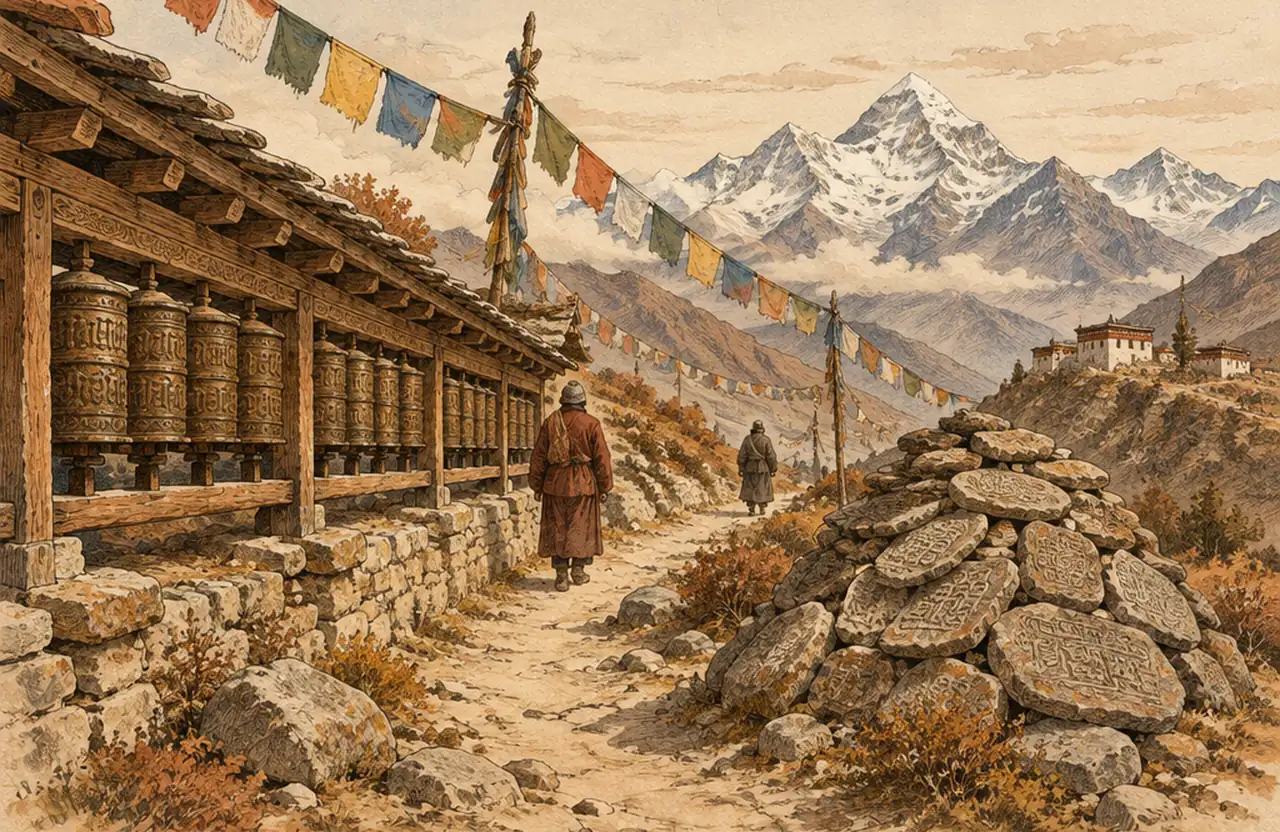
- Mani stones. The mantra is carved on stones, often painted in the six colors above, and piled into long walls along paths. Custom is to pass a mani wall on your left, walking clockwise.
- Prayer wheels. Wheels hold rolls of paper printed with the mantra many times over. They are usually turned clockwise, and, as Wikipedia’s article on prayer wheels summarizes the tradition, turning one is held to bring much the same merit as reciting the prayers inside.
- Malas. Recitation is often counted on a string of 108 beads. The counter at the top of this page does the same on screen, in rounds of 27, 54 or 108.
Can you chant it if you are not Buddhist? Tibetan teachers commonly encourage everyone to say it; it is the mantra lay people recite most. To start, say the six syllables evenly, aloud or under your breath, one round at a time. The Dalai Lama’s advice is to think about the meaning while you recite. If you want to go further, the formal practices of Chenrezig are taught by teachers within a lineage.
Where it comes from: the Kāraṇḍavyūha sūtra
The mantra first appears in the Kāraṇḍavyūha, “The Basket’s Display”. The 84000 translators date the sūtra’s appearance in writing to around the 5th century CE; the scholar who published its oldest manuscript fragments, found in a stūpa at Gilgit, suggests the 4th or 5th century. The sūtra calls the mantra the ṣaḍakṣarī mahāvidyā, “six-syllable great spell”, and treats it as the innermost heart of Avalokiteśvara.
The sūtra’s main subject is the mantra and its “inconceivable benefits”, the 84000 introduction says. It does not explain what the words mean or what each syllable is for. Those explanations came later, in Tibet. The 11th-century Maṇi Kabum built on the sūtra and became a foundation of Tibetan Avalokiteśvara practice.
The sūtra reached China late: the first Chinese translation, by Tianxizai, is from 983 CE. Today the mantra is part of one of the Ten Small Mantras recited each morning in many Chinese and Vietnamese temples, Wikipedia notes.
The six syllables, the six perfections and the six realms
Tibetan teachers often explain the mantra by matching its six syllables to other sets of six. Two lists are well known. Dilgo Khyentse Rinpoche pairs them with the six perfections; Tsangsar Tulku Rinpoche, in a Chenrezig practice text, with the six realms of rebirth that each syllable is said to purify. Mani stones paint each syllable its own color.
| Syllable | Perfection (Dilgo Khyentse) | Realm and affliction (Tsangsar Tulku) | Color on mani stones |
|---|---|---|---|
| Om | generosity | gods; pride | white |
| Ma | ethics | demigods; jealousy | green |
| Ni | patience | humans; desire | yellow |
| Pad | perseverance | animals; ignorance | light blue |
| Me | concentration | hungry ghosts; greed | red |
| Hum | wisdom | hell beings; hatred | dark blue |
Perfections, realms and colors are from Wikipedia’s articles on the mantra and on mani stones; the realm table there is attributed to Tsangsar Tulku’s practice text. Different teachers give different lists, so treat this as two well-known examples.
Benefits of the mantra: what the tradition says
The benefits taught in Tibetan Buddhism are spiritual. The Kāraṇḍavyūha itself describes the mantra’s benefits as “inconceivable”. Lama Zopa Rinpoche, of the FPMT, teaches that reciting it purifies negative karma, that “it is easy to purify negative karma and collect extensive merit”, and that a person who recites it often blesses the beings their body touches. Teachers also speak of developing compassion and of a good rebirth.
These are claims of a religious tradition, made inside its own view of karma and rebirth. We report them as that, and we don’t confirm or dispute them. On October 23, 2026, a PubMed search for the mantra, Avalokiteśvara or “Tibetan mantra” found two records, and neither studied the effect of chanting this mantra.
If you want calm or attention, the page on mantras covers what the studies of repetition found.
All six syllables in one table (same data as the tool above)
| Syllable | Tibetan | Meaning | Sounds like | Note |
|---|---|---|---|---|
| oṃ | ཨོཾ | the sacred syllable; for the Dalai Lama, body, speech and mind | ōm | Dilgo Khyentse Rinpoche ties it to generosity. On mani stones it is painted white. |
| ma | མ | first half of maṇi, “jewel” | muh | Ethics, in Dilgo Khyentse’s list. Painted green. |
| ṇi | ཎི | second half of maṇi, “jewel” | ni, tongue curled back; Tibetans say “ni” | Patience, in Dilgo Khyentse’s list. Painted yellow. |
| pad | པད | first half of padme, “lotus” in a case form | pud; Tibetans often say “pe” | Perseverance, in Dilgo Khyentse’s list. Painted light blue. |
| me | མེ | end of padme: “in the lotus” or “O lotus”, scholars disagree | may | Concentration, in Dilgo Khyentse’s list. Painted red. |
| hūṃ | ཧཱུྃ | a syllable with no dictionary meaning, used in incantations | hoom; Tibetans say “hung” | For the Dalai Lama it stands for indivisibility. Wisdom, in Dilgo Khyentse’s list. Painted dark blue. |
When to stop. Stop for now if anxiety or panic builds up instead of easing, or if you feel unreal or cut off from your body. Breathe normally and do something ordinary. If it stays, talk to a doctor or a mental health professional; our help page lists free lines.
What this page does not promise. We don’t claim the mantra heals, protects, brings luck or changes your next life; those are beliefs of a tradition. The tool shows the syllables and counts; it plays no audio. For practice beyond reciting, a teacher of the tradition is the right guide.
Frequently asked questions
What does Om Mani Padme Hum mean in English?
“Om, jewel, lotus, Hum”: “jewel in the lotus” is one reading, “O jewel-lotus” another. More: What does it mean? ↑
Is Om Mani Padme Hum Sanskrit or Tibetan?
Sanskrit words, first found in an Indian sūtra; Tibetans write and say it their own way. More: Sanskrit or Tibetan? ↑
How do you pronounce Om Mani Padme Hum?
Sanskrit “ōm muh-ni pud-may hoom”, Tibetan “om mani peme hung”. Both are in use. More: How to pronounce and write it ↑
Why is it called the six-syllable mantra?
Om, ma, ṇi, pad, me, hūṃ: six syllables, and the source sūtra names it after that. More: The six syllables ↑
Can anyone chant this mantra?
It is the mantra lay Tibetans recite most, and teachers widely encourage it; deeper practice is taught within a lineage. More: How to chant it; mani stones, prayer wheels ↑
What are the benefits of chanting Om Mani Padme Hum?
The tradition speaks of purification, compassion and rebirth; no study of the mantra exists in PubMed. More: Benefits: what the tradition says ↑
Is this mantra a prayer?
It addresses Avalokiteśvara; read as “O jewel-lotus”, it calls him by name. More: Why scholars translate it differently ↑
How is it written in Chinese?
The Chinese characters 唵嘛呢叭咪吽 transcribe the sounds; it reached China in 983 CE. More: Where it comes from ↑
Sources (11)
- The Basket’s Display (Kāraṇḍavyūha, Toh 116), trans. P. A. Roberts with Tulku Yeshi, introduction i.1–i.4 and i.11
- The Dalai Lama. Kindness, Clarity, and Insight, trans. and ed. J. Hopkins, co-ed. E. Napper (excerpt “A Talk on Om Mani Padme Hum”)
- Lama Zopa Rinpoche. The benefits of chanting OM MANI PADME HUM
- Om mani padme hum (first appearance; readings by D. Lopez, A. Studholme, D. Keown, S. Konow; Dilgo Khyentse and Tsangsar Tulku on the six syllables; hrīḥ; China 983)
- D. S. Lopez Jr. Prisoners of Shangri-La: Tibetan Buddhism and the West, ch. 4 “The Spell” (University of Chicago Press); used here via the Wikipedia summary, book not opened
- A. Studholme. The Origins of Om Manipadme Hum: A Study of the Kāraṇḍavyūha Sūtra (SUNY Press); used here via the Wikipedia summary
- Mani stone (colours of the six syllables; walls passed on the left)
- Prayer wheel (turned clockwise; merit of turning)
- Monier-Williams. A Sanskrit-English Dictionary (entries maṇi, padma, hūṃ)
- Om mantra (Britannica), on Om in Buddhist ritual
- PubMed search: “om mani padme” OR “avalokitesvara” OR “tibetan mantra” in titles and abstracts (2 records, neither a study of the mantra)