What Is a Mantra?
A mantra is a word, syllable or verse that is repeated, usually in meditation or prayer. The English word comes from Sanskrit mántra, from the root man-, “to think”; the Sanskrit dictionary’s first meaning is “instrument of thought”. In everyday English it also means a phrase you live by.
Mantra counter (mala of 108)
Example: Om (Aum), a round of 108. 108 repetitions at 8 seconds each take about 14.5 minutes. The time is our assumption, not a rule from any text.
oṃ (also written aum)
“Om! — This syllable is this whole world.” (Māṇḍūkya Upaniṣad 1, trans. R. E. Hume, 1921)
Source: Māṇḍūkya Upaniṣad 1; Chāndogya Upaniṣad 1.1.1; Yoga Sūtras 1.27–1.28. Tradition: Upanishads; Yoga Sutras 1.27–1.28.
A simple way to pace it is one repetition per out-breath. The texts we checked do not prescribe a breath pattern.
One tap, Space or Enter is one repetition. There is no sound, no account, and nothing is sent anywhere. Only your last choice of mantra and round is remembered in this browser.
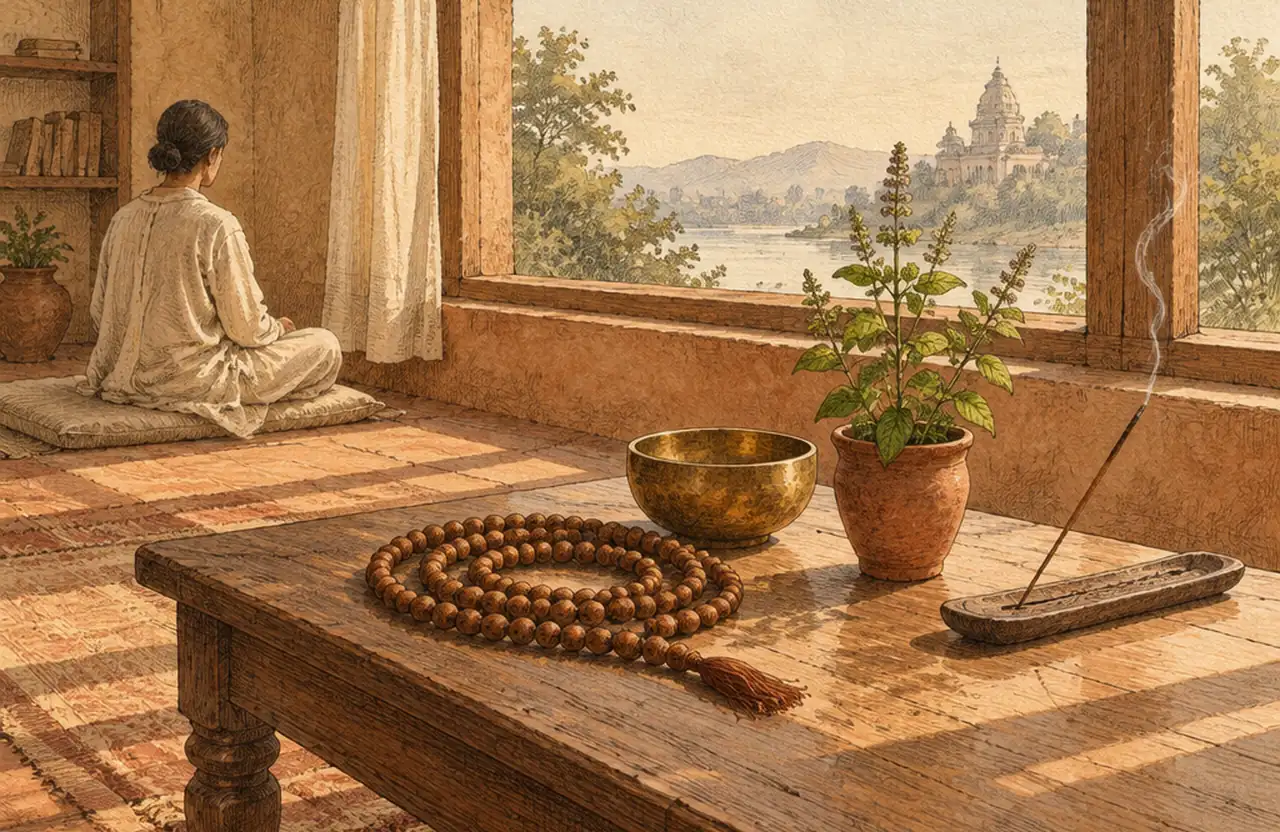
Two meanings sit under one word. In Hinduism and Buddhism a mantra is a sacred utterance, which Britannica describes as “considered to possess mystical or religious efficacy”. In plain English it can also mean a personal slogan. Britannica notes the word has moved “beyond the religious sphere to mean a watchword or slogan in the contexts of business or personal growth”. Most of this page is about the first, because that is where the sources are.
How to use a mantra (and a mala)
Choose one phrase
Pick one phrase and keep it for the whole round. If you come from a tradition, take the mantra from it: Eknath Easwaran, whose program the VA study below was built on, advised taking the formula from your own faith, Eastern or Western. If you don’t follow one, choose a short phrase you can say without arguing with it. The psychologist Diana Hill (Psychology Today, 2024) suggests listing candidates, saying them out loud, and keeping the one that feels settling in your body. That is a clinician’s practical suggestion, not a research result. The counter above offers six choices:
- Om is one syllable. The Yoga Sutras (1.27–1.28) say to repeat it and contemplate its meaning.
- So’ham has two syllables and means “I am what that is” (Müller). Texts disagree on which goes with the in-breath (see the examples below), so pick one direction and keep it.
- Om Mani Padme Hum has six syllables and is Tibetan Buddhist, addressed to Avalokiteśvara, the bodhisattva of compassion. Its translation is disputed, so use the reading you can be honest with.
- Gāyatrī is a whole Vedic verse (Rigveda 3.62.10), the longest of the six. Hear it said first, from a teacher or a recording.
- Oṃ namaḥ śivāya is a prayer to Shiva. If that is not your tradition, another phrase may suit you better.
- Your own word or phrase is the everyday sense of the word that Britannica and Cambridge both recognize. The counter keeps it in your browser and does not save it.
Say it
The sources describe three ways of saying a mantra: aloud, muttered (upāṃśu, “inaudible”), or only in the mind (mānasa). Staal describes this split, and Britannica says mantras are “spoken aloud, muttered, or merely sounded internally”. We found no source that ranks them, so use whichever fits where you are.
A simple way to pace a short mantra is one repetition per out-breath. The texts we checked do not prescribe a breath pattern. Hill suggests about five counts in and five counts out, using a word with a humming or sighing sound.
When you notice your attention has wandered, go on to the next repetition. To make it a habit, tie it to a place or an action, such as waking up or walking, as Hill suggests. Her examples include “I have arrived, I am home”, a short verse from Thich Nhat Hanh’s Plum Village tradition. At the end, sit quietly for a minute before you stand up.
Hold the mala
A mala is a string of beads for counting repetitions. Wikipedia’s Japamala entry says the main body usually has 108 beads, smaller versions often have 54 or 27, and a 109th “guru bead” is not counted. Move to the next bead on each repetition, and one trip around 108 beads is a round of 108. On a mala of 54, go around twice; on 27, four times. Our sources do not say which finger to use or which way to turn the beads, so we give no rule. Use what is comfortable. The counter at the top does the same job on screen.
How long a round takes
That depends on the mantra and your pace. At the paces we assumed in the counter, a round of 108 takes roughly:
| Mantra | Seconds per repetition (our assumption) | Round of 108 |
|---|---|---|
| Om (Aum) | 8 | about 14.5 minutes |
| So’ham | 6 | about 11 minutes |
| Om Mani Padme Hum | 5 | about 9 minutes |
| Gāyatrī | 15 | about 27 minutes |
| Om Namah Shivaya | 5 | about 9 minutes |
A round of 54 takes half as long and 27 a quarter. These times are ours, for planning, and are not in any text.
Any promise that one phrase will bring money, a partner or luck has no source behind it.
Why 108?
Britannica says mantras are “often recited 108 times (a numerologically significant number in Hinduism), often with the assistance of prayer beads”, and that a simple recitation would be three times. There is no single reason for 108. These are the explanations that have a named source:
- In Theravada Buddhism, according to Bhante Gunaratana, 108 is 6 senses × 3 (pleasant, unpleasant, neutral) × 2 (internal, external) × 3 (past, present, future).
- Tibetan beads are said to echo the 108 volumes of the Kangyur, the collected words of the Buddha.
- In Japan the temple bell Joya no Kane is struck 108 times at New Year, once for each of the bonnō, the passions or afflictions.
- Among Hindu traditions, Shaivas count 108 ganas and Sri Vaishnavas count 108 Divya Desam, holy sites.
Folk explanations circulate too. 108 = 1¹ × 2² × 3³ is a real math property, but nobody has shown it has anything to do with the practice. Claims about the distance from Earth to the Sun, “108 energy lines to the heart”, or digits adding up to 9 have no source we could find. You do not need 108: the counter offers 27, 54 and 108.
Where prayer beads came from
Nobody knows. Wikipedia’s Japamala entry notes that the Pali Nikayas and the Agamas do not mention beads. The earliest literary use of beads for mantras that the article names is the Mu Huanzi Jing, translated in the 4th–5th century CE, where the Buddha tells a king to count recitations and says that after a million “the king would end the one hundred and eight passions”.
What does mantra mean? The word in the dictionaries
The English word is Sanskrit mántra, from the root √man, “to think”. Monier-Williams, the standard Sanskrit-English dictionary, gives “instrument of thought” first, then a Vedic hymn, a sacred formula, a charm, and counsel or plan. Merriam-Webster dates the English word to 1795. The blog line “man means mind and tra means tool” does not come from the dictionary entry, which does not split the word. Scholars have no agreed definition either: Wikipedia reports that “there is no generally accepted definition of mantra”.
Word details: the full Monier-Williams entry, “tra” and “trai”, and the scholars’ disagreement
Monier-Williams gives mántra these meanings, with references to the Rigveda and later Vedic books:
- “instrument of thought”, speech, sacred text or speech, a prayer or song of praise;
- a Vedic hymn or sacrificial formula;
- a sacred formula addressed to an individual deity (his example is om śivāya namaḥ);
- a mystical verse or magical formula: an incantation, charm or spell;
- consultation, resolution, counsel, advice, plan, design, secret.
The root is √man, “to think, believe, imagine, suppose”, which the dictionary compares with Latin meminisse and English mean. Merriam-Webster gives the English history: from Sanskrit, “sacred counsel, formula”, from manyate, “he thinks”, and related to Latin mens, “mind”. Its first known use in English is 1795.
The dictionary entry says “instrument of thought”, not “of the mind”, and it does not break the word into parts. Wikipedia and Britannica do read -tra as a suffix of instrument. One older explanation derives -tra from trai, “to protect”: a commentary on the Tantras, quoted in the introduction to Tantric Mantras (Routledge), says a mantra is so called because its nature is thought and protection. That introduction adds that it would not fit all mantras, since many are “mere ritual formulas”.
Wikipedia describes a long disagreement between two schools. One holds that mantras are mostly meaningless sound constructs. The other holds that they are meaningful linguistic instruments of mind. Frits Staal belongs to the first view; he compared mantras to bird songs. Jan Gonda described them as verses and formulas believed to have religious, magical or spiritual efficacy.
Where mantras come from: the Vedas, Upanishads and Buddhism
The oldest mantras are in the Rigveda. Britannica dates it to about 1500 BCE, passed on by voice and written down about 300 BCE. Wikipedia puts the main body “most likely between c. 1500 and 1000 BCE” and adds that the dates “remain contentious”. We do not know the exact verse where the word mántra first appears, so we do not claim one. The idea may also be Indo-Iranian: Wikipedia, following the scholar Schlerath, notes that the phrase sātyas mantras appears in the Rigveda and in the Avestan Yasna 31.6, and that the Zoroastrian word is mąθran.
The Upanishads bring in meditation. The Chāndogya Upanishad opens: “Let a man meditate on the syllable Om” (1.1.1, trans. Max Müller, 1879), and says a few lines later that Om is “a syllable of permission, for whenever we permit anything, we say Om, yes” (1.1.8). Müller wrote in his introduction that meditating on Om meant “a long continued repetition of that syllable with a view of drawing the thoughts away from all other subjects”. That is a 19th-century translator’s reading, not the text’s own words. The Māṇḍūkya Upanishad, in R. E. Hume’s 1921 translation, begins: “Om! — This syllable is this whole world.”
In Buddhism, mantras are central to the Vajrayāna, sometimes called Mantrayāna, “path of mantras”. Britannica also lists the Heart Sutra’s closing mantra, the Pure Land phrase namu Amida Butsu, and Nichiren’s namu myōhō renge kyō, which is addressed to a text, the Lotus Sutra, and not to a deity. Britannica says Buddhism and Jainism adopted Sanskrit mantras from early Hinduism. Wikipedia also names the Jain Namokar and the Sikh Mūl Mantar as mantras; we did not open those texts.
Mantra examples: Om, Gayatri, Om Mani Padme Hum and others
These are the counter’s entries. IAST is the standard way of writing Sanskrit with Latin letters.
| Mantra | IAST | Translation, with translator | Source |
|---|---|---|---|
| Om (Aum) | oṃ (also written aum) | “Om! — This syllable is this whole world.” (Māṇḍūkya Upaniṣad 1, trans. R. E. Hume, 1921) | Māṇḍūkya Upaniṣad 1; Chāndogya Upaniṣad 1.1.1; Yoga Sūtras 1.27–1.28 |
| So’ham | so ’ham (saḥ + aham) | “I am what that is.” (Īśā Upaniṣad 16, trans. Max Müller, 1879) “That (is) I.” (Monier-Williams, Sanskrit-English Dictionary) | Īśā Upaniṣad 16 (the words so ’ham asmi) |
| Om Mani Padme Hum | oṃ maṇi padme hūṃ | “Homage to the jewel in the lotus.” (the common Western reading (Britannica)) “O jewel-lotus.” (the reading many scholars suggest (Britannica)) | Kāraṇḍavyūha Sūtra, compiled around the 4th–5th century CE (Wikipedia) |
| Gāyatrī | tat savitur vareṇyaṃ / bhargo devasya dhīmahi / dhiyo yo naḥ pracodayāt | “May we attain that excellent glory of Savitar the God: So may He stimulate our prayers.” (R. T. H. Griffith, 1896) “May we contemplate the desirable radiance of the god Savitṛ; may he impel our thoughts.” (Gavin Flood, in Britannica) | Ṛgveda 3.62.10 |
| Om Namah Shivaya | oṃ namaḥ śivāya | “Obeisance to Shiva.” (Britannica) | Britannica, “mantra” (given as an example of a Hindu mantra); Monier-Williams cites the form om śivāya namaḥ |
Om is written oṃ or aum. The Māṇḍūkya says it is “this whole world”, and Patañjali’s Yoga Sutras (1.27) name it as the word that designates the divine. These are the texts’ own claims, and neither says Om has a particular effect on your body.
The Gāyatrī is Rigveda 3.62.10: tat savitur vareṇyaṃ / bhargo devasya dhīmahi / dhiyo yo naḥ pracodayāt. The two translations in the table differ on one word. Griffith (1896) renders dhiyaḥ as “prayers”; Gavin Flood has “thoughts”, and the Jamison–Brereton translation of the Rigveda has “insights”. The familiar opening oṃ bhūr bhuvaḥ svaḥ is not in the Rigveda verse. Wikipedia places that prefix in the Taittirīya Āraṇyaka (2.11.1–8), a later ritual text. Britannica says the verse is given “in the ear of initiates” at the sacred-thread ceremony (upanayana); Wikipedia adds that modern Hindu reform movements spread the practice to everyone. We found no source for claims that saying it wrongly harms anyone.
The Kāraṇḍavyūha Sūtra, compiled around the end of the 4th or start of the 5th century CE, is notable for introducing Om Mani Padme Hum. It is addressed to Avalokiteśvara, the bodhisattva of compassion. Britannica says Western sources “have often translated” it as “Homage to the jewel in the lotus”, while many scholars suggest “O jewel-lotus”, a single name in the vocative. Wikipedia summarizes Donald Lopez as arguing for the vocative, and Stephen Studholme for “in the jewel-lotus”. The Dalai Lama’s explanation (Kindness, Clarity, and Insight, 1984) is a Buddhist teaching about the path, not a word-for-word translation: the six syllables mean that “in dependence on the practice of a path which is an indivisible union of method and wisdom, you can transform your impure body, speech, and mind into the pure exalted body, speech, and mind of a Buddha”.
The words so ’ham asmi end Īśā Upanishad 16, which Müller renders “I am what that is”. Later yoga manuals attach the two syllables to the breath, and they do not agree. Wikipedia says the Gheranda and Shiva Saṃhitā teach “so” on the in-breath and “ham” on the out-breath. Another text it cites, the Vijñāna-bhairava (155b), puts “sa” on the out-breath and “ha” on the in-breath, the reverse. That verse is missing from the 1918 edition and is quoted from a later commentary, so it looks like a later addition.
Britannica lists oṃ namaḥ śivāya, “Obeisance to Shiva”, as a Hindu example. It explains that simple mantras like this address a deity in the dative case, which is a form of prayer, and that many include namaḥ, “obeisance”.
Britannica says most Hindu mantras have oṃ followed by “seed” (bīja) syllables with no semantic meaning, such as gaṃ, hrīṃ and śrīṃ, regarded as “a sonic and verbal encapsulation of the deity”. How these syllables came to be linked with the chakras is a separate topic; we cover it on chakra meditation, and the system itself is on the chakras page. Hand positions that go with mantras are on mudras.
What is a mantra in yoga?
The Yoga Sutras of Patañjali give the clearest instruction. Sutra 1.27 says the word that designates the divine is praṇava, the syllable Om. Sutra 1.28, tajjapas tadarthabhāvanam, is translated on Wisdom Library as “Repeat it and contemplate upon its meaning”. The Sanskrit pairs japa, repetition, with artha-bhāvana, dwelling on the meaning.
So in this text repetition goes together with attention to meaning. Some teachers today say the sound matters and the meaning does not. Staal’s view is that part of the mantras have no literal meaning. Both are positions inside the traditions, and you can try each. For the wider practice of meditation, see meditation for spiritual awakening.
Mantra vs affirmation: what’s the difference?
An affirmation is a statement you repeat to change what you believe, so its meaning is the point. The idea has American roots. New Thought writers in the 19th century taught “affirmative prayer”; Wikipedia names Phineas Quimby (1802–1866) and Emma Curtis Hopkins (1849–1925, Scientific Christian Mental Practice, 1888), and historians dispute whether Quimby deserves the title of founder. In France Émile Coué gave patients the formula “Every day, in every way, I’m getting better and better”; his book Self-Mastery Through Conscious Autosuggestion came out in England in 1920. Wikipedia notes that Coué never produced empirical evidence for it.
A traditional mantra works differently. In the sources above it is a formula with a ritual or contemplative role; it may be a prayer to a deity, and some have no ordinary meaning. Our reading is that the two differ in what they ask of the words: an affirmation needs you to believe the sentence, a mantra needs you to repeat it.
One well-known study shows why the difference matters. In two experiments, Wood and colleagues (2009) found that people with low self-esteem who repeated “I’m a lovable person” felt worse than people who did not. People with high self-esteem felt better, “but to a limited degree”. The authors concluded that repeating positive self-statements may benefit certain people but “backfire for the very people who ‘need’ them the most”. That was one phrase, a claim about the speaker. Repeating a word like “Om” or “breathe” makes no such claim, and the study says nothing about it. That is our inference, and nobody has tested it.
Using phrases to get things is a different subject, covered on manifestation and the 3-6-9 method.
Is a mantra like a prayer? What Jesus says about repetition
Sometimes it is one. Britannica says many mantras are “devotional invocations of or prayers to divine beings”, and the same entry says others are “without any apparent lexical meaning”. So “is it a prayer?” depends on the mantra. “Oṃ namaḥ śivāya” is. A bare Om addresses no one by name.
The word mantra does not appear in the New Testament, so Jesus did not mention mantras. The nearest passage is Matthew 6:7. The King James Version reads: “But when ye pray, use not vain repetitions, as the heathen do: for they think that they shall be heard for their much speaking.” The NASB has “do not use meaningless repetition as the Gentiles do”. The Lord’s Prayer follows in 6:9–13. Whether the verse condemns repetition itself or only empty, many-worded prayer is a question on which Christians disagree, and we are not taking a side for any church.
Christian practice also has a repeated phrase of its own. The Jesus Prayer, “Lord Jesus Christ, Son of God, have mercy on me, a sinner”, is often said continuously and belongs to the hesychast tradition; Wikipedia traces it to the Egyptian desert of the 5th century and says “a sinner” was added later. Wikipedia’s Japamala entry also compares the mala with the rosary and the Islamic misbaha.
One lab study put the two side by side. Bernardi and colleagues (BMJ, 2001) had 23 healthy people recite the Ave Maria and a yoga mantra. Both slowed breathing to about six breaths a minute, which brought heart and blood-pressure rhythms into step, and baroreflex sensitivity rose from 9.5 to 11.5 ms/mmHg (p<0.05). The prayer and the mantra gave a similar effect. That shows a likeness in what slow rhythmic repetition does to the body, not that either one is better.
What the research found about mantra practice (and what it didn’t)
On October 22, 2026 a PubMed search for “mantra meditation” in titles and abstracts gave 43 records, of which only a handful were randomized trials or reviews. The studies are very different from one another, so we list a few with their size and design. “Mantra” in these studies is usually a taught program, not a word repeated alone.
| Study | Who, how many, design | What they found | Caveat |
|---|---|---|---|
| Bormann et al., 2018, American Journal of Psychiatry | 173 veterans with PTSD; mantram program (89) vs present-centered therapy (84); eight weekly one-hour sessions | Greater drop in clinician-rated PTSD severity in the mantram group (d = 0.49 after treatment, 0.46 at 2 months). 59% vs 40% no longer met PTSD criteria (p<0.04). Insomnia fell more. The share with clinically meaningful change (75% vs 61%) did not differ significantly. | Open allocation, blinded assessment. A taught program with a therapist, not a word repeated alone. |
| Joshi et al., 2022, JAMA Network Open | 80 health care workers; Transcendental Meditation (a mantra technique) 20 minutes twice daily for 3 months vs usual care | The main outcome, overall distress, was not significant: −1.8 points (95% CI −4.2 to 0.6, p=0.13). Some secondary outcomes were better, such as anxiety (−2.2, p=0.01). | Open-label, one center; secondary outcomes carry less weight. |
| Orme-Johnson & Barnes, 2014, J Altern Complement Med | Meta-analysis of 16 TM studies, 1,295 people | d = −0.50 vs active treatments, −0.62 vs usual care; larger effects when starting anxiety was high. | TM only. The abstract itself says more research is needed. |
| Coitinho Biurra et al., 2026, Pain Research and Management | Meta-analysis of 7 studies, 374 people with pain | Better mental quality of life and less negative mood. No significant effect on pain, physical quality of life, depression, anxiety, stress or sleep. | Quality rated low to moderate; the authors ask for better trials. |
| Rajagopalan et al., 2023, J Basic Clin Physiol Pharmacol | People with hypertension; 80 recruited, 65 analyzed; randomized | Om chanting plus Yoga Nidra lowered depression, anxiety and stress scores (DASS). | The two were combined; Om’s share was not measured. |
| Kalyani et al., 2011, Int J Yoga | 12 healthy volunteers (9 men), fMRI, a pilot | Aloud “OM” was linked to lower activity in limbic regions, including the right amygdala, compared with rest. Saying “ssss” changed nothing there. | Tiny pilot. Use in treatment is the authors’ hypothesis. |
A 2022 narrative review (Tseng) covers stress, anxiety, hypertension and immunity and says larger, better studies are needed before firm conclusions. The 2014 JAMA Internal Medicine review of meditation programs (Goyal, 47 trials, 3,515 people) found moderate evidence of improved anxiety, depression and pain for mindfulness programs, and no evidence they beat active treatments; it was about mindfulness, not mantras. Finally, no study we found compares one mantra with another, and none measures the effect of a single repeated word apart from instruction.
Websites often say mantras “deactivate stress centers” or “stimulate the vagus nerve”. Behind that sentence is mostly the 12-person pilot above.
When to put the practice down
Repeating a word is quiet, and for most people it stays that way, but meditation can have bad effects. A 2020 systematic review (Farías and colleagues) covered 83 studies and 6,703 people. Of the 83 studies, 55 reported at least one adverse event. The overall prevalence was 8.3%, with 3.7% in experimental studies and 33.2% in observational ones. Among those 55 studies, anxiety was reported in 18 (33%), depression in 15 (27%) and cognitive anomalies in 14 (25%). The authors say events “may occur in individuals with no previous history of mental health problems”. This was about meditation in general, not mantras alone.
Stop for now if, during or after the practice:
- anxiety or panic builds up instead of easing;
- you feel numb, unreal, or cut off from your body or surroundings;
- you have thoughts of harming yourself;
- sleep, work or time with other people gets worse.
Open your eyes, feel your feet on the floor, look around the room and do something ordinary. If the feelings continue, talk to a doctor or a mental health professional. If you need to talk to someone today, our help page lists free lines. A mantra is not a treatment: in the PTSD trial above, the practice was taught by clinicians as part of a therapy program.
What this page does not promise. A mantra will not bring money, a partner, healing or a spiritual state, and no source here says it will. The studies above are small and mixed. The counter only counts; it has no power of its own.
Frequently asked questions
What is the meaning of my mantra?
See the table of examples; a few mantras have no ordinary meaning, and a phrase you chose means what its words say. More: Mantra examples ↑
Is a mantra like a prayer?
Often, yes: many mantras are prayers. Others are bare syllables that address no one. More: Is a mantra like a prayer? ↑
How do you do a mantra properly?
Pick one phrase, say it aloud, whispered or silently, and return to it when attention drifts. More: How to use a mantra (and a mala) ↑
What does Jesus say about mantras?
Not the word itself. The nearest verse is Matthew 6:7 on “vain repetitions”; readings differ. More: Is a mantra like a prayer? ↑
What is the power of a mantra?
In traditions, a religious claim. In studies, narrower outcomes, with mixed results. More: What the research found (and didn’t) ↑
What is the most powerful mantra?
No ranking exists, and no study compared mantras with each other. More: What the research found (and didn’t) ↑
What are the types of mantra japa?
Aloud, inaudible (a whisper) and mental, often counted on a mala. More: How to use a mantra (and a mala) ↑
What is the difference between a mantra and an affirmation?
An affirmation is a claim meant to change belief; a traditional mantra is a formula whose meaning may not matter. More: Mantra vs affirmation ↑
Sources (34)
- M. Monier-Williams. A Sanskrit-English Dictionary, entry mántra (p. 785) and entry √man, Cologne digital edition
- Merriam-Webster. mantra (etymology; first known use 1795)
- Britannica. mantra
- Britannica. Rigveda
- Mantra (definitions, Gonda and Staal, types of recitation, Yasna 31.6)
- Rigveda (dating)
- The Upanishads, part 1, trans. F. Max Müller, Sacred Books of the East vol. 1 (Chāndogya 1.1.1 and 1.1.8; Īśā 16)
- Māṇḍūkya Upaniṣad, verse 1, trans. R. E. Hume, The Thirteen Principal Upanishads
- Patañjali. Yoga Sūtras 1.27–1.28, English translation (translator not named on the page)
- Rigveda 3.62.10, trans. R. T. H. Griffith
- Gayatri Mantra (prefix oṃ bhūr bhuvaḥ svaḥ, Taittirīya Āraṇyaka 2.11.1–8, spread beyond initiates)
- Karandavyuha Sutra
- Om mani padme hum (translation debate: Lopez, Studholme, Keown)
- Soham (Sanskrit) (breath teaching in the Gheranda and Shiva Saṃhitā, Vijñāna-bhairava 155b)
- Japamala (108 beads, origin of prayer beads, Mu Huanzi Jing)
- 108 (number) (Buddhist and other explanations of 108)
- Introduction to Tantric Mantras: Studies on Mantraśāstra (preview; commentary on mananatrāṇa)
- New Thought (Quimby, Hopkins, affirmative prayer)
- Émile Coué (formula; Self-Mastery Through Conscious Autosuggestion, 1920)
- J. V. Wood, W. Q. E. Perunovic, J. W. Lee. Positive self-statements: power for some, peril for others. Psychological Science 20(7): 860–866
- Gospel of Matthew 6:7 (KJV and NASB)
- Jesus Prayer
- L. Bernardi et al. Effect of rosary prayer and yoga mantras on autonomic cardiovascular rhythms: comparative study. BMJ 323
- D. Hill. How to use a mantra. Psychology Today
- Mantram repetition for veterans (program based on Eknath Easwaran’s Passage Meditation)
- J. E. Bormann et al. Individual treatment of posttraumatic stress disorder using mantram repetition: a randomized clinical trial. American Journal of Psychiatry
- S. P. Joshi et al. Efficacy of Transcendental Meditation to reduce stress among health care workers: a randomized clinical trial. JAMA Network Open
- D. W. Orme-Johnson, V. A. Barnes. Effects of the Transcendental Meditation technique on trait anxiety: a meta-analysis of randomized controlled trials. J Altern Complement Med
- Y. Coitinho Biurra et al. Mantra meditation for pain conditions: a systematic review and meta-analysis. Pain Research and Management
- B. G. Kalyani et al. Neurohemodynamic correlates of “OM” chanting: a pilot functional MRI study. International Journal of Yoga
- Rajagopalan et al. Effect of Om chanting and Yoga Nidra on depression, anxiety, stress, sleep quality and autonomic functions of hypertensive subjects: a randomized controlled trial. J Basic Clin Physiol Pharmacol
- Scientific evidence of health benefits by practicing mantra meditation: narrative review. International Journal of Yoga
- M. Goyal et al. Meditation programs for psychological stress and well-being: a systematic review and meta-analysis. JAMA Internal Medicine
- M. Farias, E. Maraldi, K. C. Wallenkampf, G. Lucchetti. Adverse events in meditation practices and meditation-based therapies: a systematic review. Acta Psychiatrica Scandinavica